Full Stack Development

Full Stack Developer Roadmap

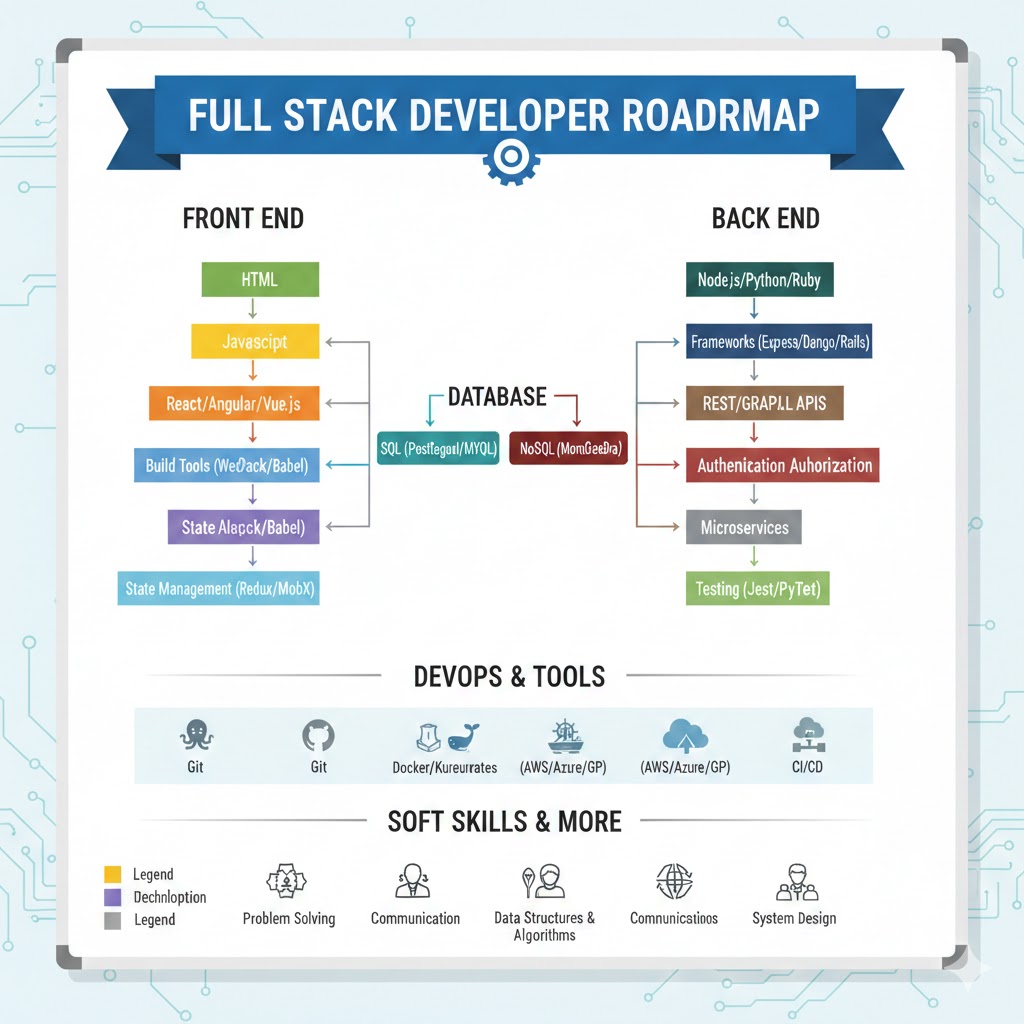
Full Stack Developer Roadmap: From Beginner to Job-Ready in 2026 Scholar’sEdge Academy offers an established pathway which teaches students all essential skills needed for their first developer position. The guide provides complete training through actual projects which use professional technologies including React and Node.js and database systems. The training program teaches you how to create industry-standard applications which will help you develop your professional portfolio and succeed in technical evaluations. What Skills Do Full Stack Developers Actually Need? The work of full stack developers involves developing both frontend and backend components. The process requires you to learn about user experience on websites together with website data processing through server systems. Frontend Technologies You Must Know Website functionality depends on three fundamental technologies which are HTML together with CSS and JavaScript. These three technologies control everything users see and interact with on websites. The use of modern frameworks results in faster development progress. The most sought-after skill of React expertise remains the top requirement followed by Vue.js and Angular skills. React serves as the optimal starting point according to Scholar’sEdge Academy because it provides the most extensive employment opportunities and strong community backing. Backend Development Essentials Node.js with Express.js gives you JavaScript on the server side. The entire application development process requires you to use a single programming language. Python with Django or Flask offers another solid path. Python’s clear syntax enables beginners to learn backend programming fundamentals through practical experience. Database expertise establishes a boundary which determines whether developers possess entry-level skills or advanced professional capabilities. You should study SQL databases such as PostgreSQL together with NoSQL databases like MongoDB. The 6-Month Learning Path to Employment The 6-Month Learning Path to Employment Month 1-2: Frontend Fundamentals Start your learning process by studying HTML5 semantic elements together with CSS Grid and Flexbox. Develop five responsive websites through your own coding efforts without using any frameworks. The foundation establishes correct understanding which protects against future misunderstandings. Daily practice of JavaScript is necessary for effective learning. The learner needs to dedicate 3-4 hours for coding different ES6 features and array methods and promises and async/await patterns. The user will develop interactive calculators and todo lists and weather applications.   Week-by-Week Breakdown Week Focus Area Deliverable 1-2 HTML/CSS Basics Personal Portfolio Site 3-4 JavaScript Fundamentals Interactive Quiz App 5-6 DOM Manipulation Dynamic Task Manager 7-8 API Integration Movie Search Application Month 3-4 The period from Month 3-4 includes the study of React and Modern Frontend development techniques. Developers gained new component development methods through React hooks. Students will learn useState and useEffect and useContext and custom hooks through the development of actual applications.  Many beginners face challenges with state management because of its complexity. The built-in context API of React functions as a beginner-friendly option which leads to simpler learning for Redux. The approach helps students at Scholar’sEdge Academy because it decreases their frustration while it develops their self-assurance.  The following projects serve as proof of your React abilities: The e-commerce product catalog displays items which customers can add to their shopping cart. The social media dashboard provides users with authentication capabilities. The real-time chat application enables users to communicate through WebSockets. Users of the blog platform can create content using markdown formatting.  Node.js and Express.js provide developers with tools for creating RESTful APIs through their fast development process. The system requires users to understand routing and middleware and error handling and request validation.  The ability to authenticate people serves as the dividing line between amateur and expert users. The system requires implementation of three authentication methods which include JWT tokens and bcrypt password hashing and OAuth social logins.  The process of database design needs designers to think through every aspect of their design. The system requires users to master four fundamental concepts which include normalization and relationships and indexing and query optimization. The system requires users to develop scalable schemas according to their application needs.  The system requires users to understand these essential backend concepts. Server-side rendering enables better performance for websites while improving their search engine optimization capabilities. Next.js enables developers to create modern web applications through its combination of React and backend development features.  The design patterns of APIs directly impact the ability to maintain a system. The system requires users to either implement REST principles system or they can use GraphQL to create adaptable data retrieval methods. Month 6: DevOps and Deployment Git version control is mandatory for any developer job. Practice branching strategies, pull requests, and collaborative workflows on GitHub. Deployment transforms local projects into live applications. Learn these platforms: Vercel for frontend applications Heroku or Railway for full stack apps AWS EC2 for more control and scalability Docker for containerization CI/CD pipelines automate testing and deployment. Set up GitHub Actions to run tests and deploy automatically when you push code. Creating Your Employment-Ready Portfolio Your portfolio demonstrates capabilities better than any resume. Include 4-6 substantial projects that show different skills. Requirements for Portfolio Project Each project needs clean code, proper documentation, and live deployment. Add README files that explain your technical decisions and the challenges which you solved. The most impressive applications to employers are full stack applications. Create projects that use React for front ends and Node.js for back ends with real database systems. The projects that help Scholar’sEdge Academy students secure jobs the most include these three examples Task management system with team collaboration E-commerce platform with payment integration Social network with user profiles and posts Analytics dashboard which retrieves data from various APIs. Technical Interview Preparation Data structures and algorithms appear in most technical interviews. Focus on arrays, objects, linked lists, trees, and hash tables. Common Algorithm Challenges Category Practice Problems Arrays Two Sum, Maximum Subarray Strings Valid Anagram, Longest Substring Trees Binary Tree Traversal, Validate BST Dynamic Programming Climbing Stairs, House Robber LeetCode, HackerRank, and CodeSignal offer practice platforms. Solve 2-3 problems daily during your final month of preparation. System design questions test senior-level thinking. Understand load balancers, caching strategies, database sharding, and

Full Stack Development

Frontend vs Backend vs Full Stack Development: Key Differences Explained

The field of web development separates into three main specializations which include frontend developers who create user interfaces through HTML and CSS and JavaScript. Backend developers create server functions which interact with databases and APIs through coding in Python and Java and Node.js. Full Stack developers master both sides, managing complete web applications from user interface to database. Frontend roles focus on visual design and user experience, backend roles emphasize data management and server performance, while full stack positions require broader technical knowledge across the entire development lifecycle. The comprehensive training programs at Scholar’sEdge Academy enable you to select and master the most suitable development path which matches your career objectives and technical abilities. What is Frontend Development? Frontend development creates everything users interact with on websites and applications. The frontend work begins when you click a button and scroll through content and fill out a form. Core Technologies: HTML serves as the foundation for web content organization CSS manages the appearance and layout of web content JavaScript enables web content to become interactive and dynamic React, Angular, Vue.js serve as the backbone of contemporary web applications At Scholar’sEdge Academy, frontend developers learn how to turn design mockups into interactive and responsive websites. The position requires both original solution development and strict technical execution. Key Responsibilities: Creating user interfaces that work properly on different devices Improving website speed and performance through various optimization techniques Developing accessibility features which enable all users to access content Working together with design teams and backend development teams Testing website performance across different web browsers What is Backend Development? The backend development system provides vital support for all website operations which users cannot see. The system manages three components which include server setup and database handling and application execution of user requests.  Primary Technologies: The system uses Python and Java and PHP and Ruby programming languages. The system uses Node.js to develop servers that operate with JavaScript. The system supports MySQL and PostgreSQL and MongoDB databases. The system uses RESTful APIs and GraphQL to transmit data. Backend developers handle sensitive operations like user authentication, payment processing, and data storage. ScholarsEdge Academy teaches students to implement security systems and build scalable architectural frameworks.  Core Functions: The system develops and controls database structures. The team produces backend software that handles application processes. The system creates application programming interfaces to link with the user interface. The team establishes security protocols and user verification processes. The team works to improve server capabilities through performance enhancements and system scalability. What is Full Stack Development? Full Stack development combines frontend and backend expertise into one versatile role. These developers understand the complete web development ecosystem from user interface to database architecture. Technology Stack Coverage: The system includes frontend frameworks and libraries. The system supports backend programming languages. The system includes database systems and their administration tools. The system includes DevOps tools and deployment methods. The system uses version control systems and collaboration platforms. Full Stack developers at Scholar’sEdge Academy’s gain comprehensive knowledge which makes them valuable assets for startups and established companies. The role requires continuous learning across multiple technology domains. Professional Advantages: The system provides complete project architecture understanding to users. The system enables quicker development of prototypes and minimum viable products. The system enables improved team communication between different specialization areas. The system enables users to access a wider range of job positions. The system increases salary possibilities for employees in multiple employment markets.   Frontend vs Backend vs Full Stack: Complete Comparison Aspect Frontend Backend Full Stack Primary Focus User interface and experience Server logic and databases Complete application stack Languages HTML, CSS, JavaScript Python, Java, PHP, Ruby Both frontend and backend Tools React, Vue, Angular, Sass Django, Node.js, Spring, Laravel All development tools Salary Range $70,000 – $120,000 $80,000 – $130,000 $85,000 – $140,000 Learning Curve Moderate Moderate to High High Job Demand High Very High Very High Work Style Visual and creative Logic and architecture Balanced hybrid approach Team Collaboration Designers, UX specialists DevOps, database admins Cross-functional teams Skills Required for Each Development Path Frontend Developer Skills Technical Competencies: HTML5 semantic markup and structure CSS3 animations and responsive design JavaScript ES6+ and TypeScript Frontend frameworks (React, Angular, Vue) Performance optimization techniques Browser developer tools proficiency Soft Skills: Visual design understanding Attention to detail User empathy and testing Design pattern knowledge Backend Developer Skills Technical Requirements: Server-side programming languages Database design and SQL queries API development and integration Authentication and authorization systems Caching strategies and optimization Cloud platform management Professional Abilities: Problem-solving mindset System architecture planning Security awareness Performance tuning expertise Full Stack Developer Skills Comprehensive Technical Knowledge: Complete frontend technology stack Backend programming and frameworks Database management systems DevOps and deployment pipelines Version control systems (Git) Testing frameworks and methodologies Essential Professional Skills: Project management capabilities Quick technology adaptation Cross-team communication End-to-end thinking Career Prospects and Salary Expectations The web development field offers strong career growth regardless of specialization. Scholar’sEdge Academy’s graduates enter a thriving job market with multiple career trajectories. Frontend Development Careers: Entry-level positions start around $70,000 annually. Senior frontend developers earn $120,000 or more. Specializations include UI/UX development, mobile web development, and performance engineering. Backend Development Opportunities: Backend roles begin near $80,000 for junior positions. Experienced backend architects command salaries exceeding $130,000. Career paths include API specialist, database architect, and DevOps engineer. Full Stack Development Potential: Full Stack developers start around $85,000 with potential to reach $140,000 or higher. The versatility opens doors to technical lead roles, startup CTOs, and independent consulting. How to Choose Your Development Path Consider Frontend Development if: You find pleasure in visual design together with user experience elements and creative problem-solving skills which work best when you receive instant visual results. Choose Backend Development when: The combination of data structures and system architecture with your ability to solve logic puzzles drives your interest in building secure systems which handle large volumes of data. Pursue Full Stack Development for: The opportunity to control all aspects of a project

Full Stack Development

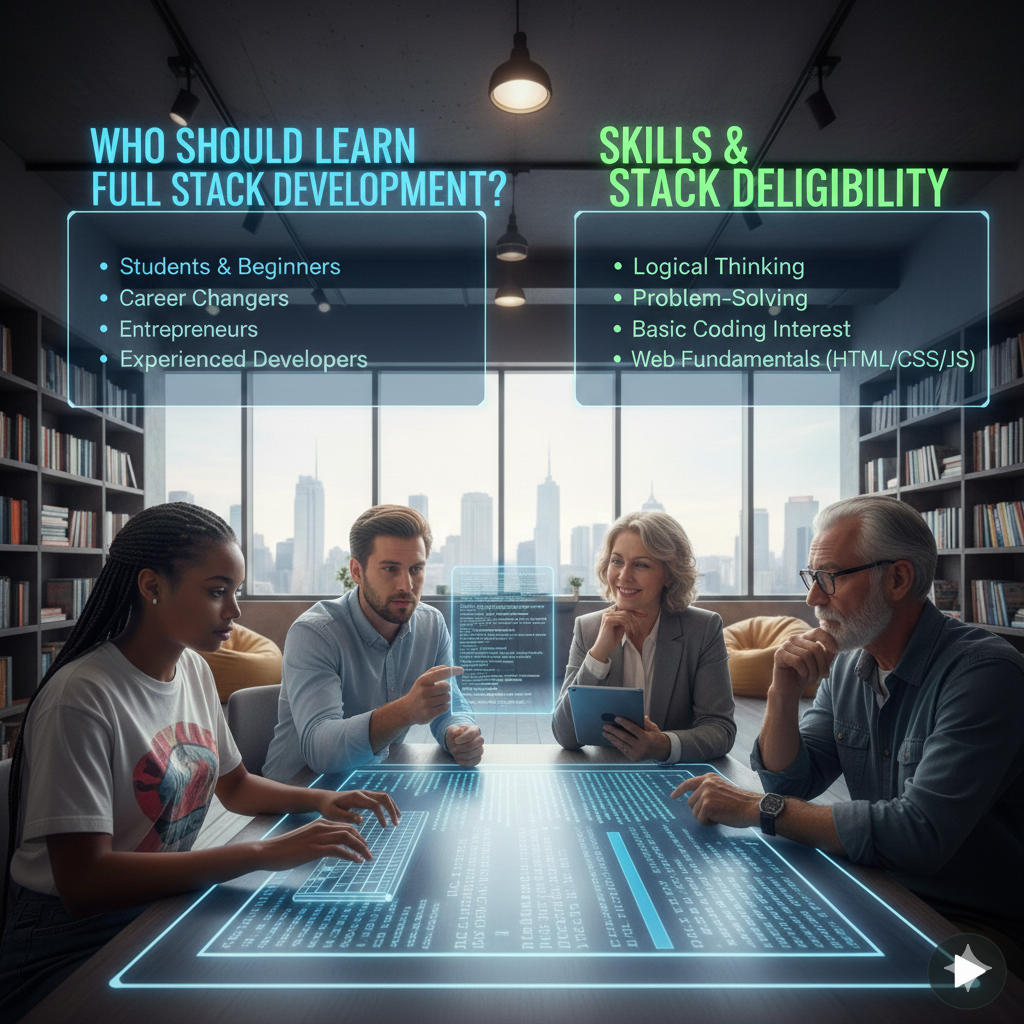
Who Should Learn Full Stack Development? Skills & Eligibility

Dedicated people with logical reasoning skills can learn full stack development without needing a computer science degree. Full stack development provides all necessary skills to create modern web applications which support recent graduates, career changers, frontend and backend developers, entrepreneurs, and freelancers who want to improve their product development skills. At Scholar’sEdge Academy, we have trained students from commerce, engineering, arts, and working backgrounds who range in age from 18 to 45 plus and now work as successful developers who earn between 50 thousand and 150 thousand dollars annually. Your problem-solving abilities and willingness to learn and your attention to detail and three to eight months of training are the actual requirements for this position which does not need any technical background. Full stack development provides a career path that leads to remote technology jobs, which pay high salaries and require proven skills instead of educational credentials to enter the field. Understanding Full Stack Development Eligibility Full stack development does not require a computer science degree because it requires no prior experience in coding. The program requires you to dedicate yourself to learning both frontend and backend technologies which operate modern web applications. Educational Background Requirements Scholar’sEdge Academy accepts students from all educational backgrounds because it offers programs which suit students with various educational qualifications.  Computer Science Graduates: Natural fit with programming fundamentals.  Engineering Students: Strong analytical skills translate well to coding.  Science and Mathematics Majors:  Students who study these majors have already developed their ability to use logical thinking and problem-solving skills. Arts and Commerce Graduates: Fresh perspectives often create innovative solutions.   Working Professionals: Career switchers bring valuable domain expertise The truth? Your degree matters less than your willingness to learn. I’ve seen commerce graduates become exceptional full stack developers at Scholar’sEdge Academy because they brought business logic understanding that pure tech graduates lacked. Skills You Need Before Starting Full Stack Development Let’s talk about what actually matters when you begin your full stack development training. Core Prerequisites Skill Category What You Need Why It Matters Basic Computer Skills File management, internet navigation, software installation Foundation for development environment setup Logical Thinking Ability to break problems into smaller parts Essential for writing algorithms and debugging code English Proficiency Reading technical documentation Most programming resources are in English Mathematics Fundamentals Basic algebra and logic Helps with data structures and algorithms Patience & Persistence Willingness to debug and troubleshoot Coding involves continuous problem-solving Technical Skills You’ll Develop You don’t need these before starting, but you’ll master them during your full stack development course at Scholar’sEdge Academy: HTML, CSS, JavaScript for frontend development React, Angular, or Vue.js frameworks Node.js, Python, or Java for backend programming Database management with SQL and NoSQL Version control using Git and GitHub RESTful API design and integration Cloud deployment and DevOps basics Who Benefits Most from Full Stack Development Training? Recent Graduates Fresh graduates face intense competition in the job market. Full stack development gives you multiple skill sets, making you valuable to startups and enterprises alike. The placement-focused curriculum at Scholar’sEdge Academy prepares you for employment through its job-ready training that goes beyond course completion. Career Switchers Do you need to change your career from a non-tech position? Full stack development provides access to: Higher salary potential (developers earn significantly more) Remote work opportunities across the world The startup environment which values new ideas An educational setting which supports ongoing knowledge development Work that involves actual projects instead of repetitive tasks The career transition program at Scholar’sEdge Academy provides solutions for professionals who need to switch to technology careers from non-technical work. Frontend or Backend Specialists Do you currently work as a frontend developer or backend engineer? Your value to your current employer increases when you acquire skills from the other side. You become eligible for senior and architect roles and acquire the ability to build products independently. Your team collaboration skills improve through this learning process. Entrepreneurs and Startup Founders Why depend on developers when you can build your MVP yourself? Full stack development training at Scholar’sEdge Academy empowers entrepreneurs to: Create prototypes of their ideas without needing developer assistance Manage discussions with technical teams Select the appropriate technologies for their projects Lower their initial product development expenses Freelancers and Consultants Full stack developers charge higher fees because they provide customers with complete development services. The project progress achieves rapid completion because one person manages both frontend and backend development tasks which results in consistent code quality. Age and Experience Criteria People seldom speak about this fact which states that people can learn full stack development at any age. Schola’s Edge Academy has successfully trained three different age groups. The software industry values skills over age. Your coding ability together with your problem-solving skills and project delivery capabilities hold greater value than your date of birth Which Technical Background Do You Need? With Technical Background The following programming courses will help you advance your learning when you already have programming experience: Programming fundamentals Data structures and algorithms Object-oriented concepts The advanced track at Scholar’s Edge Academy enables students to bypass fundamental knowledge and study contemporary frameworks and design principles. Without Technical Background Most successful developers started their careers without any coding experience. The foundational program at Scholar’s Edge Academy combines six components. The program begins with basic programming logic. The program includes complete coding tutorials with multiple steps. The program offers interactive coding practice. The program provides mentorship for all student questions. The program uses project-based learning to teach students.  Success Prediction Through Personality Traits Your journey to become a full stack developer requires technical skills but these particular personality traits bring major effects. Your problem-solving mind works through all difficulties because you always seek their solutions. Successful developers maintain curiosity about all fresh technological developments which occur because technology develops at a rapid pace. Developers need to pay attention to every detail because even small errors in program syntax can prevent a program from working. Developers need to follow structured work procedures

Full Stack Development

What Is Full Stack Development? A Beginner’s Guide to Mastering Web Development

Full stack development describes the entire web development process which includes both frontend development and backend development. A full stack developer builds complete websites by handling all aspects of development which include database systems server infrastructure application programming interfaces and user interface design.  Scholar’sEdge Academy provides training programs which teach students to develop software through all stages of its production. You will learn to create responsive user interfaces, manage databases, implement business logic, and deploy applications to production servers. The term “full stack” means developers work across all components of web development systems. To develop complete software applications you must acquire proficiency in multiple programming languages and development frameworks and database systems and software development tools. Core Components of Full Stack Development Full stack development consists of three main layers which operate together to create a complete system. The presentation layer controls all elements which users can see and use on their screens. Frontend developers at Scholar’sEdge Academy learn HTML5 for structure, CSS3 for styling, and JavaScript for interactivity. Modern frameworks like React and Angular and Vue.js enable developers to build interactive single-page web applications.  The application layer processes business logic and performs data operations and establishes server communication. The backend technologies of a web application use Node.js and Python with Django or Flask and Ruby on Rails and Java Spring Boot and PHP Laravel. These programming languages handle user request processing and user authentication and database connections. Database Management Layer The data layer stores and retrieves information efficiently. Relational databases like MySQL, PostgreSQL, and Microsoft SQL Server organize data in structured tables. NoSQL databases including MongoDB, Cassandra, and Redis handle unstructured data and scale horizontally for large applications. Development Layer Technologies Primary Function Frontend HTML, CSS, JavaScript, React, Angular, Vue.js User interface and experience Backend Node.js, Python, Java, Ruby, PHP Business logic and data processing Database MySQL, MongoDB, PostgreSQL, Redis Data storage and retrieval DevOps Git, Docker, AWS, Jenkins, Kubernetes Deployment and maintenance   Essential Technologies Full Stack Developers Must Know Programming Languages JavaScript remains the most popular language for full stack development because it runs on both frontend and backend through Node.js. Python provides developers with easy-to-understand syntax together with efficient development frameworks which enable them to build applications without difficulty. Java delivers enterprise-grade stability and performance which businesses need to run their extensive software systems. Frontend Frameworks and Libraries The frontend sector builds its applications around React which uses a component system together with virtual DOM technology. Angular provides a complete framework with built-in routing, forms, and state management. Developers can use Vue.js as a progressive framework which allows them to build applications step by step. Backend Frameworks Express.js enables developers to create lightweight Node.js servers which require only basic setup work. Django provides developers with complete functionality because it includes authentication systems, administrative interfaces, and object relational mapping tools. Spring Boot enables Java application developers to create applications through its automatic configuration system together with its built-in server functionality. Database Management Systems PostgreSQL enables users to execute intricate queries while maintaining ACID standards required for financial software. MongoDB enables users to save documents that resemble JSON format while it provides horizontal scaling capabilities through its distributed system architecture. Redis stores data in memory to support both caching needs and real-time system requirements. Version Control and Collaboration Tools Git enables teams to work together on code development by tracking changes and providing tools for branch creation and merge request management. GitHub provides repository hosting services together with tools for managing projects. GitLab provides businesses with complete CI/CD systems which enable them to conduct automatic testing and software deployment. What Does a Full Stack Developer Do? Scholar’sEdge Academy teaches full stack developers to manage all aspects of application development from start to finish. The team creates user interfaces through their design work which enables users to navigate websites easily while accessing content on different devices. You create wireframes, implement designs, and optimize load times for better user experience.  The system requires you to construct server-side components which handle user input and enforce business rules while checking the validity of information. You develop RESTful APIs, handle authentication, and manage user sessions securely.  The database management system requires you to create data schemas, write efficient database queries, and safeguard the accuracy of stored information. Your responsibilities include creating backup procedures, executing database migrations, and tracking database system operations.  The process of deploying applications involves using containerization methods and orchestration tools to launch applications on cloud computing platforms. You complete system setup through web server configuration, continuous integration pipeline establishment, and application performance monitoring.  The code optimization process involves debugging work to discover performance problems and repair errors while enhancing software efficiency. You complete your role by writing unit tests which help assess code quality and conducting code reviews together with refactoring of outdated code.  The team works together with stakeholders to gather project requirements while providing technical project assessments and delivering completed features according to predetermined timelines. You take part in sprint planning sessions and daily standing meetings and retrospective assessment sessions.   Career Opportunities in Full Stack Development The demand for full stack developers continues growing as companies seek versatile professionals who understand complete application architecture. Scholar’sEdge Academy prepares students for these career paths: Junior Full Stack Developer positions require 0-2 years of experience and focus on implementing features under senior developer guidance. You work on bug fixes, add new functionality, and learn coding standards. Full Stack Developer roles need 2-5 years of experience and involve independent project ownership. You design system architecture, mentor junior developers, and lead feature development. Senior Full Stack Developer positions require 5+ years of experience and demand technical leadership skills. You make architectural decisions, conduct code reviews, and optimize system performance. Full Stack Architect roles involve designing scalable systems, selecting technology stacks, and establishing development standards. You evaluate third-party services, plan infrastructure, and ensure security compliance. Technical Lead positions combine development skills with project management responsibilities. You coordinate with product teams, break down

Full Stack Development

Become a Full Stack Developer: The Ultimate Career-Ready Skill at Scholar’sEdge

In today’s digital world, the demand for skilled Full Stack Developers is at an all-time high. From building stunning websites to managing powerful server-side applications, Full Stack Development has become a must-have skill for those aiming to thrive in tech careers. At Scholar’sEdge, we offer a comprehensive Full Stack Development course that transforms beginners into job-ready professionals. What is Full Stack Development? Full Stack Development refers to the ability to build and manage both the frontend (user interface) and backend (server, database, and application logic) of a web application. A Full Stack Developer can handle everything from designing the layout of a website to managing how the server processes data — making them incredibly versatile and valuable. Why Should You Learn Full Stack Development? Here’s why Full Stack Development is one of the most sought-after career paths: High Demand, High Pay: Companies need developers who can handle the full lifecycle of a web project — and they pay well for it. Freedom to Build Projects Independently: No more relying on teams to get your ideas online. Build, launch, and scale projects yourself. Creative and Technical Growth: Work with visuals, logic, data, and code — a perfect mix of creativity and engineering. In-Demand Skills for Startups and Tech Companies: Whether you’re joining a startup or freelancing, full stack skills give you an edge. What You’ll Learn at Scholar’sEdge Our course curriculum covers everything you need to master full stack development, including: HTML, CSS, and JavaScript: The core technologies of the web Responsive Design using Tailwind or Bootstrap JavaScript Frameworks like React or Vue.js Backend with Node.js and Express Databases: MongoDB or MySQL RESTful APIs and Integration Authentication and Authorization Git & GitHub for version control Deployment with Netlify, Vercel, and Heroku Capstone Project: Build a Complete Full Stack Application Each module includes hands-on practice, mini-projects, and real-world coding scenarios to prepare you for real jobs. Who Should Join This Course? Our Full Stack Development course is ideal for: Students and Graduates wanting to break into tech Working Professionals looking to upskill or switch careers Freelancers and Entrepreneurs aiming to build web apps Designers who want to add backend skills to their toolkit No prior coding experience? No problem. Our trainers start from the fundamentals and guide you step-by-step. Real Projects. Real Skills. Real Confidence. At Scholar’sEdge, we don’t just teach theory. You’ll build and deploy actual web applications that you can showcase in your portfolio. You’ll also gain exposure to team collaboration tools, code versioning, and project workflows — just like in a real tech job. Your Path to Becoming a Developer Starts Here Ready to build websites, apps, and your future? Scholar’sEdge’s Full Stack Development course is more than a class — it’s a career launchpad. Get certified, build real-world projects, and gain the confidence to crack interviews or freelance on your own. 📢 Contact Us Phone: +91 99020 58603Email: Scholarsedgeacademyedu@gmail.comAddress: 25/1 building no 19 9th cross road jp nagar 2nd phase bangalore-560078