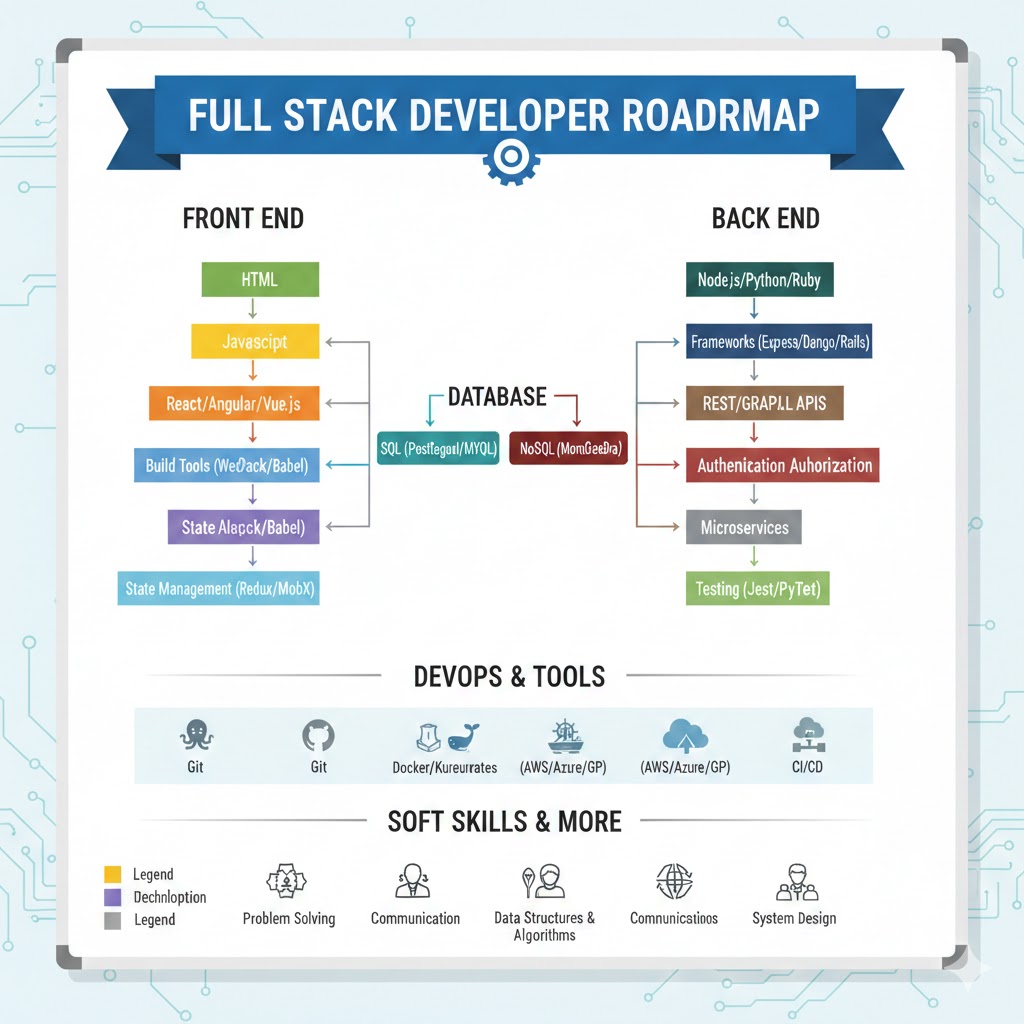
Full Stack Developer Roadmap: From Beginner to Job-Ready in 2026
Scholar’sEdge Academy offers an established pathway which teaches students all essential skills needed for their first developer position. The guide provides complete training through actual projects which use professional technologies including React and Node.js and database systems. The training program teaches you how to create industry-standard applications which will help you develop your professional portfolio and succeed in technical evaluations.
What Skills Do Full Stack Developers Actually Need?
The work of full stack developers involves developing both frontend and backend components. The process requires you to learn about user experience on websites together with website data processing through server systems.
Frontend Technologies You Must Know
Website functionality depends on three fundamental technologies which are HTML together with CSS and JavaScript. These three technologies control everything users see and interact with on websites.
The use of modern frameworks results in faster development progress. The most sought-after skill of React expertise remains the top requirement followed by Vue.js and Angular skills. React serves as the optimal starting point according to Scholar’sEdge Academy because it provides the most extensive employment opportunities and strong community backing.
Backend Development Essentials
Node.js with Express.js gives you JavaScript on the server side. The entire application development process requires you to use a single programming language.
Python with Django or Flask offers another solid path. Python’s clear syntax enables beginners to learn backend programming fundamentals through practical experience.
Database expertise establishes a boundary which determines whether developers possess entry-level skills or advanced professional capabilities. You should study SQL databases such as PostgreSQL together with NoSQL databases like MongoDB.
The 6-Month Learning Path to Employment The 6-Month Learning Path to Employment
Month 1-2: Frontend Fundamentals
Start your learning process by studying HTML5 semantic elements together with CSS Grid and Flexbox. Develop five responsive websites through your own coding efforts without using any frameworks. The foundation establishes correct understanding which protects against future misunderstandings.
Daily practice of JavaScript is necessary for effective learning. The learner needs to dedicate 3-4 hours for coding different ES6 features and array methods and promises and async/await patterns. The user will develop interactive calculators and todo lists and weather applications.
Week-by-Week Breakdown
| Week | Focus Area | Deliverable |
| 1-2 | HTML/CSS Basics | Personal Portfolio Site |
| 3-4 | JavaScript Fundamentals | Interactive Quiz App |
| 5-6 | DOM Manipulation | Dynamic Task Manager |
| 7-8 | API Integration | Movie Search Application |
Month 3-4
The period from Month 3-4 includes the study of React and Modern Frontend development techniques. Developers gained new component development methods through React hooks. Students will learn useState and useEffect and useContext and custom hooks through the development of actual applications.
Many beginners face challenges with state management because of its complexity. The built-in context API of React functions as a beginner-friendly option which leads to simpler learning for Redux. The approach helps students at Scholar’sEdge Academy because it decreases their frustration while it develops their self-assurance.
The following projects serve as proof of your React abilities:
The e-commerce product catalog displays items which customers can add to their shopping cart. The social media dashboard provides users with authentication capabilities. The real-time chat application enables users to communicate through WebSockets. Users of the blog platform can create content using markdown formatting.
Node.js and Express.js provide developers with tools for creating RESTful APIs through their fast development process. The system requires users to understand routing and middleware and error handling and request validation.
The ability to authenticate people serves as the dividing line between amateur and expert users. The system requires implementation of three authentication methods which include JWT tokens and bcrypt password hashing and OAuth social logins.
The process of database design needs designers to think through every aspect of their design. The system requires users to master four fundamental concepts which include normalization and relationships and indexing and query optimization. The system requires users to develop scalable schemas according to their application needs.
The system requires users to understand these essential backend concepts. Server-side rendering enables better performance for websites while improving their search engine optimization capabilities. Next.js enables developers to create modern web applications through its combination of React and backend development features.
The design patterns of APIs directly impact the ability to maintain a system. The system requires users to either implement REST principles system or they can use GraphQL to create adaptable data retrieval methods.
Month 6: DevOps and Deployment
Git version control is mandatory for any developer job. Practice branching strategies, pull requests, and collaborative workflows on GitHub.
Deployment transforms local projects into live applications. Learn these platforms:
- Vercel for frontend applications
- Heroku or Railway for full stack apps
- AWS EC2 for more control and scalability
- Docker for containerization
CI/CD pipelines automate testing and deployment. Set up GitHub Actions to run tests and deploy automatically when you push code.
Creating Your Employment-Ready Portfolio
Your portfolio demonstrates capabilities better than any resume. Include 4-6 substantial projects that show different skills.
Requirements for Portfolio Project
Each project needs clean code, proper documentation, and live deployment. Add README files that explain your technical decisions and the challenges which you solved.
The most impressive applications to employers are full stack applications. Create projects that use React for front ends and Node.js for back ends with real database systems.
The projects that help Scholar’sEdge Academy students secure jobs the most include these three examples
Task management system with team collaboration
E-commerce platform with payment integration
Social network with user profiles and posts
Analytics dashboard which retrieves data from various APIs.
Technical Interview Preparation
Data structures and algorithms appear in most technical interviews. Focus on arrays, objects, linked lists, trees, and hash tables.
Common Algorithm Challenges
| Category | Practice Problems |
| Arrays | Two Sum, Maximum Subarray |
| Strings | Valid Anagram, Longest Substring |
| Trees | Binary Tree Traversal, Validate BST |
| Dynamic Programming | Climbing Stairs, House Robber |
LeetCode, HackerRank, and CodeSignal offer practice platforms. Solve 2-3 problems daily during your final month of preparation.
System design questions test senior-level thinking. Understand load balancers, caching strategies, database sharding, and microservices architecture.
Getting Your First Developer Job
The process of applying for jobs requires more than just submitting your resume to companies. Your technology stack should serve as the basis for selecting target companies which you should approach through their career pages for job applications.
The process of searching for employment gets much faster through building professional connections. You should participate in local meetups while also contributing to open source projects and building connections with developers through Twitter and LinkedIn.
Tailoring Your Application
You should create different resumes for each job application. Your project descriptions should match the competencies that job descriptions require.
The existence of cover letters continues to hold value for applicants who compete for top-tier positions. You should describe your enthusiasm for the company while demonstrating how your projects address challenges that they encounter with their products.
Interview preparation extends beyond coding. You should practice explaining your projects while comparing different methods and developing appropriate questions about how the team works.
Continuing Education After Landing Your Job
Web development technology experiences continuous change throughout its existence. You should spend 5 to 10 hours each week studying new frameworks and learning tools and acquiring best practices.
Scholar’sEdge Academy provides ongoing mentorship even after course completion. Our community includes working developers who exchange knowledge and provide information about job openings.
The advanced topics that researchers should study include TypeScript which provides type safety and testing frameworks such as Jest and Cypress and methods for performance optimization and cloud architectural design patterns.
Scholar’sEdge Academy provides complete full stack developer training through its practical training programs and individual mentoring and job placement services. The curriculum delivers technology training which meets current market requirements because it includes all essential skills that employers demand. You can begin your transformation from an absolute beginner into a professional developer who meets industry standards by joining our program which already has more than 100 graduates now employed at leading technology firms.
Frequently Asked Questions
How long does it take to become job-ready as a full stack developer?
Most dedicated learners reach job-ready status in 6-9 months with consistent daily practice.Students at Scholar’sEdge Academy who dedicate 4-6 hours every day will reach their first job interview within 6 months and receive their first job offer by the end of 8 months.
Do I need a computer science degree to become a full stack developer?
No degree is required for most full stack developer positions. Employers care more about your portfolio, coding ability, and problem-solving skills. Many developers who achieved success in their field taught themselves or completed bootcamp programs.
Which development area should I study first, frontend development or backend development? Frontend development provides instant visual feedback because you can see your work, which helps you stay motivated to work. Understanding HTML, CSS, and JavaScript before backend concepts creates a stronger foundation for full stack work.
The best programming language for full stack development is JavaScript because it works for both frontend and backend development. Node.js learning enables developers to use a single programming language throughout their entire software stack which decreases their need to switch between different programming languages
How many projects do I need in my portfolio to get hired?
The candidate should include 4-6 high quality projects which demonstrate their various abilities. One or two complex full stack applications impress employers more than ten simple tutorials. The project needs to show three elements which include solution finding abilities and programming excellence and practical system operation capabilities. .
Which certifications hold value for full stack developers?
Practical skills and portfolio projects outweigh the importance of certifications according to their value. Developers should spend their time on application development instead of pursuing multiple certifications. AWS and Azure certifications show value when applying for DevOps roles.