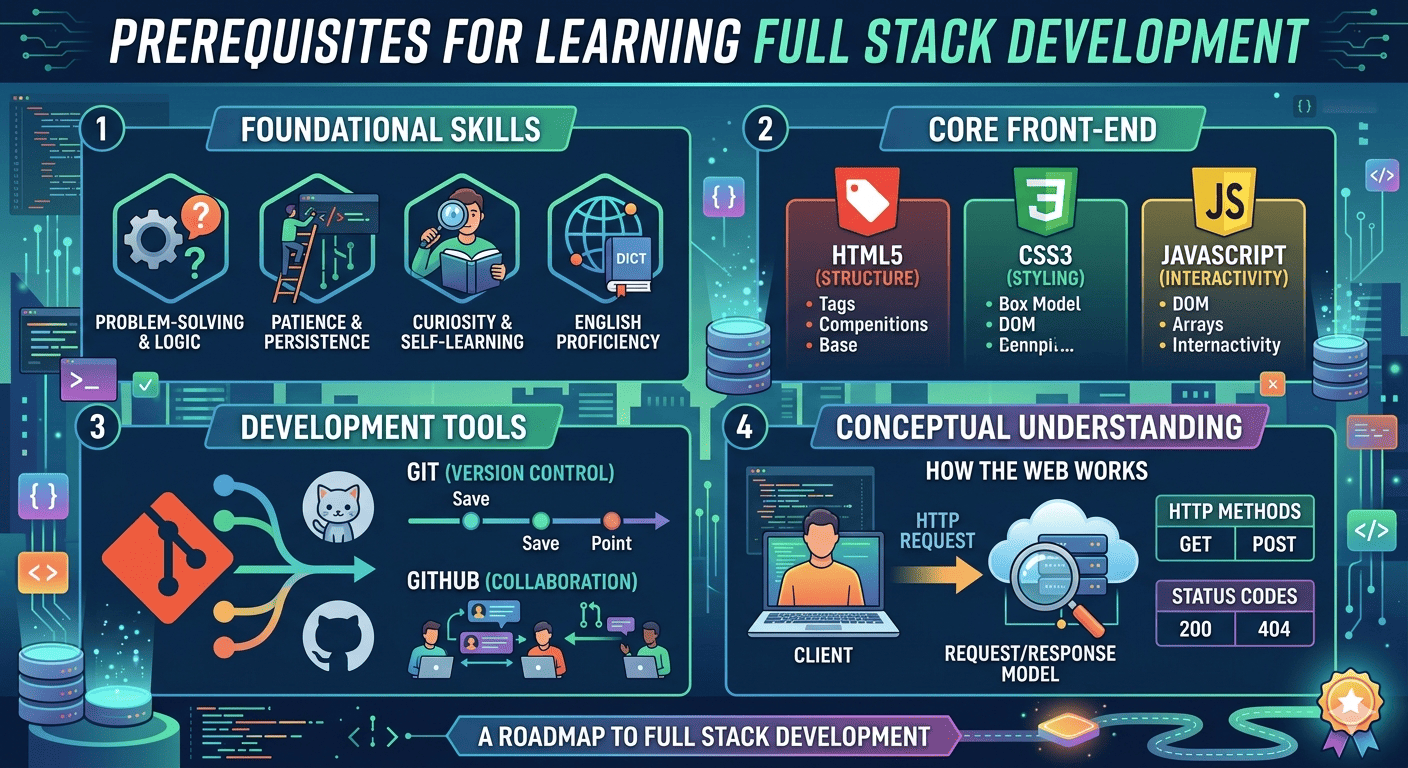
The full stack development journey begins for you when you acquire the essential skills that all developers need to master. The guide provides a complete list of requirements which start from essential computer skills and basic programming knowledge and continue until candidates achieve database understanding and version control system proficiency. The complete pathway to full stack development training has been proven through Scholar’sEdge Academy which has helped hundreds of students achieve essential skills needed for training in development.
Who Can Learn Full Stack Development?
Full stack development welcomes learners from all backgrounds. The beauty of this field lies in its accessibility—you don’t need a computer science degree to excel.
Non-IT Professionals Can Succeed When They Have:
- Strong logical thinking abilities
- Problem-solving mindset
- Willingness to learn technical concepts
- Dedication to consistent practice
- IT Professionals Already Possess:
- Technical foundation knowledge
- Understanding of software concepts
- Familiarity with development environments
- Basic troubleshooting skills
Scholar’sEdge Academy has trained both categories successfully, proving that motivation matters more than your starting point.
Essential Technical Prerequisites
Computer Fundamentals You Must Know
Before writing your first line of code, you need solid computer operation skills.
| Skill Area | What You Need | Why It Matters |
| Operating Systems | Windows, Linux, or Mac navigation | Development happens across platforms |
| File Management | Creating, organizing, moving files | Projects require structured file systems |
| Internet Basics | Browsers, search, downloads | Accessing resources and documentation |
| Typing Speed | Minimum 30 WPM | Coding efficiency depends on typing |
Programming Fundamentals Required
You cannot skip basic programming concepts when entering full stack development.
Core Programming Concepts:
- Variables and data types
- Conditional statements (if-else logic)
- Loops (for, while iterations)
- Functions and parameters
- Arrays and objects
- Basic algorithms
Scholar’sEdge Academy recommends starting with JavaScript or Python. These languages provide gentle learning curves while building strong foundations.
Why These Concepts Matter: Both frontend and backend development rely heavily on these fundamentals. When you understand variables, you’ll grasp state management in React. When you master loops, database queries become intuitive.
Mathematics and Logical Thinking
Math Skills That Help
Full stack development isn’t calculus-heavy, but certain mathematical concepts prove valuable.
Helpful Mathematical Areas:
- Basic arithmetic operations
- Percentage calculations
- Logic and Boolean algebra
- Pattern recognition
- Basic statistics (for data handling)
For Non-IT Learners: Don’t panic about advanced mathematics. High school level math suffices for most full stack development tasks. Scholar’sEdge Academy focuses on practical application rather than theoretical mathematics.
Logical Reasoning Abilities
Your ability to think logically outweighs mathematical prowess.
Develop These Thinking Skills:
- Breaking complex problems into smaller parts
- Understanding cause and effect relationships
- Pattern identification
- Sequential thinking
- Debugging mindset
Practice puzzles, play strategy games, or solve coding challenges on platforms like HackerRank to sharpen logical thinking.
Web Technology Basics
HTML and CSS Foundation
Before tackling frameworks, master the building blocks of web development.
HTML Essentials:
- Document structure (tags, elements, attributes)
- Semantic HTML5 elements
- Forms and input types
- Links and navigation
- Media embedding
CSS Fundamentals:
- Selectors and specificity
- Box model understanding
- Flexbox and Grid layouts
- Responsive design principles
- Basic animations
Scholar’sEdge Academy structures these prerequisites into a two-week intensive module. Students gain hands-on experience building real web pages before advancing to JavaScript frameworks.
JavaScript Basics
JavaScript powers both frontend and backend in modern full stack development.
JavaScript Prerequisites:
- DOM manipulation
- Event handling
- ES6+ syntax features
- Asynchronous programming concepts
- JSON data handling
- API consumption basics
Learning Path Recommendation: Spend 4-6 weeks on JavaScript fundamentals before touching React, Angular, or Vue. This investment pays dividends throughout your full stack journey.
Database Concepts
Understanding Data Storage
Full stack developers must communicate with databases confidently.
| Database Type | When to Use | Prerequisites |
| SQL (MySQL, PostgreSQL) | Structured data, relationships | Table concepts, query basics |
| NoSQL (MongoDB) | Flexible schemas, scalability | JSON understanding |
| In-Memory (Redis) | Caching, session storage | Key-value pair concepts |
Fundamental Database Concepts:
- CRUD operations (Create, Read, Update, Delete)
- Database normalization basics
- Primary and foreign keys
- Indexing principles
- Query optimization awareness
SQL Query Fundamentals
Learn basic SQL before your full stack course begins.
Essential SQL Commands:
- SELECT statements with WHERE clauses
- JOIN operations (INNER, LEFT, RIGHT)
- GROUP BY and aggregate functions
- INSERT, UPDATE, DELETE operations
- Basic subqueries
Scholar’sEdge Academy provides SQL preparatory materials to all enrolled students, ensuring everyone starts with equivalent database knowledge.
Version Control Basics
Git and GitHub Essentials
Version control isn’t optional in modern development workflows.
Git Concepts You Need:
- Repository initialization
- Commit workflow
- Branch creation and merging
- Pull and push operations
- Conflict resolution basics
GitHub Platform Skills:
- Creating repositories
- Cloning projects
- Pull request workflow
- Basic collaboration features
Time Investment: Dedicate one week to Git fundamentals. This skill serves your entire development career, not just full stack projects.
Development Tools Familiarity
Code Editors and IDEs
Comfort with development environments accelerates your learning.
Recommended Tools:
- Visual Studio Code (most popular)
- Sublime Text (lightweight alternative)
- WebStorm (professional option)
Essential Editor Skills:
- File navigation shortcuts
- Multi-cursor editing
- Extensions installation
- Integrated terminal usage
- Debugging panel basics
Command Line Proficiency
Terminal comfort separates struggling learners from confident developers.
Command Line Basics Required:
- Directory navigation (cd, ls, pwd)
- File operations (touch, mkdir, rm, mv)
- Package manager usage (npm, yarn)
- Running development servers
- Environment variable configuration
Scholar’sEdge Academy includes terminal training in the foundation phase, ensuring students overcome command line anxiety early.
Soft Skills That Matter
Self-Learning Ability
Full stack development evolves rapidly. Your learning journey never truly ends.
Develop These Habits:
- Reading documentation effectively
- Searching for solutions independently
- Following tutorials and courses
- Joining developer communities
- Building side projects
Problem-Solving Mindset
Technical skills mean nothing without strong problem-solving abilities.
Cultivate These Approaches:
- Breaking errors into searchable queries
- Systematic debugging processes
- Testing hypotheses methodically
- Asking quality questions in forums
- Learning from failed attempts
For Non-IT Professionals: Start with beginner-friendly coding challenges. Websites like Codecademy, freeCodeCamp, and Codewars build problem-solving muscles through practice.
Time Commitment Expectations
Realistic Learning Timeline
Understanding time requirements prevents frustration and dropout.
Prerequisites Phase:
- Computer fundamentals: 1-2 weeks
- Programming basics: 6-8 weeks
- HTML/CSS: 2-3 weeks
- JavaScript fundamentals: 4-6 weeks
- Database basics: 2 weeks
- Git/GitHub: 1 week
Total Preparation Time: Non-IT professionals should allocate 4-5 months for comprehensive preparation. IT professionals with some programming exposure can compress this to 2-3 months.
Scholar’sEdge Academy offers accelerated prerequisite bootcamps for working professionals, covering essentials in intensive weekend sessions.
Daily Practice Recommendations
Consistency trumps intensity in learning full stack development.
Optimal Practice Schedule:
- Weekday learners: 2-3 hours daily
- Weekend warriors: 6-8 hours on weekends
- Full-time students: 5-6 hours daily
Quality Over Quantity: Focused, deliberate practice for two hours exceeds unfocused grinding for six hours.
Learning Resources Comparison
| Resource Type | Best For | Time Required | Cost |
| YouTube Tutorials | Visual learners, quick concepts | Flexible | Free |
| Online Courses | Structured learning, certificates | 3-6 months | Paid ($20-$200) |
| Coding Bootcamps | Career switchers, intensity | 3-6 months | Premium ($5000+) |
| Books | Deep understanding, reference | Self-paced | Moderate ($30-$100) |
| Mentorship Programs | Personalized guidance | 6-12 months | Variable |
Scholar’sEdge Academy combines structured curriculum with mentorship, providing the best elements of multiple learning approaches.
Common Mistakes to Avoid
Prerequisites Mistakes That Derail Learners:
- Skipping Fundamentals: Jumping into React without JavaScript mastery creates confusion
- Tutorial Hell: Watching endless courses without building projects
- Ignoring Command Line: Avoiding terminal limits your development capabilities
- Neglecting Git Early: Learning version control under deadline pressure increases stress
- Perfectionism Paralysis: Waiting to “fully understand” before moving forward
- Isolated Learning: Not engaging with developer communities
Your full stack development path begins after you acquire sufficient knowledge base to start your studies. Scholar’sEdge Academy provides complete prerequisite training programs which serve both IT professionals and non-IT professionals. Our approach helps you acquire all necessary skills to learn full stack development which prepares you for advanced framework studies needed to achieve your career transition success. Join hundreds of students who built their development careers on solid foundations.
Frequently Asked Questions
Can I learn full stack development without any coding background?
You can learn full stack development because there are thousands of successful developers who began their journey without any coding skills. The key to success requires learners to master all necessary skills before they start learning advanced framework systems. Scholar’sEdge Academy offers complete beginners training through structured learning paths which help 78 percent of non-IT students become successful development professionals. The complete setup process requires all non-IT professionals to study dedicated material for four to five months while studying 15 to 20 hours each week. The prerequisite requirements for IT professionals who have basic programming skills take between two to three months to complete. Your learning speed depends on your existing knowledge and how intensely you learn and your practice habits.
Do I need a computer science degree for full stack development?
No degree required. Self-taught developers who learn full stack fundamentals can achieve success in their careers despite lacking formal computer science degrees. Employers value your portfolio and problem-solving abilities and hands-on experience more than your educational credentials.
Which programming language should I learn first?
JavaScript serves as the optimal entry point for full stack development because it enables users to work on both frontend and backend systems through Node.js. Python provides easier syntax which helps absolute beginners to learn programming. JavaScript serves as the recommended programming language according to Scholar’sEdge Academy because students need to use it throughout their entire full stack development process.
Which programming language should I learn first?
JavaScript serves as the ideal starting point for full stack development because it enables developers to create both frontend and backend applications through its Node.js framework. Python offers absolute beginners through its easier-to-understand programming syntax. The Academy of Scholars’Edge recommends students learn JavaScript because they will use it for their entire development process.
Is mathematics essential for full stack development?
Full stack developers require only basic arithmetic skills and logical thinking abilities to handle their daily work. The job does not require you to understand advanced calculus or linear algebra. You should concentrate on developing your skills in logical reasoning, pattern recognition and problem decomposition while avoiding concerns about advanced mathematical concepts.
What is the appropriate amount of money I should spend on learning resources before I start a course?
Use free resources such as YouTube and freeCodeCamp and MDN documentation to establish your basic knowledge. You should buy one high-quality paid course which costs between $50 to $150 because it provides organized educational content. The Academy of Scholars’Edge provides all required learning resources to its enrolled students which means they do not need to spend money on extra materials.
Can I work full-time while completing prerequisites?
Yes, many students who achieve success work full-time while they complete their prerequisite studies. The student must spend 2-3 hours on weekdays and 6-8 hours on weekends for their studies. This schedule allows the student to finish their prerequisites within a period of five to six months while still working at their job. The ability to maintain a regular study pattern provides greater advantages than extended study periods.
What computer specifications do I need for learning?
A mid-range laptop serves as sufficient equipment for students who want to complete their prerequisite studies and initial development work. The minimum requirements include an Intel i5 processor or equivalent and 8GB of RAM and 256GB of SSD storage. Your initial hardware needs do not include high-cost equipment because you should spend your money on effective educational materials.