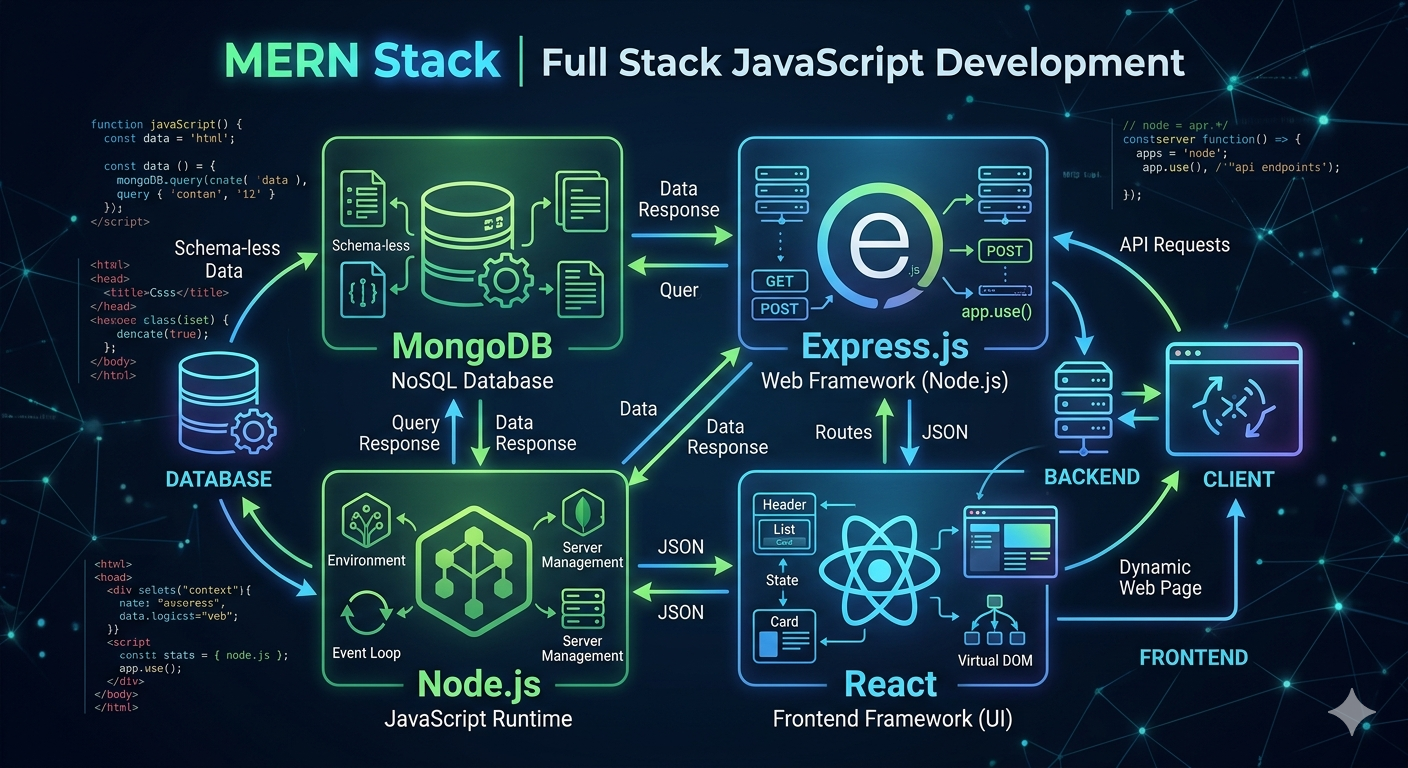
MERN stack explained: MongoDB, Express, React, Node.js represents the most popular JavaScript-based full stack development framework for building modern web applications. At Scholar’s Edge Academy, our MERN stack training program teaches working professionals how MongoDB handles database operations, Express manages server-side routing, React powers dynamic user interfaces, and Node.js executes JavaScript on the backend. This comprehensive guide breaks down each technology, demonstrates how they work together, reveals practical implementation strategies, and shows you how mastering MERN stack development accelerates your transition into high-paying full stack developer roles.
Understanding the MERN Stack Architecture
MERN stack explained: MongoDB, Express, React, Node.js forms a complete JavaScript ecosystem for web development. Here’s why this matters for your career:
Companies choose MERN because it uses JavaScript across the entire application stack. This means:
- Faster development with one language throughout
- Easier team collaboration and code sharing
- Reduced context switching between technologies
- Simplified deployment and maintenance
Scholar’s Edge Academy structures MERN training specifically for career switchers who need production-ready skills, not just theoretical knowledge.
MongoDB: Your NoSQL Database Solution
What MongoDB Brings to MERN Stack
MongoDB serves as the database layer in MERN applications, storing data in flexible JSON-like documents instead of rigid table structures.
| Feature | MongoDB | Traditional SQL |
| Data Structure | Flexible documents | Fixed schemas |
| Scaling | Horizontal (easy) | Vertical (complex) |
| Query Language | JavaScript-based | SQL syntax |
| Schema Changes | Instant | Migration required |
Key MongoDB Capabilities:
- Document-based storage matching JavaScript objects
- Dynamic schema adapting to changing requirements
- Aggregation pipeline for complex data operations
- Built-in replication for high availability
- Sharding for horizontal scaling
Practical MongoDB Implementation
Scholar’s Edge Academy teaches MongoDB through real applications:
Data Modeling Strategies:
- Embedding vs referencing documents
- One-to-many relationship patterns
- Many-to-many with junction collections
- Denormalization for read performance
Query Optimization Techniques:
- Index creation for faster queries
- Explain plans for performance analysis
- Projection to limit returned fields
- Compound indexes for multi-field searches
Real-World Example:
javascript
// User profile with embedded addresses
{
_id: ObjectId(“…”),
name: “John Developer”,
email: “john@example.com”,
addresses: [
{ type: “home”, street: “123 Main St”, city: “Tech City” },
{ type: “work”, street: “456 Office Blvd”, city: “Startup Hub” }
],
createdAt: ISODate(“2026-01-15”)
}
You’ll build applications managing user data, product catalogs, blog posts, and complex relationships using MongoDB’s flexible document model.
Express.js: Backend Framework Simplified
Express Powers Your Server Layer
Express.js handles HTTP requests and server-side logic in MERN applications. This lightweight framework provides:
Core Express Features:
- Routing for different URL endpoints
- Middleware for request processing
- Template engine integration
- Error handling mechanisms
- Static file serving
Building Production APIs with Express
Scholar’s Edge Academy focuses on professional API development:
RESTful API Design Patterns:
| HTTP Method | Purpose | Example Endpoint |
| GET | Retrieve data | /api/products |
| POST | Create new resource | /api/products |
| PUT | Update entire resource | /api/products/:id |
| PATCH | Partial update | /api/products/:id |
| DELETE | Remove resource | /api/products/:id |
Essential Middleware Stack:
- Body parsing for JSON requests
- CORS configuration for cross-origin requests
- Authentication with JWT tokens
- Request logging for debugging
- Error handling for graceful failures
Authentication Implementation:
javascript
// Protected route example
router.get(‘/api/profile’, authenticateToken, async (req, res) => {
const user = await User.findById(req.user.id);
res.json(user);
});
Validation and Security:
- Input sanitization preventing injection attacks
- Rate limiting to prevent abuse
- Helmet.js for security headers
- Environment variables for sensitive data
You’ll create secure REST APIs, implement authentication flows, handle file uploads, and build webhook integrations using Express.
React: Dynamic Frontend Development
React Creates Interactive User Interfaces
React dominates frontend development in MERN applications because it offers component-based architecture and efficient rendering.
React Fundamentals in MERN Context:
Component Architecture:
- Functional components with hooks
- Props for data passing
- State management with useState
- Side effects with useEffect
- Custom hooks for reusable logic
State Management Approaches:
| Solution | Use Case | Complexity | Learning Curve |
| useState | Component-level state | Low | Easy |
| Context API | Shared state (medium apps) | Medium | Moderate |
| Redux | Large-scale applications | High | Steep |
| Zustand | Modern alternative to Redux | Medium | Easy |
Connecting React to Express Backend
Scholar’s Edge Academy emphasizes practical API integration:
Data Fetching Patterns:
- Axios for HTTP requests
- Async/await for clean code
- Loading states for better UX
- Error handling and retry logic
- Optimistic updates for responsiveness
Real Implementation:
javascript
// Fetching products from Express API
const [products, setProducts] = useState([]);
const [loading, setLoading] = useState(true);
useEffect(() => {
axios.get(‘/api/products’)
.then(response => setProducts(response.data))
.catch(error => console.error(error))
.finally(() => setLoading(false));
}, []);
Form Handling and Validation:
- Controlled components
- Client-side validation
- Server-side validation feedback
- File upload with preview
- Multi-step form flows
You’ll build dashboards, authentication interfaces, shopping carts, and real-time chat applications using React connected to Express backends.
Node.js: JavaScript Runtime Environment
Node.js Enables Server-Side JavaScript
Node.js runs JavaScript outside browsers, powering both Express and build tools in MERN development.
Why Node.js Works for MERN:
- Event-driven architecture for scalability
- Non-blocking I/O for concurrent requests
- NPM ecosystem with 2+ million packages
- Single language across frontend and backend
- Active community and corporate support
Node.js Core Concepts
Scholar’s Edge Academy covers essential Node.js skills:
Asynchronous Programming:
- Callbacks and callback hell
- Promises for cleaner async code
- Async/await syntax
- Event loop understanding
- Stream processing for large data
Module System:
- CommonJS vs ES modules
- Creating reusable modules
- NPM package management
- Dependency versioning
- Security auditing
Performance Optimization:
- Clustering for multi-core systems
- Caching strategies with Redis
- Database connection pooling
- Memory leak detection
- Load balancing techniques
How MERN Technologies Work Together
Complete Application Flow
MERN stack explained: MongoDB, Express, React, Node.js creates seamless full stack applications through this workflow:
Request Flow Example:
- User Action: Clicks “Add to Cart” button in React
- React Processing: Component sends POST request to Express API
- Express Routing: Route handler receives request
- Validation: Express middleware validates product data
- Database Operation: MongoDB stores cart item
- Response: Express sends confirmation back to React
- UI Update: React updates cart display without page reload
Authentication Flow:
- User submits login form (React)
- Express validates credentials against MongoDB
- Server generates JWT token
- React stores token in localStorage
- Subsequent requests include token in headers
- Express middleware verifies token
- Protected routes return user-specific data
Scholar’s Edge Academy projects implement complete authentication systems, payment processing, file uploads, and real-time features so you understand how MERN technologies integrate.
Development Tools and Workflow
Essential MERN Development Stack
Professional MERN developers use these tools:
Development Environment:
- VS Code with extensions
- Postman for API testing
- MongoDB Compass for database visualization
- Chrome DevTools for debugging
- Git for version control
Package Dependencies:
| Category | Popular Packages |
| Authentication | jsonwebtoken, bcrypt, passport |
| Validation | joi, express-validator, yup |
| File Upload | multer, cloudinary |
| nodemailer, sendgrid | |
| Testing | jest, supertest, react-testing-library |
Deployment Pipeline:
- GitHub for code hosting
- Docker for containerization
- CI/CD with GitHub Actions
- MongoDB Atlas for database hosting
- Vercel or Heroku for application deployment
You’ll configure complete development environments, implement automated testing, and deploy production applications during Scholar’s Edge Academy training.
Real-World MERN Applications
Projects That Build Your Portfolio
Scholar’s Edge Academy curriculum includes production-grade projects:
E-Commerce Platform:
- Product catalog with search and filters
- Shopping cart with session management
- Payment integration with Stripe
- Order tracking and history
- Admin dashboard for inventory
Social Media Application:
- User profiles and authentication
- Post creation with image uploads
- Real-time notifications
- Comment and like functionality
- Friend connections and messaging
Project Management Tool:
- Team collaboration features
- Task assignment and tracking
- File attachment handling
- Activity timeline
- Role-based permissions
Blog Platform:
- Rich text editor integration
- Category and tag system
- Comment moderation
- SEO optimization
- Analytics dashboard
These projects demonstrate your ability to build complete applications, not just isolated features.
Career Advantages of MERN Stack
Why Companies Hire MERN Developers
MERN stack skills open high-paying opportunities:
Market Demand Statistics:
- 67% of companies use Node.js in production
- React powers 8+ million websites
- MongoDB adoption grows 40% annually
- Average MERN developer salary: $95,000 – $130,000
Role Opportunities:
- Full Stack Developer
- MERN Stack Specialist
- JavaScript Engineer
- Backend Developer (Node.js focus)
- Frontend Developer (React focus)
Scholar’s Edge Academy career support helps you position MERN skills effectively, prepare for technical interviews, and negotiate competitive compensation.
How Scholar’s Edge Academy Teaches MERN
Structured Learning Path
MERN stack explained: MongoDB, Express, React, Node.js requires hands-on practice, not video watching:
Program Structure:
Phase 1: Fundamentals (Weeks 1-4)
- JavaScript ES6+ features
- Node.js and Express basics
- MongoDB CRUD operations
- React component fundamentals
Phase 2: Integration (Weeks 5-8)
- Connecting React to Express APIs
- Authentication implementation
- File upload handling
- Error handling patterns
Phase 3: Advanced Features (Weeks 9-12)
- Real-time features with Socket.io
- Payment processing integration
- Performance optimization
- Security best practices
Phase 4: Production Deployment (Weeks 13-16)
- Docker containerization
- CI/CD pipeline setup
- Cloud deployment strategies
- Monitoring and logging
Mentorship Benefits:
- Code reviews from senior developers
- Architecture design guidance
- Interview preparation
- Portfolio optimization
- Job search support
Start Building with MERN Stack Today
MERN stack explained: MongoDB, Express, React, Node.js provides the complete technology foundation for modern full stack development careers. At Scholar’s Edge Academy, you’ll master each technology through building production applications, receive mentorship from experienced developers, and gain career support that helps you land your first development role.
Ready to become a MERN stack developer? Scholar’s Edge Academy offers comprehensive training designed for working professionals, complete with hands-on projects, code reviews, interview preparation, and job placement assistance. Master the MERN stack technologies that companies actively hire for and launch your development career in 2026.
Frequently Asked Questions
How long does it take to learn MERN stack development?
Expect 4-6 months to reach job-ready proficiency with focused learning and hands-on projects. Scholar’s Edge Academy accelerates this through structured curriculum, mentorship, and real application development that builds your portfolio while you learn.
Do I need prior programming experience to learn MERN stack?
Basic JavaScript knowledge helps, but Scholar’s Edge Academy curriculum starts with JavaScript fundamentals before diving into MERN technologies. Career switchers with no programming background successfully complete the program through dedicated practice.
Which MERN technology should I learn first?
Start with JavaScript fundamentals, then Node.js and Express for backend basics, followed by React for frontend, and finally MongoDB integration. Scholar’s Edge Academy teaches this sequence because it builds conceptual understanding progressively.
Is MERN stack better than other technology stacks?
MERN excels for JavaScript developers building modern web applications with rapid development needs. Scholar’s Edge Academy chose MERN because it offers the best combination of job market demand, learning curve, and career opportunities for beginners.
Can MERN stack handle large-scale enterprise applications?
Yes, companies like Netflix, LinkedIn, and Uber use MERN technologies in production systems serving millions of users. Scholar’s Edge Academy teaches scalability patterns, caching strategies, and performance optimization required for enterprise applications.
What’s the average salary for MERN stack developers?
Entry-level MERN developers earn $70,000 – $90,000, mid-level developers make $95,000 – $130,000, and senior developers command $130,000 – $180,000 depending on location and company size. Scholar’s Edge Academy provides salary negotiation guidance based on your experience level.
How do I build a portfolio showcasing MERN stack skills?
Create 3-5 complete applications demonstrating different features: authentication system, payment processing, real-time features, file uploads, and API integration. Scholar’s Edge Academy students build portfolio projects throughout the program with mentor guidance ensuring professional quality.
What companies hire MERN stack developers?
Startups favor MERN for rapid development, while enterprises use it for internal tools and customer-facing applications. Scholar’s Edge Academy maintains partnerships with companies actively hiring MERN developers, providing direct job placement opportunities.