Quick answer: Common SOC analyst interview questions for freshers cover the CIA triad, IDS vs IPS, the TCP three-way handshake, what a SIEM does, true vs false positives, how to analyse a phishing email, Windows event IDs 4624 and 4625, MITRE ATT&CK, hashing vs encryption, SQL injection and XSS, and the phases of incident response. Practise explaining each in two sentences.
Not sure where to start? Try a free demo class, online or at our J. P. Nagar centre. Book on WhatsApp
A SOC analyst watches alerts, decides which are real, and helps contain the ones that are. Interviews for fresher roles test whether you understand networks, logs and the way attacks unfold, and whether you stay calm and logical. This guide gives twelve questions with short model answers. Use them to practise, then add your own examples from a home lab.
Twelve SOC interview questions with short answers
Learn the idea behind each answer instead of memorising the words. Interviewers often follow up with “how would you check that?”, so be ready to name a tool or a log.
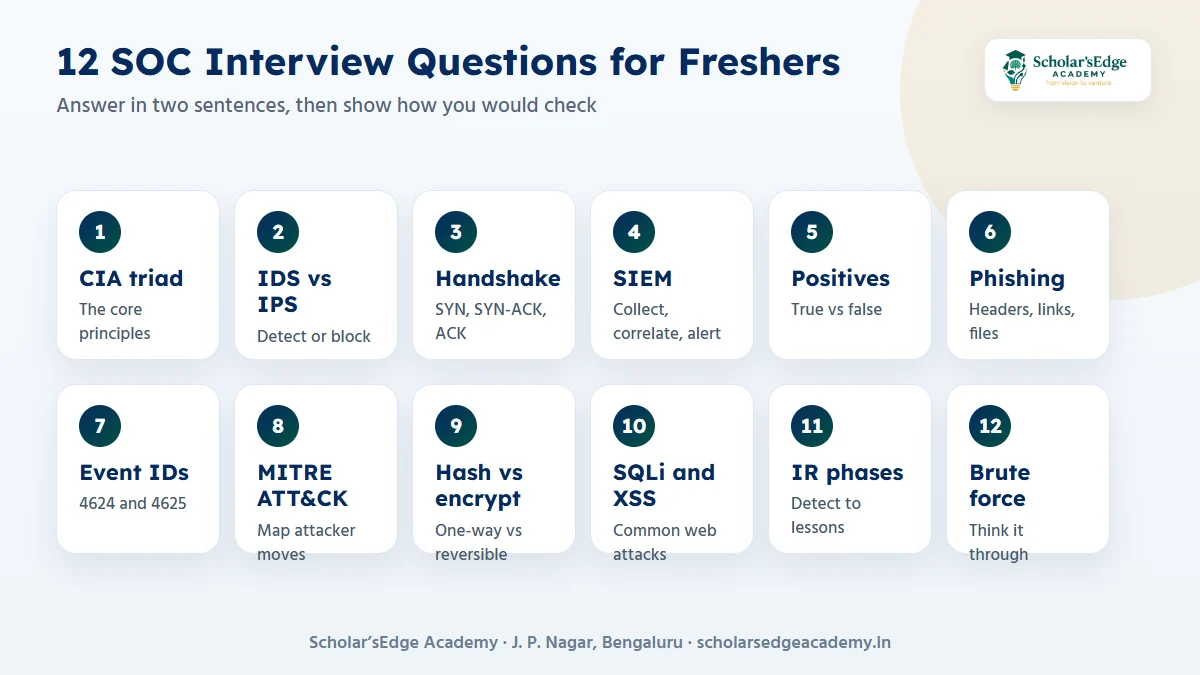
| Question | What the interviewer checks |
|---|---|
| What is the CIA triad? | You know confidentiality, integrity and availability |
| IDS vs IPS | One detects and alerts, the other can also block |
| TCP three-way handshake | You understand how a connection starts |
| What does a SIEM do? | You know logs are collected, correlated and alerted on |
| True vs false positive | You can judge whether an alert is real |
| Analyse a phishing email | You check headers, links, attachments and sender |
| Event IDs 4624 and 4625 | You can read Windows logon logs |
| What is MITRE ATT&CK? | You can map attacker behaviour to tactics |
| Hashing vs encryption | You know one is one-way and the other reversible |
| SQL injection and XSS | You know common web attacks and the fixes |
| Phases of incident response | You know the order from detection to lessons learned |
| A brute-force alert fires. What next? | You can think through a real case step by step |
- CIA triadConfidentiality means only the right people see data, integrity means data is not changed without permission, and availability means systems work when needed.
- IDS vs IPSAn intrusion detection system watches traffic and raises alerts. An intrusion prevention system sits in the path and can also block the traffic.
- Three-way handshakeThe client sends SYN, the server replies SYN-ACK, and the client sends ACK. After that the connection is open. Many scans abuse partial handshakes.
- What a SIEM doesA security information and event management tool gathers logs from many systems, normalises them, correlates events and raises alerts. Splunk, Microsoft Sentinel and Wazuh are common examples. See SIEM explained.
- True vs false positiveA true positive is a real threat that was flagged. A false positive is harmless activity that was flagged. Too many false positives cause alert fatigue, so tuning matters.
- Phishing email analysisCheck the sender address and the full email headers, hover over links without clicking, scan attachments in a sandbox, and compare the domain with the real one. Report and block if it is malicious.
- Windows event IDsEvent 4624 is a successful logon and 4625 is a failed logon. Many 4625 events from one source followed by a 4624 can suggest a brute-force attack that succeeded.
- MITRE ATT&CKIt is a public knowledge base of attacker tactics and techniques. Analysts use it to name what an attacker did and to check whether their detections cover each technique.
- Hashing vs encryptionHashing turns data into a fixed-length value that cannot be reversed and is used to check integrity or store passwords. Encryption can be reversed with the right key.
- SQL injection and XSSIn SQL injection, user input changes a database query, and parameterised queries prevent it. In cross-site scripting, a page runs attacker script in a visitor’s browser, and output encoding prevents it. Both appear in the OWASP Top 10.
- Incident response phasesPreparation, detection and analysis, containment, eradication and recovery, then post-incident review. NIST describes this life cycle in its incident handling guide.
- Brute-force alert scenarioConfirm the source and target, check how many failures and whether a success followed, look at the account and the host, block or isolate if it is real, reset credentials, document what you saw and tune the rule.
How to practise at home
- Build a small lab with a Linux machine and a Windows machine, and send their logs to a free SIEM such as Wazuh.
- Use Wireshark to capture a three-way handshake and a DNS lookup, then explain each packet aloud.
- Take a public phishing sample and write a five-line analysis of it.
- Map one attack you read about to the MITRE ATT&CK technique names.
- Write down one incident as a short report: what happened, how you know, what you did.
A calm, ordered answer to a scenario question. Say what you would check first, what that would tell you, and what you would do next.
Mistakes freshers make in SOC interviews
- Listing tools without explaining what they do. Say what problem each tool solves.
- Guessing instead of saying how you would verify. “I would check the logs for…” is a good answer.
- Ignoring the paperwork. Documenting an incident clearly is a core part of the job.
- Forgetting the basics. Many interviews start with ports, DNS and HTTP.
How our course prepares you
The SOC Analyst & Cloud Security course at our J. P. Nagar centre runs for 4.5 months: 3 hours a day, Monday to Friday, plus a Saturday lab, with a weekend batch also available. Tools include Nmap, Wireshark, Burp Suite, Kali Linux, Splunk, Microsoft Sentinel and Wazuh. Projects include a home SOC lab with custom detections, a ransomware incident investigation, a cloud security audit and a simulated SOC shift. A 2-month internship is included for every enrolled student.
For the bigger picture, read the SOC analyst roadmap and is cybersecurity a good career choice.
Ready to try a class before you decide?Book a free demo class to see the syllabus, ask about fees and batches, and meet the team. Every course includes a 2-month internship, and classes run online and offline.Book on WhatsAppCall +91 99020 58603
Frequently asked questions
What should I study first for a SOC analyst interview?
Networking basics, Windows and Linux logs, how a SIEM works, common attacks and the incident response phases.
Do SOC analyst interviews include coding?
Usually only light scripting or query questions. Understanding logs, networks and attacks matters more for fresher roles.
What is the difference between a SOC analyst and a penetration tester?
A SOC analyst defends by monitoring and responding to alerts. A penetration tester attacks systems with permission to find weaknesses.
Which certifications help a fresher?
Entry-level security certificates can help, but hands-on lab work and clear explanations often matter more in interviews.
Can a non-IT graduate become a SOC analyst?
It needs serious study. Our SOC Analyst course is aimed at engineering, BCA, BSc IT and MCA graduates and IT support and network staff, so check eligibility on the course page or ask us on WhatsApp.
Not sure yet? Talk to us
Book a free demo class or ask for 1:1 guidance on WhatsApp at +91 99020 58603, or use the form on our contact page. You can also compare all our courses. Scholar’sEdge Academy is at Building No. 19, 25/1, 9th Cross Road, 2nd Phase, J. P. Nagar, Bengaluru, Karnataka 560078. Read how we write and check our articles in our editorial policy.
