Quick answer: Ethical hacking (offensive security) means testing systems the way an attacker would, with permission, to find weaknesses. A SOC analyst (defensive security) watches systems, investigates alerts and responds to attacks. For most freshers in India, SOC analyst is the more common first job, and many ethical hackers start in defensive roles and move across later.
Not sure where to start? Try a free demo class, online or at our J. P. Nagar centre. Book on WhatsApp
Key takeaways
- Ethical hacking finds weaknesses before attackers do. SOC work catches and stops attacks as they happen.
- Both need the same base: networking, Linux, Windows and how attacks work.
- EC-Council recommends 2 years of IT security experience for its CEH exam, which shows how employers see offensive roles.
- Our Cybersecurity course is defensive (SOC and cloud security) and also teaches attacker tools such as Nmap, Burp Suite and Kali Linux.
“Ethical hacking course in Bangalore” is one of the most searched cybersecurity terms, and many students ask whether they should learn hacking or join a SOC. The honest answer depends on what you enjoy and what jobs are open to freshers. This guide compares the two paths and explains how to start.
What is ethical hacking?
Ethical hacking is the authorised testing of systems to find security weaknesses before criminals do. Ethical hackers, also called penetration testers or red teamers, scan networks, test web applications and try to break in, always with written permission, and then report how to fix what they found.
What does a SOC analyst do?
A SOC analyst works in a Security Operations Centre and defends an organisation. The work is to watch alerts in a SIEM, investigate suspicious activity, decide what is real, contain incidents and write up what happened. This is often called the blue team. Read SIEM explained for the main tool.
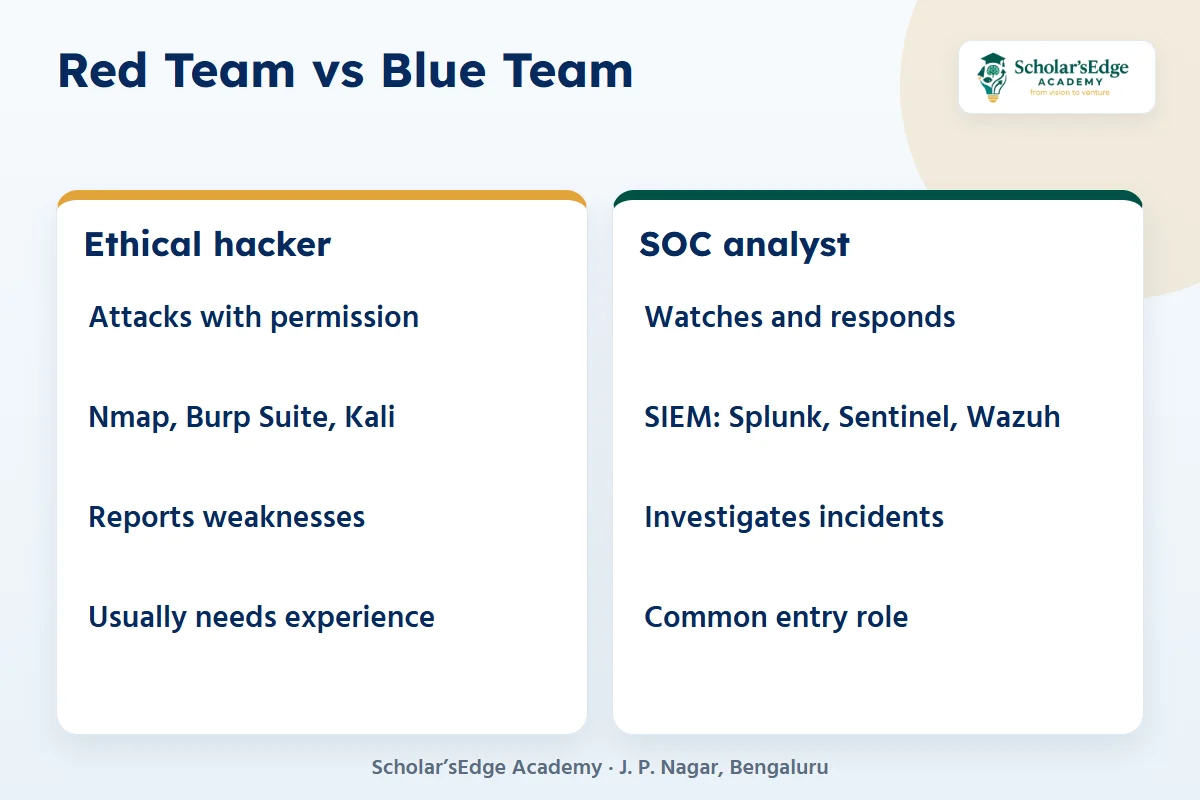
Ethical hacking vs SOC analyst: what is the difference?
| Point | Ethical hacker | SOC analyst |
|---|---|---|
| Side | Offensive (red team) | Defensive (blue team) |
| Daily work | Scan, test and try to break in, then report | Monitor alerts, investigate, respond, report |
| Main tools | Nmap, Burp Suite, Kali Linux, Metasploit | SIEM (Splunk, Microsoft Sentinel, Wazuh), EDR, Wireshark |
| Typical first certificate | CEH, then advanced practical exams | CompTIA Security+, SIEM vendor certificates |
| Entry for freshers | Harder: usually needs proven skill | More common entry role (SOC L1) |
| Work pattern | Projects with deadlines | Often shifts, because monitoring runs all day |
Which is better for freshers: ethical hacking or SOC analyst?
SOC analyst is usually the more realistic first step. Offensive roles expect people who already understand systems and defence well. EC-Council, which runs the Certified Ethical Hacker exam, recommends at least 2 years of IT security experience for candidates, although it lists no formal prerequisite (EC-Council). A SOC role gives you that experience, and the skills carry across.
Start as a defender anyway, and keep practising offence in legal labs and capture-the-flag events. Knowing how attacks are detected makes you a much better ethical hacker later.
What skills do both paths need?
Both start from the same base. Learn these first, whichever side you choose.
TCP/IP, DNS, HTTP, ports and how traffic flows.
Linux and Windows administration and the command line.
The OWASP Top 10, malware basics and the MITRE ATT&CK framework.
Enough Python or Bash to automate small tasks.
What is the CEH exam like?
The CEH knowledge exam has 125 multiple-choice questions in 4 hours, and EC-Council says the current version is 13. An optional practical exam has 20 challenges in 6 hours (EC-Council). A certificate helps, but employers still ask what you can do, so lab practice matters as much as the exam.
How much do cybersecurity freshers earn in India?
Cybersecurity freshers in India earn about ₹4 to ₹7 LPA, and services and managed security firms, which hire many SOC analysts, start nearer ₹3.5 to ₹5 LPA, according to Weekday. These are published estimates, not offers. See our IT fresher salary guide for other roles.
How do you become a SOC analyst as a fresher?
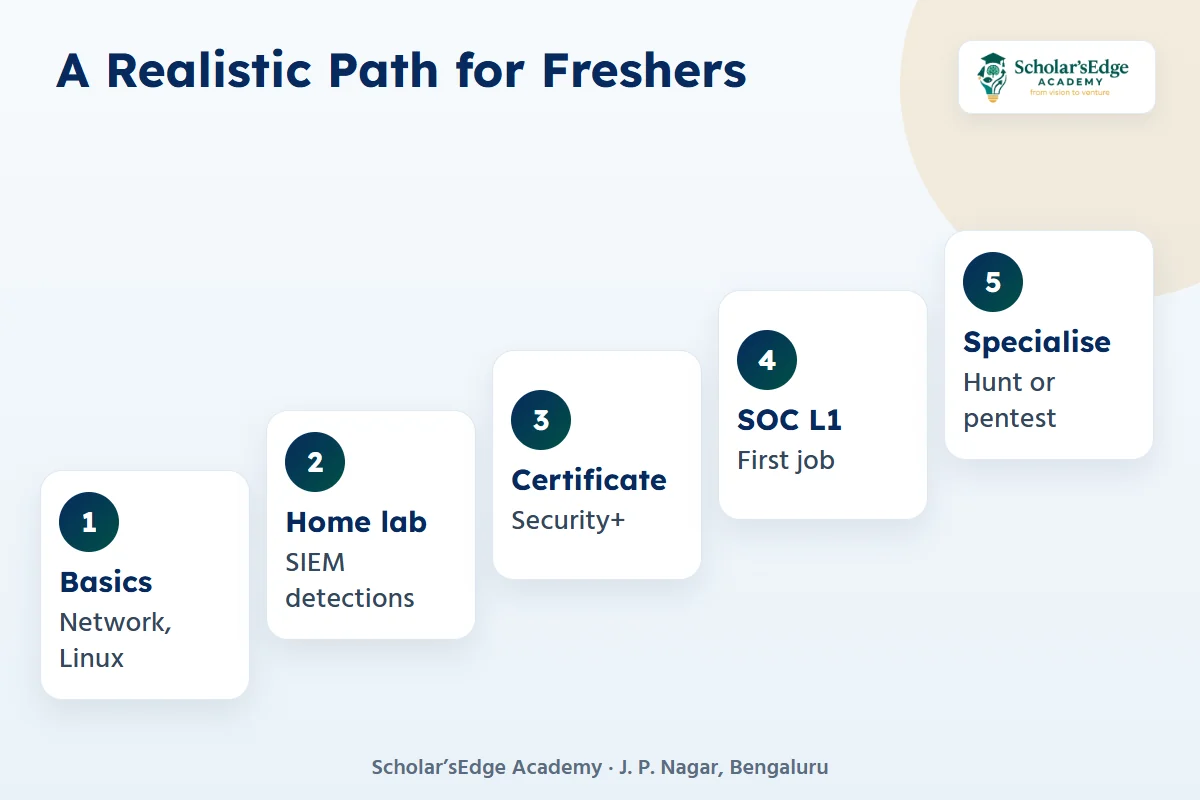
- Learn the baseNetworking, Linux, Windows and attack basics.
- Build a home labSet up a SIEM such as Wazuh and write a few detections.
- Investigate incidentsPractise on sample logs: phishing, brute force, ransomware.
- Get an entry certificateCompTIA Security+ is a common choice.
- Apply for SOC L1 rolesShow your lab, your detections and a written incident report.
- Specialise laterMove toward threat hunting, cloud security or penetration testing.
Follow the detailed SOC analyst roadmap and practise with our cybersecurity interview questions.
Where can you learn cybersecurity in Bangalore?
Our Cybersecurity: SOC Analyst and Cloud Security course in J. P. Nagar is a defensive course. You learn networking, Linux and Windows administration and scripting; threats, the OWASP Top 10, Nmap, Wireshark, Burp Suite and Kali Linux; SIEM with Splunk, Microsoft Sentinel and Wazuh, log analysis, MITRE ATT&CK and incident response; detections and threat hunting; and AWS and Azure cloud security. You build a home SOC lab, investigate a ransomware incident, run a cloud security audit and work a simulated SOC shift. It runs 4.5 months with a 2-month internship, and the offer fee is ₹31,999. We do not run a separate ethical hacking course.
The course is for engineering, BCA, BSc IT and MCA graduates, and for IT support and network staff. Still deciding? Read is cybersecurity a good career and cybersecurity vs cloud and DevOps.
Ready to try a class before you decide?Book a free demo class to see the syllabus, ask about fees and batches, and meet the team. Every course includes a 2-month internship, and classes run online and offline.Book on WhatsAppCall +91 99020 58603
Frequently asked questions
Is ethical hacking a good career for freshers?
It can be, but entry roles are harder to get without proven skill. Many people start as SOC analysts and move into ethical hacking later.
Which is better, ethical hacking or cyber security?
Ethical hacking is one part of cybersecurity. Cybersecurity also includes SOC work, cloud security and governance, which offer more entry roles.
Does a SOC analyst need coding?
A little. Basic Python or Bash scripting helps you automate tasks and read logs, but deep programming is not required at L1.
Is CEH required to become an ethical hacker?
No single certificate is required. CEH is well known, and employers also value practical labs and proven findings.
Can I learn ethical hacking at Scholar’sEdge Academy?
Our course is defensive (SOC and cloud security) and includes attacker tools such as Nmap, Burp Suite and Kali Linux, but we do not offer a separate ethical hacking course.
Sources we checked
We checked these on 15 November 2026. Figures from outside sources can change; check the source before you rely on them.
- EC-Council: Certified Ethical Hacker.
- Weekday: cyber security salary in India 2026.
- Course details: Cybersecurity: SOC Analyst and Cloud Security.
Not sure yet? Talk to us
Book a free demo class or ask for 1:1 guidance on WhatsApp at +91 99020 58603, or use the form on our contact page. You can also compare all our courses and our combo courses. Scholar’sEdge Academy is at Building No. 19, 25/1, 9th Cross Road, 2nd Phase, J. P. Nagar, Bengaluru, Karnataka 560078. Read how we write and check our articles in our editorial policy.
