Quick answer: ETL extracts data, transforms it on a separate processing server, and then loads the cleaned result into a warehouse. ELT extracts data, loads it raw into a cloud warehouse first, and transforms it there with SQL. ELT is common with modern cloud warehouses because storage and compute are cheap and flexible. ETL still fits strict privacy rules and small, well-defined feeds.
Not sure where to start? Try a free demo class, online or at our J. P. Nagar centre. Book on WhatsApp
Every data team has to move data from where it is created, such as apps, payment systems and spreadsheets, to where it is analysed. The order of the steps decides where the heavy work happens and who can change it later. That is the whole difference between ETL and ELT, and it is a favourite interview question for data engineering freshers.
ETL and ELT side by side
Both patterns have the same three steps: extract, transform and load. Only the order changes, and the order changes the tools and the team.
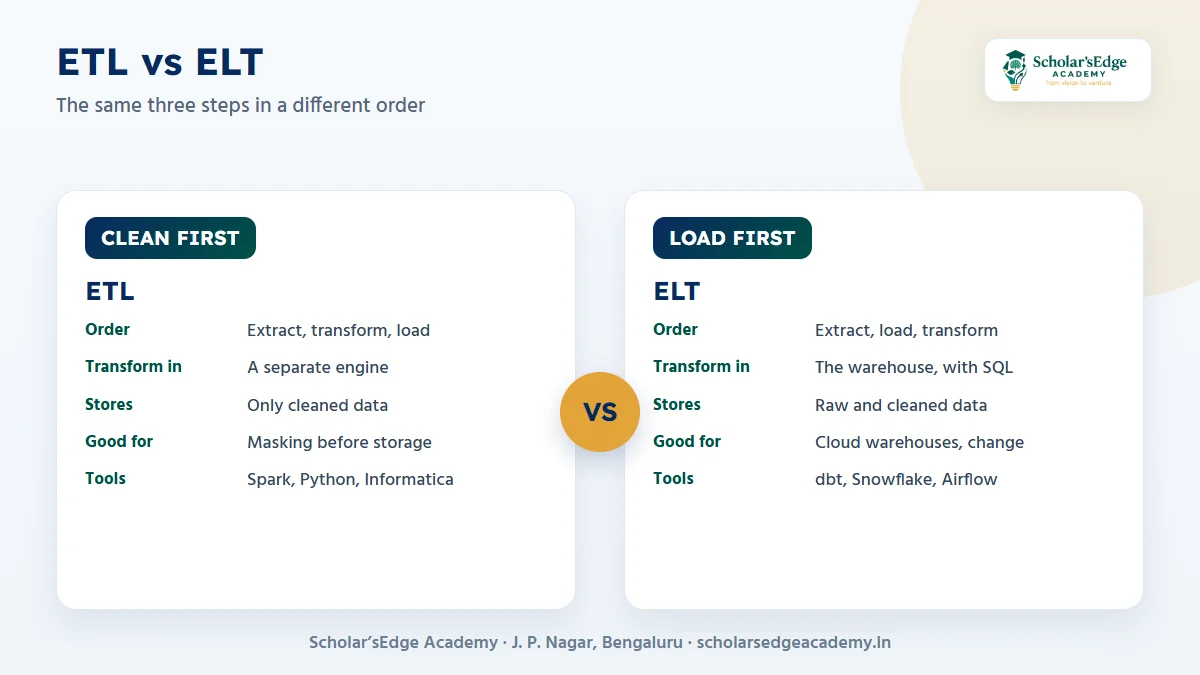
| Point | ETL | ELT |
|---|---|---|
| Order of steps | Extract, transform, then load | Extract, load, then transform |
| Where transformation runs | A separate processing server or tool | Inside the data warehouse, usually with SQL |
| What is stored first | Only the cleaned result | The raw data and the cleaned models |
| Flexibility | Changing a rule means reprocessing from the source | Raw data is kept, so you can re-run new logic |
| Speed to first data | Slower, because transformation comes first | Faster, because loading comes first |
| Privacy control | Sensitive fields can be removed before loading | Needs access rules inside the warehouse |
| Typical tools | Informatica, Talend, custom Python or Spark jobs | Cloud warehouses with dbt and an ingestion tool |
| Best fit | Strict compliance, small and stable feeds | Growing data, many analysts, cloud warehouse |
- ExtractPull data from the source: a database, an API, files or an event stream. Keep track of what you already pulled so you do not load the same rows twice.
- Transform in ETLClean and reshape the data on a processing engine before it reaches the warehouse. You can drop or mask sensitive columns here.
- Load in ETLWrite only the final, cleaned tables into the warehouse. Analysts see tidy data but not the raw feed.
- Load in ELTCopy the raw data straight into the warehouse or a data lake. This is quick and keeps the full history.
- Transform in ELTUse SQL inside the warehouse, often managed with a tool such as dbt, to build clean models from the raw tables. Each model can be tested and version-controlled.
- Orchestrate and monitorBoth patterns need a scheduler such as Apache Airflow, data-quality checks and alerts. See the Airflow documentation for how pipelines are defined as code.
Which one should a beginner learn first?
Learn both ideas, but practise ELT with SQL first. Modern teams use cloud warehouses, and SQL is the skill every data engineer and analyst shares. Then learn a Python or Spark transformation so that you can explain ETL and its use cases.
A simple example
A shop exports daily orders from its website as a file. In an ETL setup, a Python job reads the file, removes test orders, converts currencies and writes a clean orders table. In an ELT setup, the file is loaded unchanged into a raw table, and a SQL model builds the clean table from it. If finance later asks for a new rule, the ELT team changes one SQL model and re-runs it, while the ETL team may need to reprocess the old files.
ETL cleans before storing, ELT stores first and cleans inside the warehouse, so ELT keeps the raw data and is easier to change.
Common mistakes
- Loading everything without checks. Add row counts and null checks at each step.
- Mixing raw and clean tables. Keep them in separate schemas with clear names.
- Ignoring cost. Heavy transformations in a warehouse use compute, so schedule and size them sensibly.
- Forgetting privacy. Decide early which fields are personal and who may read them.
How our course covers this
The Data Engineering course at our J. P. Nagar centre runs for 5 months: 3 hours a day, Monday to Friday, plus a Saturday pipeline lab, with a weekend batch also available. Tools include Python, SQL, Pandas, PySpark, Apache Spark, Apache Airflow, Kafka, AWS, Snowflake, Delta Lake, dbt and Docker. Projects include a batch ETL pipeline from an API to a warehouse, an Airflow daily pipeline with data-quality checks, a real-time Kafka and Spark pipeline and a deployed AWS capstone. A 2-month internship is included for every enrolled student.
Read the data engineering roadmap next, or compare roles in data analyst vs data engineer.
Ready to try a class before you decide?Book a free demo class to see the syllabus, ask about fees and batches, and meet the team. Every course includes a 2-month internship, and classes run online and offline.Book on WhatsAppCall +91 99020 58603
Frequently asked questions
What is the main difference between ETL and ELT?
ETL transforms data before loading it into the warehouse. ELT loads raw data first and transforms it inside the warehouse.
Is ELT replacing ETL?
ELT is more common with modern cloud warehouses, but ETL is still used where data must be cleaned or masked before storage, or where feeds are small and stable.
What does dbt do?
dbt runs SQL transformations inside a warehouse, with testing and version control. It handles the transform step of ELT.
Do I need Python to be a data engineer?
Yes, for most roles. Python is used for extraction, orchestration and transformation, alongside SQL.
Which should a fresher learn first, ETL or ELT?
Learn the concepts of both, and practise ELT with SQL first, because SQL is the skill used across data roles.
Not sure yet? Talk to us
Book a free demo class or ask for 1:1 guidance on WhatsApp at +91 99020 58603, or use the form on our contact page. You can also compare all our courses. Scholar’sEdge Academy is at Building No. 19, 25/1, 9th Cross Road, 2nd Phase, J. P. Nagar, Bengaluru, Karnataka 560078. Read how we write and check our articles in our editorial policy.
