Quick answer: The best GenAI projects for a fresher’s resume are ones that solve a real problem, use your own data, are measured and are deployed. Build at least three: a RAG chatbot that answers from documents with citations, an AI agent that uses tools with safe limits, and one deployed app with a live link. Below are 10 project ideas from beginner to advanced, with the skills each one proves.
Not sure where to start? Try a free demo class, online or at our J. P. Nagar centre. Book on WhatsApp
Key takeaways
- Recruiters look for working, deployed projects with clear READMEs, not certificates alone.
- Cover three skills across your projects: RAG, tool calling or agents, and deployment.
- Measure your project. “Answers 40 test questions, 34 correctly” says more than “accurate chatbot”.
- Never commit API keys to GitHub, and put limits on anything an agent can do.
“GenAI projects for resume”, “RAG projects for resume” and “AI agent projects for resume” are some of the most searched AI terms among Indian students right now, and for good reason: an AI application developer is hired for what they can build. This guide gives you 10 project ideas in order of difficulty, what each one proves and how to present it so an interviewer takes it seriously.
What makes a GenAI project good enough for a resume?
A resume-worthy GenAI project solves a real problem, works on data you chose, is tested and can be opened through a live link or a clear demo video. A tutorial you copied line by line does not count, because interviewers will ask why you made each choice.
Pick a use a business would pay for: support, search, reports, data questions.
Use documents, tables or APIs you collected, not only the tutorial’s sample.
Keep a small test set and report how many answers were right.
A live link or a short demo video, plus a README that explains your design.
Which 10 GenAI projects can you build for your resume?
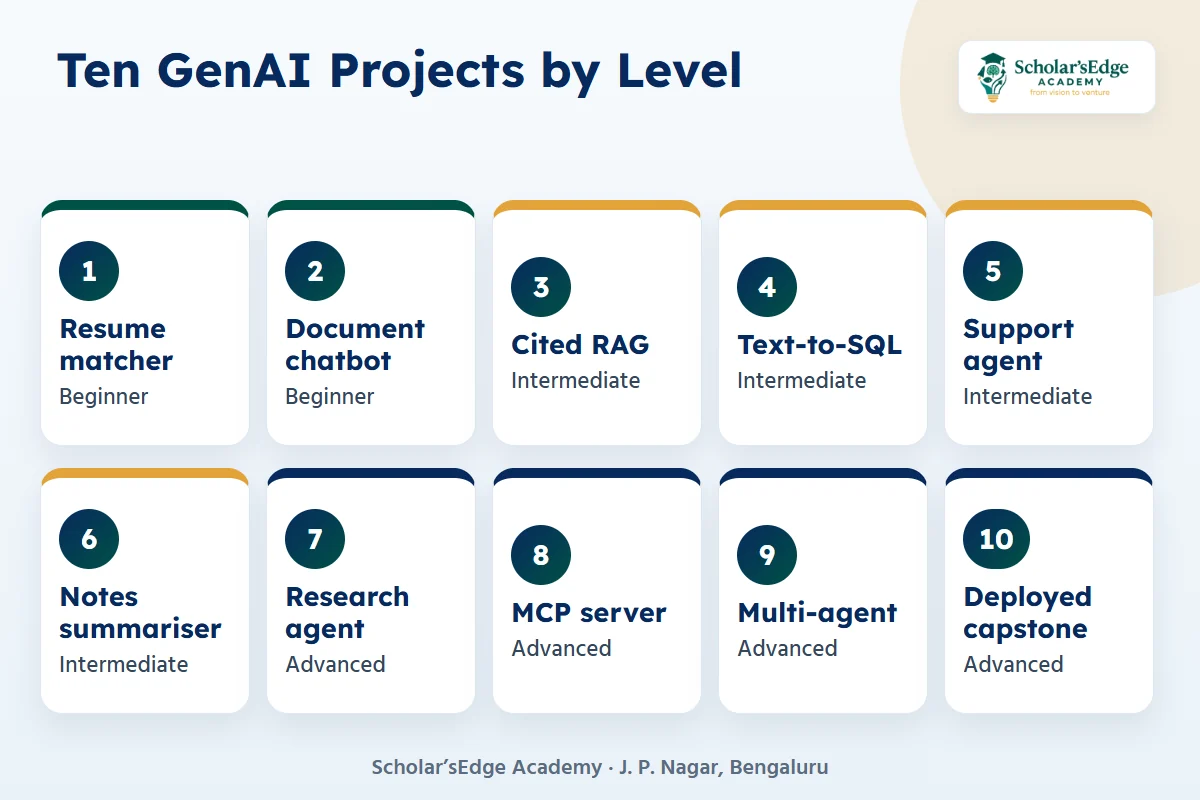
The table lists all ten projects. Start at the top and stop when you have three strong ones that match the jobs you want.
| Project | Level | Main skills |
|---|---|---|
| 1. Job description and resume matcher | Beginner | LLM API, prompts, structured JSON output |
| 2. Document Q&A chatbot (RAG) | Beginner | Embeddings, vector database, retrieval |
| 3. Multi-document RAG with citations | Intermediate | Chunking, reranking, evaluation |
| 4. Natural-language-to-SQL assistant | Intermediate | SQL, schema prompts, safe query checks |
| 5. Customer-support agent | Intermediate | Tool calling, rules, human approval |
| 6. Lecture or meeting notes summariser | Intermediate | Speech-to-text, long-text summarising |
| 7. Research agent with LangGraph | Advanced | Agent state, memory, stop conditions |
| 8. Your own MCP server | Advanced | Model Context Protocol, tool design |
| 9. Multi-agent content pipeline | Advanced | CrewAI or LangGraph, agent roles, review step |
| 10. Deployed capstone with monitoring | Advanced | FastAPI, Docker, cloud, logging, cost tracking |
Beginner GenAI projects
Beginner projects prove you can call a large language model (LLM) from code and control its output. Do these first, even if they feel simple.
1. Job description and resume matcher (beginner)
Paste a job description and a resume, and the app returns a match score, missing skills and three suggested resume bullets as structured JSON that your code can check.
- Skills it proves: calling an LLM API from Python, writing testable prompts, asking for structured output and validating it.
- Make it stand out: show what happens when the model returns bad JSON, and how your code retries or rejects it.
2. Document Q&A chatbot (beginner)
A chatbot that answers questions from a set of PDFs, such as a college handbook or a public company policy, using retrieval-augmented generation (RAG). RAG finds the most relevant passages first and gives only those to the model, so answers come from your documents instead of the model’s memory.
- Skills it proves: embeddings, a vector database such as Chroma, retrieval and prompt design. New to the idea? Read what is RAG.
- Make it stand out: make the bot say “I could not find this in the documents” instead of guessing.
Intermediate GenAI projects
Intermediate projects prove you can make an AI app reliable: measured answers, safe access to data and tools, and sensible handling of errors.
3. Multi-document RAG with citations (intermediate)
Upgrade project 2 to search many documents, show the source and page for every answer, and compare two chunk sizes or a reranker to see which gives better answers.
- Skills it proves: chunking strategy, metadata filters, reranking and evaluation with a small question set. Tools such as Ragas help measure RAG quality.
- Make it stand out: publish your test questions and a before-and-after table in the README.
4. Natural-language-to-SQL assistant (intermediate)
Ask “Which five products sold most last month?” in plain English. The app writes the SQL, runs it on a read-only database, checks the result and explains it.
- Skills it proves: SQL, giving the model the table schema, validating queries before they run and handling empty results.
- Make it stand out: use a read-only database user and block anything that is not a SELECT query.
5. Customer-support agent (intermediate)
An agent that reads a support message, looks up the order through a tool, decides the next step within your rules and drafts a reply. Refunds above a limit wait for a person to approve.
- Skills it proves: tool calling (also called function calling), designing tool inputs, business rules and human-in-the-loop approval. See AI agents explained.
- Make it stand out: log every tool call and show one example where the agent correctly refused to act.
6. Lecture or meeting notes summariser (intermediate)
Upload an audio recording. The app turns speech into text, splits long transcripts into parts, summarises them and lists action items with owners and dates.
- Skills it proves: speech-to-text APIs, handling long inputs, summarising in stages and structured output.
- Make it stand out: compare the summary with your own notes for three recordings and report what it missed.
Advanced GenAI projects
Advanced projects prove you can build agentic systems that plan several steps, and run them safely in production.
7. Research agent with LangGraph (advanced)
Give the agent a question such as “compare three cloud certifications for freshers”. It plans searches, reads sources, keeps notes in its state, writes a cited report and stops after a set number of steps.
- Skills it proves: LangGraph state and graphs, memory, retries, stop conditions and citing sources.
- Make it stand out: add a step limit and a cost limit, and show both in the demo.
8. Your own MCP server (advanced)
Build a small Model Context Protocol (MCP) server that lets an AI assistant safely read a SQLite database or a shared spreadsheet you own. MCP is an open standard for connecting AI applications to tools and data.
- Skills it proves: tool design, input validation, permissions and how AI assistants discover tools.
- Make it stand out: expose only read actions first, then add one write action that needs confirmation.
9. Multi-agent content pipeline (advanced)
Three agents work in turn: one researches a topic, one writes a draft and one checks facts and tone against a checklist, sending the draft back if it fails.
- Skills it proves: agent roles, hand-offs and review loops with CrewAI or LangGraph.
- Make it stand out: show the reviewer agent catching at least one real mistake.
10. Deployed capstone with monitoring (advanced)
Take your best project and ship it properly: a FastAPI back end, a simple front end, Docker, deployment on a cloud platform such as AWS, logs for every request and a running total of API cost.
- Skills it proves: APIs, containers, cloud deployment, logging, rate limits and keeping secrets out of code.
- Make it stand out: add a small dashboard with request count, average response time and cost per day.
Which GenAI projects should a fresher build first?
Build three projects that together cover RAG, agents and deployment. That combination matches what AI application developer job descriptions ask for, and it gives you three different stories for interviews.
- First: a RAG chatbotProject 2, then upgrade it to project 3 with citations and a test set.
- Second: an agent with toolsProject 5 or 7, with limits and human approval.
- Third: deploy one of themProject 10: a live link, Docker and a clean README.
How do you write a GenAI project on your resume?
Write each project as one or two bullets that say what you built, with which tools, and what result you measured. The figure shows the formula.
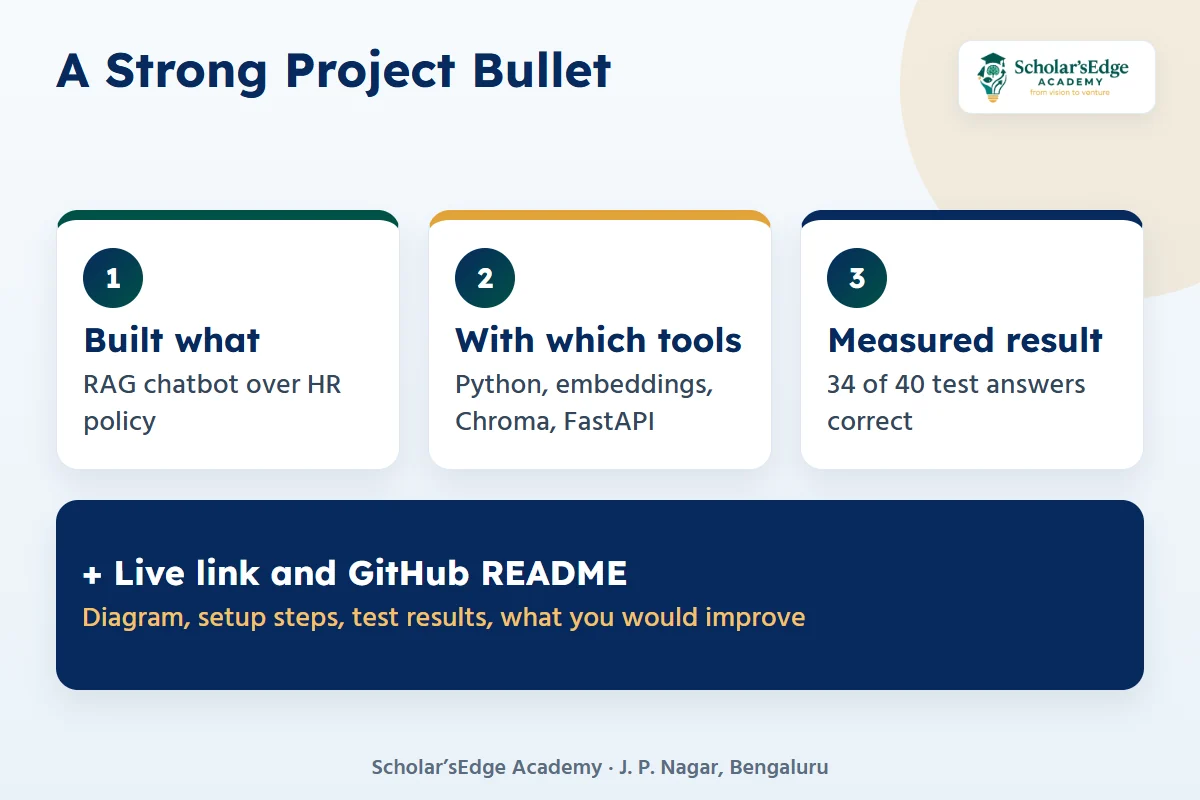
Built a RAG chatbot over 120 pages of HR policy using Python, embeddings and Chroma; it answered 34 of 40 test questions correctly with page citations. Deployed with FastAPI and Docker (live link, GitHub).
- Put the live link and the GitHub link next to the project title.
- In the README, add a diagram, setup steps, your test results and what you would improve next.
- Be ready to explain every design choice, from chunk size to the model you picked and why.
What mistakes make AI projects look weak?
- A copied tutorial. Same dataset, same code, no changes. Interviewers spot it in two questions.
- No evaluation. “It works well” with no test questions or numbers.
- API keys in the code. Keep keys in environment variables and out of GitHub.
- Agents with no limits. Unlimited steps, unlimited spending or actions without approval. The OWASP Top 10 for LLM Applications lists “excessive agency” and prompt injection as top risks.
- No README. If a recruiter cannot run or understand it in two minutes, it does not help you.
Where can you build these projects with guidance in Bangalore?
Our AI Application Developer course in J. P. Nagar is built around projects like these: you build a company document chatbot (RAG), a customer-support AI agent, a natural-language-to-SQL data assistant and a deployed domain capstone. Along the way you learn Python, FastAPI, the Claude, GPT and Gemini APIs, embeddings, vector databases, LangGraph, CrewAI, MCP, Docker and AWS. The course runs 5 months with a 2-month internship, and the offer fee is ₹41,999. For the full learning order, read our AI application developer roadmap.
Ready to try a class before you decide?Book a free demo class to see the syllabus, ask about fees and batches, and meet the team. Every course includes a 2-month internship, and classes run online and offline.Book on WhatsAppCall +91 99020 58603
Frequently asked questions
Which GenAI project is best for a resume?
A RAG chatbot over real documents, with citations and a measured test set, is the best first project. Pair it with one agent project and deploy at least one of them.
How many AI projects should a fresher have on a resume?
Three strong, deployed projects are better than ten small tutorials. Together they should cover RAG, tool calling or agents, and deployment.
Can I use free LLM APIs for resume projects?
Yes. Several providers offer free tiers or low-cost models, and you can also run small open models locally. Check each provider’s current limits and pricing before you build.
Are LangChain projects good for a resume?
Yes, if you can explain what the framework does for you. Interviewers value understanding RAG and tool calling more than the name of a library.
Should I put final-year AI projects on my resume?
Yes, if they are your own work and you can demo them. Add a live link or demo video and a clear README.
Do I need machine learning knowledge to build GenAI projects?
Not deep machine learning. You need Python, APIs, prompts, embeddings and basic data skills. Some ML basics help you explain how models behave.
Sources we checked
We checked these on 20 November 2026. Figures from outside sources can change; check the source before you rely on them.
- OpenAI: function calling guide.
- Anthropic: tool use with Claude.
- LangChain: LangGraph overview.
- Model Context Protocol: introduction.
- Chroma: introduction.
- CrewAI documentation.
- Ragas documentation.
- OWASP Top 10 for LLM Applications 2025.
- FastAPI documentation.
- Course details: AI Application Developer course.
Not sure yet? Talk to us
Book a free demo class or ask for 1:1 guidance on WhatsApp at +91 99020 58603, or use the form on our contact page. You can also compare all our courses and our combo courses. Scholar’sEdge Academy is at Building No. 19, 25/1, 9th Cross Road, 2nd Phase, J. P. Nagar, Bengaluru, Karnataka 560078. Read how we write and check our articles in our editorial policy.
