Quick answer: A good generative AI course in Bangalore teaches you to build working AI applications, not only to use chatbots. Look for Python, LLM APIs, prompt engineering, RAG, AI agents and deployment, with projects you build yourself. At Scholar’sEdge Academy in J. P. Nagar, the AI Application Developer course covers all of these in 5 months, with a 2-month internship, at an offer fee of ₹41,999.
Not sure where to start? Try a free demo class, online or at our J. P. Nagar centre. Book on WhatsApp
Key takeaways
- Decide first: do you want to use AI tools at work, or build AI applications? The courses are very different.
- A building course should cover Python, LLM APIs, RAG, agents, testing and deployment.
- Free certificate courses are useful for basics. They rarely include projects that a trainer reviews.
- Ask every institute for the syllabus, project list, class hours, fee and refund policy in writing.
“Generative AI course in Bangalore”, “agentic AI course” and “generative AI course fees” are some of the most searched course terms in India right now. The trouble is that the same name is used for a two-hour tools workshop and a five-month developer programme. This guide explains what to learn, how to compare courses and what our own course includes.
What is a generative AI course?
A generative AI course teaches how models that create text, images or code work, and how to use them. There are two kinds. User courses teach prompting and AI tools for everyday work. Developer courses teach you to build AI features into software with code. If you want an AI job, you need the second kind. Not sure of the terms? Read agentic AI vs generative AI.
What should a generative AI course syllabus include?
A developer-level syllabus should take you from Python to a deployed AI app. The figure shows the modules in the order they build on each other.
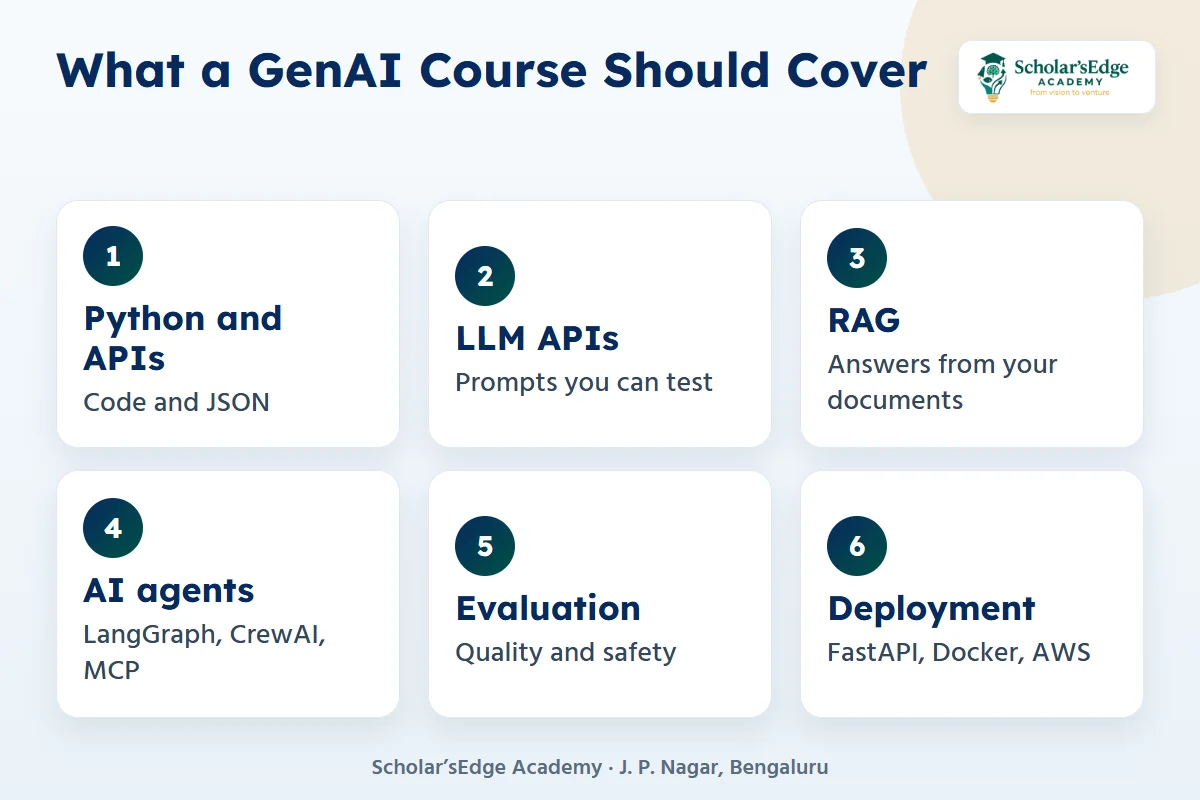
| Module | What you should be able to do |
|---|---|
| Python and APIs | Write clean Python, call web APIs and handle JSON |
| LLM APIs and prompt engineering | Call a model from code, write prompts you can test and control cost |
| Embeddings and RAG | Make the model answer from your own documents using a vector database |
| AI agents | Use tool calling, LangGraph, CrewAI and MCP for multi-step tasks |
| Evaluation and safety | Measure answer quality, handle errors and stop prompt injection |
| Deployment | Ship the app with FastAPI, Docker and a cloud platform such as AWS |
Is a free generative AI course with certificate enough?
A free course is a good start, but it is usually not enough for a job. Free courses explain the ideas well. What they rarely give you is a trainer who reviews your code, real projects with your own data and help when you get stuck. Employers ask to see what you built, so judge any course, free or paid, by the projects you finish.
How do you choose a generative AI course in Bangalore?
Compare courses on proof, not promises. Use these five checks at every institute, including ours.
Ask for the project list. You should build at least one RAG app and one agent yourself.
Count the teaching hours per week and how long the course runs.
The syllabus should name LLM APIs, a vector database, an agent framework and a cloud.
Building AI apps needs coding. Ask what background the course expects.
Fee, what it includes and the refund policy, in writing before you pay.
No institute can promise you a job or a salary. Treat guarantees as a reason to ask more questions. Read our checklist for choosing a training institute.
What is the generative AI course fee in Bangalore?
Fees vary widely with length and depth, so compare the fee with the hours and projects you get. Our published fees are below. Confirm the current fee when you enquire, because offer fees can change.
| Option | Length | Offer fee | Best for |
|---|---|---|---|
| AI Foundations Weekend Bootcamp | 4 weekends | To be announced | Complete beginners |
| AI Application Developer | 5 months + 2-month internship | ₹41,999 | Building GenAI and agent apps |
| AI Software Engineer combo | 10 months + 2-month internship | ₹59,999 | Full stack plus AI |
| AI Data Professional combo | 9 months + 2-month internship | ₹54,999 | Data analytics plus AI |
| AI Data Engineer combo | 10 months + 2-month internship | ₹69,999 | Data engineering plus AI |
What do you learn in our AI Application Developer course?
You learn Python, Git, Linux and SQL basics; Pandas, NumPy and scikit-learn; FastAPI and LLM APIs; prompt engineering, embeddings, vector databases and RAG; AI agents with tool calling, LangGraph, CrewAI, MCP and multi-agent systems; and how to evaluate and deploy AI apps with Docker and AWS.
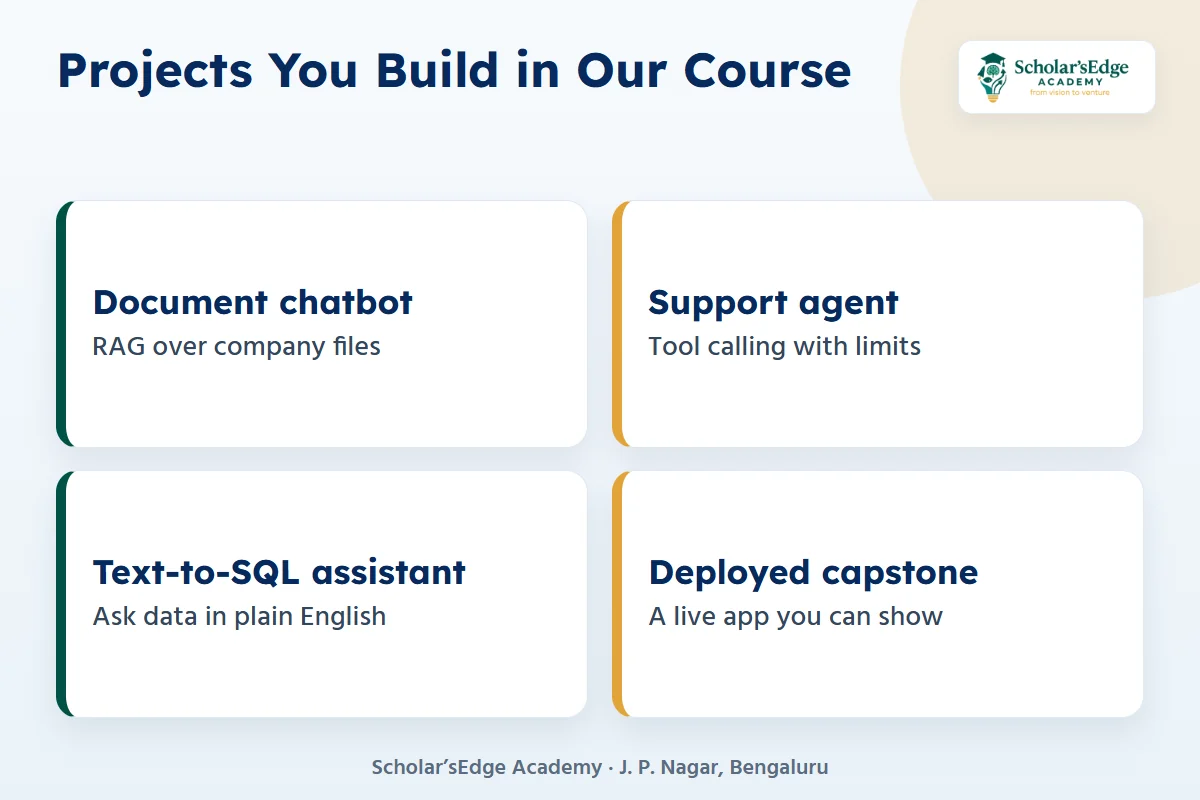
Classes run 3 hours a day, Monday to Friday, plus a Saturday lab, and a weekend batch is available. You can study online or at our J. P. Nagar centre. A 2-month internship is included.
Who can join a generative AI course?
Our AI Application Developer course is for engineering, BCA, MCA and BSc graduates or final-year students, and for professionals moving into AI. If you have never coded, start with the AI Foundations Weekend Bootcamp, which needs no experience. Read weekend bootcamp vs main course to decide.
Is a generative AI course worth it in 2026?
It is worth it if you finish real projects and can explain them. AI tools are now normal at work: 84% of respondents in the 2025 Stack Overflow survey use or plan to use them in development. That makes basic AI use common, so the value is in building and testing AI features, not only prompting.
Ready to try a class before you decide?Book a free demo class to see the syllabus, ask about fees and batches, and meet the team. Every course includes a 2-month internship, and classes run online and offline.Book on WhatsAppCall +91 99020 58603
Frequently asked questions
What is the best generative AI course in Bangalore?
The best course is the one that matches your goal and makes you build projects. Compare syllabus, projects, hours, eligibility and written terms at each institute.
What is the generative AI course fee at Scholar’sEdge Academy?
The AI Application Developer course has an offer fee of ₹41,999 and a regular fee of ₹49,999 for 5 months of training, with a 2-month internship included.
Is there an agentic AI course in Bangalore?
Yes. Our AI Application Developer course in J. P. Nagar includes AI agents with tool calling, LangGraph, CrewAI, MCP and multi-agent systems.
Can I learn generative AI without coding?
You can learn to use AI tools without coding. To build AI applications you need Python, which our course teaches from the basics.
Is the course online or offline?
Both. You can attend online or at our J. P. Nagar centre, on a weekday or weekend batch.
How long does it take to learn generative AI?
Our developer course takes 5 months of daily classes plus a 2-month internship. The bootcamp introduction takes 4 weekends.
Sources we checked
We checked these on 15 November 2026. Figures from outside sources can change; check the source before you rely on them.
- Stack Overflow 2025 Developer Survey: AI.
- Course details and fees: AI Application Developer course and courses page.
Not sure yet? Talk to us
Book a free demo class or ask for 1:1 guidance on WhatsApp at +91 99020 58603, or use the form on our contact page. You can also compare all our courses and our combo courses. Scholar’sEdge Academy is at Building No. 19, 25/1, 9th Cross Road, 2nd Phase, J. P. Nagar, Bengaluru, Karnataka 560078. Read how we write and check our articles in our editorial policy.
