Quick answer: You can get an IT job after a career gap by refreshing one in-demand skill, building two or three recent projects, explaining the gap in three honest sentences, and applying to specific roles instead of everything. A short gap needs little explanation. A long gap needs recent proof of work. Many people return after several years, though it takes more preparation.
Not sure where to start? Try a free demo class, online or at our J. P. Nagar centre. Book on WhatsApp
Key takeaways
- Be direct. In a LinkedIn survey, 51% of hirers said they are more likely to contact a candidate who explains a career break.
- Recent proof beats old experience. Fresh projects answer the question hirers are really asking.
- Plan for about 90 days: learn, build, then apply.
- Pick a path that fits your degree. Data Analytics and Performance Marketing are open to any graduate at our academy.
A gap can come from caregiving, health, exam preparation, family duties, a layoff or a job search that took too long. None of these needs an apology. What hirers want to know is simple: are your skills current, and will you stay? This guide shows how to answer both, with sample lines for your interview and a 90-day plan.
Can I get a job after a long career gap?
Yes, you can get a job after a long gap, including a 3, 4 or 5 year gap, but you will need recent evidence of your skills. Some company hiring rules favour recent graduates, so a mass-recruiter route may be closed. Focus on smaller firms, startups and roles where a portfolio counts. Bangalore has many of these, and a 2-month internship can also give you recent work to talk about.
How do you explain a career gap in an interview?
Explain it in three short lines: the reason, what you did to stay ready, and why you are ready now. Then stop talking and let the interviewer ask more. Long stories make a normal gap sound like a problem.
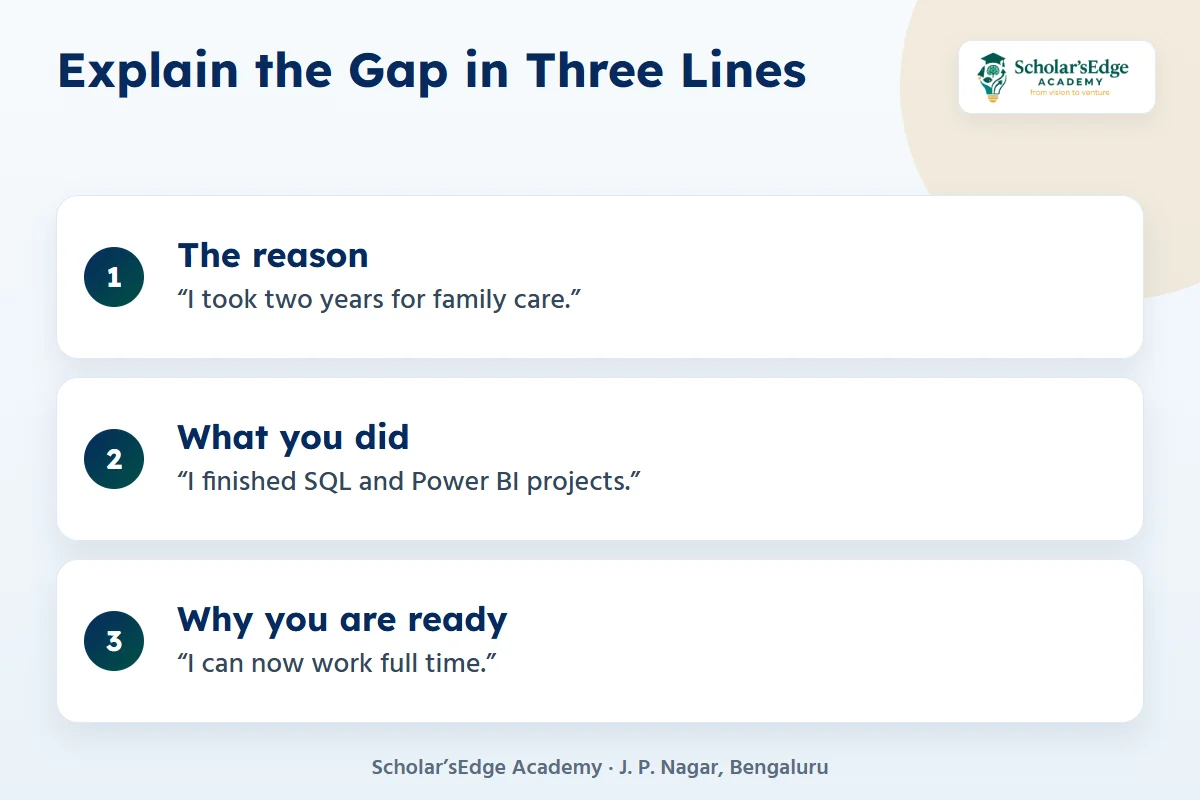
“During the last four months I completed SQL and Power BI projects. My family situation is settled, and I am ready to work full time.”
“I decided to move to IT, learnt cloud basics and built an AWS project. This is the career I want now.”
“I used the time to learn Docker and CI/CD, and I can show you my pipeline.”
Use your own true facts in these examples. Never invent a job or stretch dates. Background checks can find this, and it would cost you far more than the gap.
How do you show a career gap on a resume?
Show the gap honestly in one line and fill it with what you did. Put skills and projects above work history if your last job is several years old.
- Add one line in your timeline. For example: “Career break, 2023 to 2025: family care. Completed Data Analytics training and three projects.”
- Lead with a skills summary. Name the tools you can use today.
- Add 2 or 3 recent projects. Link to GitHub, a dashboard or a live demo.
- Use the LinkedIn career break option. It sits in the Experience section and offers 13 types of break, including caregiving, and health and well-being.
A 90-day plan to get back into IT
Ninety days is enough to become interview-ready for an entry role if you study daily. Full courses take longer, so treat this as your first stretch.
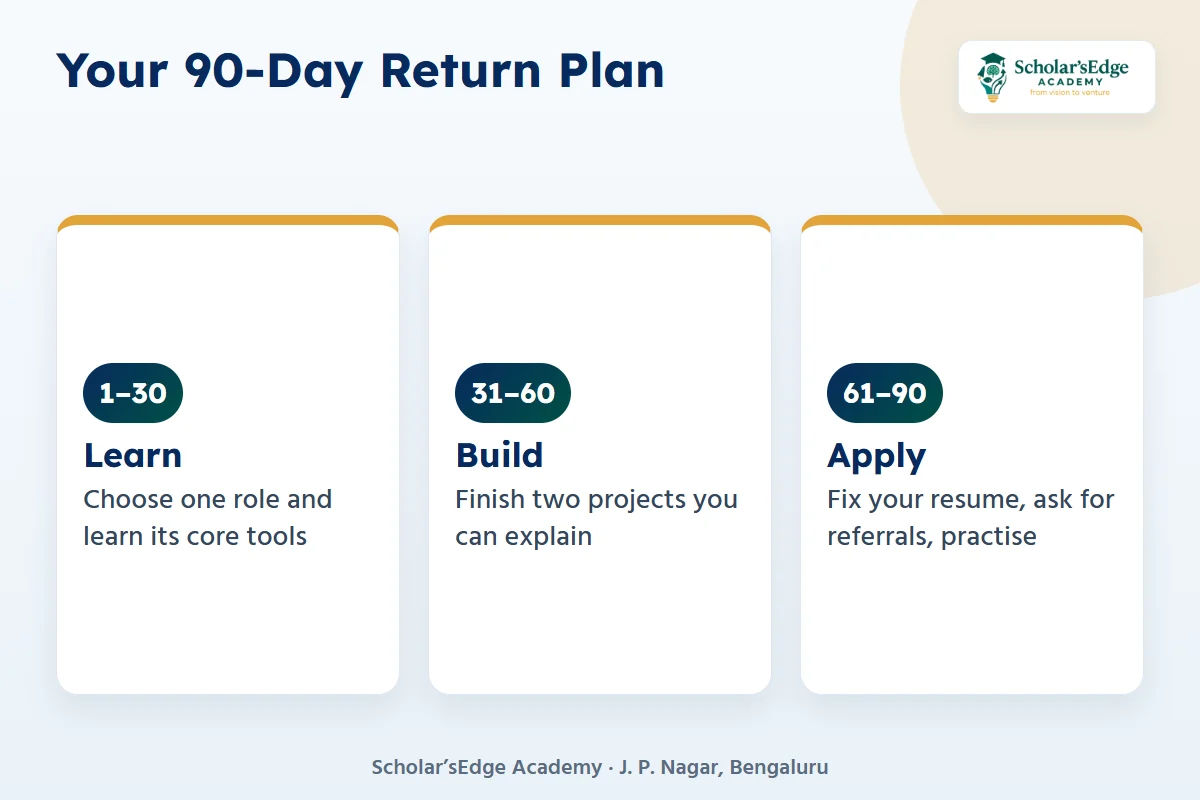
- Days 1 to 30: choose and learnPick one role and learn its core tools. Stop collecting courses, because one finished path beats five started ones.
- Days 31 to 60: buildFinish two projects on real or realistic data, and write a short note on what each one proves.
- Days 61 to 90: applyUpdate your resume and LinkedIn, ask former colleagues for referrals, and send fewer, better applications. Practise your three-line answer.
Which IT course is best after a career gap?
The best course is the one your degree and past work already support. Use the table to find a starting point.
| Your background | A good starting point | Why |
|---|---|---|
| Any degree, including B.Com, BBA and BA | Data Analytics with AI (4 months) | Open to any graduate, and it uses business sense you may already have |
| Any degree, marketing or sales interest | AI-Powered Performance Marketing (3 months) | Open to any graduate, and it is the shortest path, with a live campaign |
| Engineering, BCA, MCA or BSc | Full Stack Development (5 months) | Rebuilds coding skills with modern tools |
| IT support or network experience | Cybersecurity or Cloud and DevOps | Builds on what you already know |
| Past developer or tester | AI Application Developer (5 months) | Updates your skills for current AI work |
Every course has online and offline classes and a weekend batch, which helps if you have family duties. Every enrolled student gets a 2-month internship, and we give resume and mock interview support. We do not promise a job. If your degree is outside IT, also read how a non-IT graduate can switch to IT.
Returning to work after a break as a woman in tech
Search for “returnship” and “women returner” programmes, because several large companies run them for people returning after a break. Read the eligibility rules carefully, as many ask for past work experience. If you have none, projects and an internship are your first step. In the same LinkedIn research, 51% of hirers said people who take career breaks can restart their careers at any time.
Do not undersell yourself. LinkedIn found 48% of hirers think the biggest mistake returning candidates make is undervaluing themselves on pay or seniority. Know your range: see our IT fresher salary guide.
Ready to try a class before you decide?Book a free demo class to see the syllabus, ask about fees and batches, and meet the team. Every course includes a 2-month internship, and classes run online and offline.Book on WhatsAppCall +91 99020 58603
Frequently asked questions
Can I get a job after a 4 year gap?
Yes, though it needs more preparation. Show recent projects, a clear reason for the gap and current skills, and focus on employers that look at portfolios.
What are good reasons for a career gap in an interview?
Any true reason is acceptable: family care, health, study, a layoff or a career change. Say it briefly and move to what you are doing now.
How long a career gap is acceptable in IT?
There is no fixed rule. Up to a year rarely needs much explanation. Beyond that, hirers look for proof that your skills are current.
Do companies in Bangalore hire people with a career gap?
Yes, particularly smaller firms and startups, and some companies run returnship programmes. Mass campus-style hiring is often stricter about graduation year.
Can I study on weekends while managing family duties?
Yes. Our courses have a weekend batch, and classes are available online and at J. P. Nagar.
Is a career gap a problem for an internship?
No. Our 2-month internship is included for every enrolled student, whatever the gap.
Sources we checked
We checked these on 6 November 2026. Salary and hiring figures are published estimates and they change often.
Not sure yet? Talk to us
Book a free demo class or ask for 1:1 guidance on WhatsApp at +91 99020 58603, or use the form on our contact page. You can also compare all our courses and our combo courses. Scholar’sEdge Academy is at Building No. 19, 25/1, 9th Cross Road, 2nd Phase, J. P. Nagar, Bengaluru, Karnataka 560078. Read how we write and check our articles in our editorial policy.
