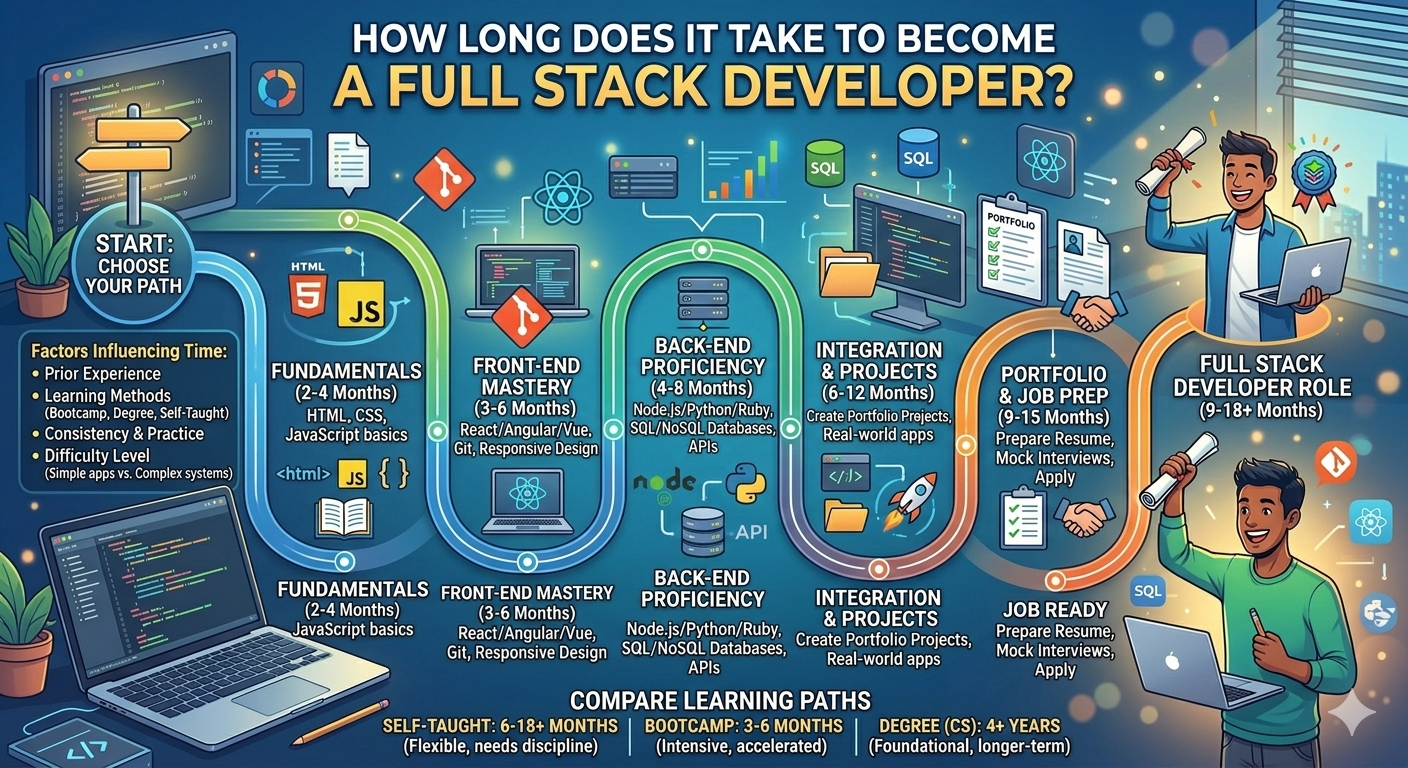
The process of becoming a full stack developer takes 6-12 months with dedicated structured training or 1-2 years through self-directed learning. The full stack development program at Scholar’sEdge Academy transforms beginners into job-ready developers through six to nine months of hands-on projects and industry mentorship and real-world application development. Your knowledge level at the beginning combined with your daily study time of at least four to six hours and your choice of learning method and your decision to study full-time or part-time will determine how long it takes to complete the program. By dedicating time to learn the correct curriculum which includes React for frontend development and Node.js for backend development and database management and version control and deployment skills you can achieve job market entry within one year while developing professional applications that address actual business challenges.
Understanding the Full Stack Developer Journey
The path to becoming a full stack developer requires personalized learning because it does not follow a predetermined route. Your background, learning intensity, and career goals significantly impact your timeline.
What Determines Your Learning Timeline?
Your Starting Point Matters
Beginners with zero programming experience need additional time learning fundamentals like HTML, CSS, JavaScript basics, programming logic, and problem-solving approaches. The people who have some coding experience can proceed faster through the essential learning material.
Daily Time Investment
| Learning Intensity | Hours per Day | Timeline to Job-Ready |
| Part-time learner | 2-3 hours | 18-24 months |
| Committed learner | 4-6 hours | 9-12 months |
| Full-time intensive | 8+ hours | 6-9 months |
| Bootcamp accelerated | 10-12 hours | 3-6 months |
Learning Method Impact
Scholar’sEdge Academy combines multiple proven approaches:
- Structured curriculum with clear milestones
- Project-based learning for practical skills
- Mentor-guided code reviews
- Peer collaboration sessions
- Industry-relevant capstone projects
Breaking Down the Full Stack Developer Roadmap
Frontend Development Phase (2-4 Months)
Your journey starts with client-side technologies that users interact with directly.
Core Technologies to Master:
- HTML5 semantic markup and accessibility standards
- CSS3 styling, flexbox, grid layouts, responsive design
- JavaScript fundamentals (ES6+, DOM manipulation, async programming)
- React.js or Vue.js for building interactive interfaces
- State management with Redux or Context API
- Frontend build tools like Webpack and Vite
At Scholar’sEdge Academy, students build 5-8 frontend projects during this phase, including responsive portfolios, e-commerce interfaces, and interactive dashboards.
Backend Development Phase (2-4 Months)
Backend technologies power the logic, authentication, and data processing behind applications.
Essential Backend Skills:
- Server-side programming (Node.js, Express, Python Django, or Ruby on Rails)
- RESTful API design and implementation
- Authentication and authorization (JWT, OAuth)
- Server configuration and middleware
- Error handling and logging
- Security best practices (input validation, SQL injection prevention)
Database Management:
- SQL databases (PostgreSQL, MySQL)
- NoSQL databases (MongoDB, Redis)
- Database design and normalization
- Query optimization and indexing
- ORM tools (Sequelize, Mongoose)
DevOps and Deployment Skills (1-2 Months)
Professional developers must deploy and maintain applications in production environments.
Critical Deployment Knowledge:
- Version control with Git and GitHub workflows
- Cloud platforms (AWS, Google Cloud, Azure basics)
- Containerization with Docker
- CI/CD pipelines
- Environment management
- Basic Linux command line operations
- Application monitoring and debugging
Portfolio Building Phase (1-2 Months)
Scholar’sEdge Academy emphasizes portfolio development throughout the program, culminating in 2-3 substantial projects that demonstrate your full stack capabilities.
Portfolio Project Requirements:
- Complex frontend with advanced interactions
- Robust backend API with authentication
- Database integration with multiple relationships
- Deployed and accessible online
- Clean, documented codebase
- Responsive and user-friendly design
Accelerating Your Full Stack Development Journey
Proven Strategies for Faster Mastery
- Follow Structured Learning Paths
Random tutorial-hopping wastes time. Scholar’sEdge Academy’s curriculum eliminates guesswork with step-by-step progression from fundamentals to advanced concepts.
- Build Projects from Day One
Theory without practice leads nowhere. Every concept learned should be immediately applied in mini-projects before moving forward.
- Learn by Teaching and Explaining
Join study groups, answer questions on forums, explain concepts to peers. Teaching solidifies your understanding faster than passive learning.
- Contribute to Open Source
Real-world codebases teach professional standards, collaboration workflows, and expose you to different coding styles and architectures.
- Get Code Reviews from Experienced Developers
Feedback accelerates improvement exponentially. Scholar’sEdge Academy provides weekly code reviews from industry professionals.
Common Roadblocks and How to Overcome Them
Tutorial Trap Syndrome
Watching endless tutorials without building creates false confidence. Solution: Follow the 80/20 rule (80% coding, 20% consuming content).
Imposter Syndrome Paralysis
Feeling overwhelmed by the vast technology landscape is normal. Focus on core technologies first, then expand gradually.
Trying to Learn Everything Simultaneously
Master one technology stack before diversifying. Scholar’sEdge Academy recommends the MERN stack (MongoDB, Express, React, Node.js) or PERN stack (PostgreSQL, Express, React, Node.js) for beginners.
What Makes Scholar’sEdge Academy Different
Industry-Aligned Curriculum
Our program updates quarterly to reflect current hiring requirements from tech companies, startups, and development agencies.
Real Project Experience
Students work on 3 client-simulation projects mimicking actual development agency workflows, including requirement gathering, sprint planning, and deliverable presentations.
Career Support Beyond Coding
- Resume and portfolio optimization
- Interview preparation with mock technical assessments
- LinkedIn profile enhancement
- Networking opportunities with hiring partners
- Job application strategy and negotiation coaching
Mentorship from Working Developers
Learn from professionals actively building production applications, not just academic instructors. Get insights into daily developer workflows, debugging strategies, and industry best practices.
Skills That Set You Apart in the Job Market
Beyond Technical Proficiency
Soft Skills Employers Value:
- Problem decomposition and logical thinking
- Clear technical communication
- Collaboration using Agit workflows
- Project documentation practices
- Time estimation and task management
- Adaptability to new technologies
Advanced Differentiators
- Testing (unit tests, integration tests, end-to-end testing)
- Performance optimization techniques
- Accessibility (WCAG standards)
- Progressive Web App development
- API documentation with Swagger/OpenAPI
- Basic UX principles and user research
Frequently Asked Questions
Can I become a full stack developer in 3 months?
Three months is extremely aggressive and only realistic for those with prior programming experience, learning full-time (8-10 hours daily), and following an intensive bootcamp format. Scholar’sEdge Academy’s accelerated track serves experienced developers transitioning to web development and takes 4-5 months minimum.
Do I need a computer science degree to become a full stack developer?
No degree required. Most successful full stack developers are self-taught or bootcamp-trained. Employers prioritize demonstrable skills through portfolios and technical interviews over formal education. Scholar’sEdge Academy students without degrees regularly receive job offers based on project work and technical competency.
Should I learn frontend or backend first?
Start with frontend development. HTML, CSS, and JavaScript provide immediate visual feedback that helps maintain motivation. Understanding user interfaces before diving into server logic creates better context for why backend systems exist and how they serve frontend needs.
How much time should I dedicate daily to learning full stack development?
Minimum 4-6 hours daily for steady progress toward job-readiness in 9-12 months. Less than 2 hours daily extends the timeline significantly and makes concept retention difficult. Scholar’sEdge Academy recommends blocking consistent time slots rather than sporadic learning sessions.
What programming language should I learn first for full stack development?
JavaScript is the optimal starting point because it works for both frontend (React, Vue) and backend (Node.js), allowing you to become job-ready faster with one language. Scholar’sEdge Academy’s curriculum centers on JavaScript full stack development for this reason.
Can I get a job as a full stack developer without professional experience?
Yes, through strong portfolio projects demonstrating production-level code quality, contributing to open source projects, freelancing for small clients, and building clones of popular applications with added features. Scholar’sEdge Academy’s capstone projects specifically mimic real client work to provide equivalent experience.
How do I know when I’m ready to apply for full stack developer jobs?
You’re job-ready when you can build a full application from scratch (planning, coding, testing, deployment) without tutorials, explain your code decisions clearly, debug problems independently, and your portfolio includes 3-4 substantial projects with clean, documented code. Scholar’sEdge Academy includes mock technical interviews to assess readiness.
What’s the salary expectation for entry-level full stack developers?
Entry-level full stack developers typically earn between $60,000-$85,000 annually, varying by location, company size, and skill level. Remote positions offer geographic flexibility. Scholar’sEdge Academy graduates average $72,000 in their first developer role.
Your Next Steps Toward Full Stack Development Mastery
The time required to become a full stack developer needs better definition to determine its length. You will achieve job readiness within six to twelve months when you combine targeted learning with organized educational programs and practical work in projects. The timeline depends less on calendar months and more on accumulated learning hours, project complexity, and skill application consistency.
The Scholar’sEdge Academy curriculum enables students to learn faster through its combination of mentoring guidance and practical project work and its ability to solve common challenges that affect self-study learners. Our students create applications that meet professional standards while learning how to work in development teams and they leave school prepared for employment success.
The technology industry needs skilled full stack developers who can bridgefrontend user experience with backend functionality. The first step of your journey begins at this moment. The full stack developer path enables professionals to develop creative solutions while achieving high salaries and expanding their knowledge base throughout their careers.
Are you prepared to begin your journey to become a full stack developer? The most efficient way to develop your skills as a developer occurs at Scholar’sEdge Academy because it offers you a complete pathway and mentoring assistance and practical developer experience.