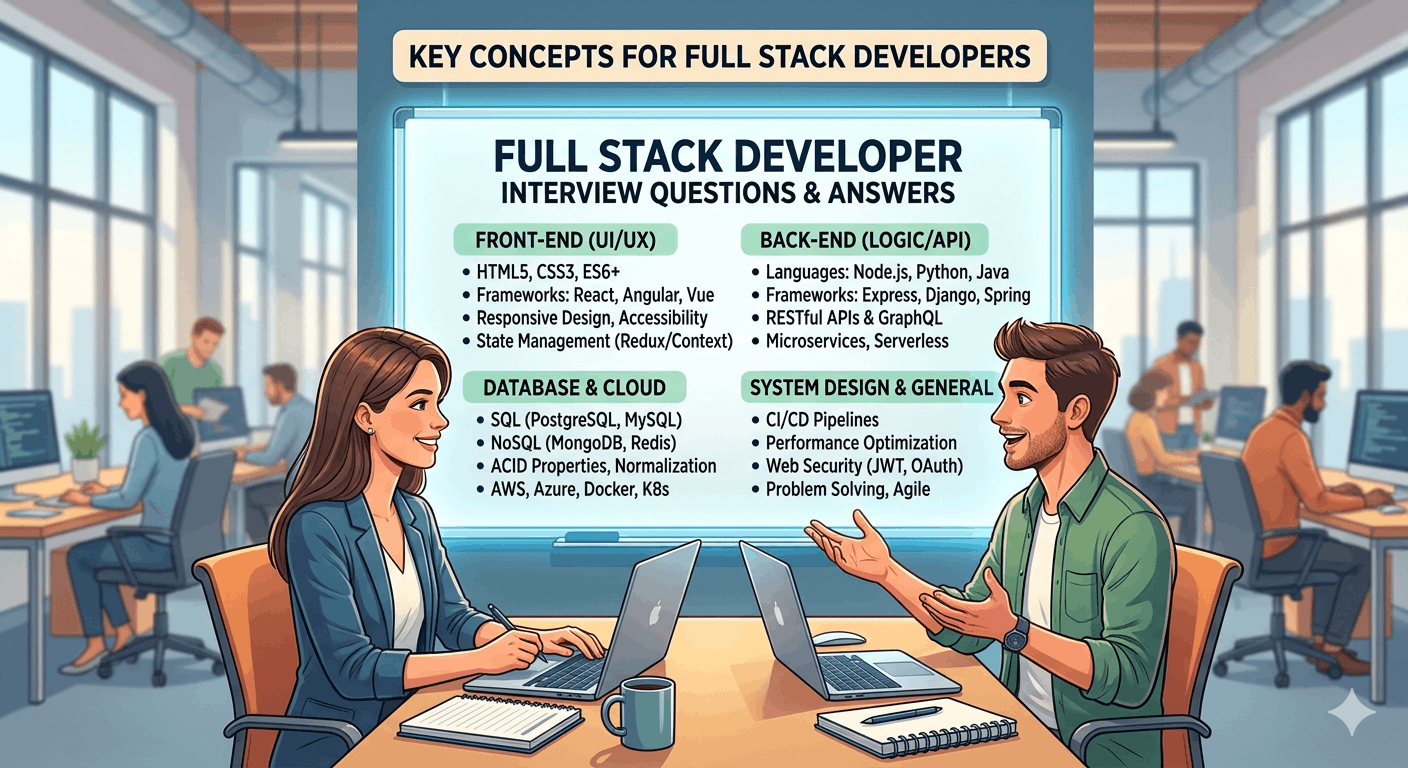
Full stack developer interview questions and answers cover JavaScript fundamentals, React component architecture, Node.js backend concepts, database design, API development, system design scenarios, and coding challenges that companies actually ask. At Scholar’s Edge Academy, our interview preparation program equips career switchers with proven answers, real-world project examples, and hands-on practice for technical rounds that land high-paying full stack positions. This comprehensive guide delivers the exact questions hiring managers ask, detailed answer frameworks, and preparation strategies that transform nervous candidates into confident developers ready to ace any interview.
JavaScript and Frontend Interview Questions
Core JavaScript Concepts
Question 1: Explain the difference between var, let, and const
Direct Answer: var has function scope and gets hoisted, let has block scope without hoisting to the top, and const also has block scope but creates immutable bindings that cannot be reassigned.
Detailed Explanation:
javascript
// var – function scoped
function varExample() {
if (true) {
var x = 10;
}
console.log(x); // 10 – accessible outside block
}
// let – block scoped
function letExample() {
if (true) {
let y = 10;
}
console.log(y); // ReferenceError
}
// const – block scoped, immutable binding
const user = { name: ‘John’ };
user.name = ‘Jane’; // Allowed – object mutation
user = {}; // Error – cannot reassign
Scholar’s Edge Academy teaches these fundamentals through practical coding exercises where you debug scoping issues in real applications.
Question 2: What is closure and provide a practical use case?
Direct Answer: A closure is a function that remembers variables from its outer scope even after that scope has finished executing. Closures enable data privacy, factory functions, and callback patterns.
Practical Example:
javascript
function createCounter() {
let count = 0; // Private variable
return {
increment: function() {
count++;
return count;
},
decrement: function() {
count–;
return count;
},
getCount: function() {
return count;
}
};
}
const counter = createCounter();
console.log(counter.increment()); // 1
console.log(counter.increment()); // 2
console.log(counter.getCount()); // 2
This pattern appears frequently in Scholar’s Edge Academy projects for managing application state and creating module patterns.
Question 3: Explain event delegation and its benefits
Direct Answer: Event delegation attaches a single event listener to a parent element instead of multiple listeners on child elements, improving performance and handling dynamically added elements automatically.
Implementation:
javascript
// Without delegation – multiple listeners
document.querySelectorAll(‘.button’).forEach(button => {
button.addEventListener(‘click’, handleClick);
});
// With delegation – single listener
document.querySelector(‘.container’).addEventListener(‘click’, (e) => {
if (e.target.matches(‘.button’)) {
handleClick(e);
}
});
Benefits:
- Reduces memory consumption
- Works with dynamically added elements
- Simplifies event handler management
- Improves application performance
React Interview Questions
Question 4: What are React hooks and why were they introduced?
Direct Answer: React hooks are functions that let you use state and lifecycle features in functional components without writing classes. They solve problems with class component complexity, code reuse difficulties, and confusing this keyword behavior.
Common Hooks Table:
| Hook | Purpose | Use Case |
| useState | Manage component state | Form inputs, toggles, counters |
| useEffect | Side effects and lifecycle | API calls, subscriptions, DOM updates |
| useContext | Access context values | Theme, authentication, global state |
| useReducer | Complex state logic | Form validation, shopping carts |
| useMemo | Memoize expensive calculations | Large data filtering, sorting |
| useCallback | Memoize functions | Prevent child re-renders |
Scholar’s Edge Academy curriculum emphasizes hooks from day one because modern React development relies exclusively on functional components.
Question 5: Explain the Virtual DOM and reconciliation process
Direct Answer: The Virtual DOM is a lightweight JavaScript representation of the actual DOM. React compares the new Virtual DOM with the previous version, calculates minimal changes needed, and updates only those specific parts in the real DOM for optimal performance.
Reconciliation Process:
- Component state or props change
- React creates new Virtual DOM tree
- Diffing algorithm compares old and new trees
- React identifies minimum changes required
- Batch updates applied to real DOM
Performance Implications:
- Reduces expensive DOM operations
- Enables efficient batch updates
- Allows declarative programming model
- Improves application responsiveness
Question 6: How do you optimize React application performance?
Direct Answer: Optimize React apps through code splitting, memoization, lazy loading, proper key usage, debouncing expensive operations, and using production builds.
Optimization Techniques:
javascript
// Code splitting with lazy loading
const Dashboard = React.lazy(() => import(‘./Dashboard’));
// Memoization to prevent re-renders
const MemoizedComponent = React.memo(({ data }) => {
return <div>{data.map(item => <Item key={item.id} {…item} />)}</div>;
});
// useMemo for expensive calculations
const sortedData = useMemo(() => {
return data.sort((a, b) => a.value – b.value);
}, [data]);
// useCallback for stable function references
const handleClick = useCallback(() => {
console.log(selectedId);
}, [selectedId]);
Scholar’s Edge Academy projects require passing Lighthouse performance audits, ensuring you build optimized applications.
Backend and Node.js Interview Questions
Question 7: Explain the Event Loop in Node.js
Direct Answer: The Event Loop is Node.js’s mechanism for handling asynchronous operations. It continuously checks the call stack and callback queue, executing callbacks when the stack is empty, enabling non-blocking I/O operations.
Event Loop Phases:
- Timers: Executes setTimeout and setInterval callbacks
- Pending Callbacks: Executes I/O callbacks deferred from previous cycle
- Idle/Prepare: Internal operations only
- Poll: Retrieves new I/O events, executes callbacks
- Check: Executes setImmediate callbacks
- Close Callbacks: Handles socket closures
Practical Example:
javascript
console.log(‘Start’);
setTimeout(() => {
console.log(‘Timeout’);
}, 0);
Promise.resolve().then(() => {
console.log(‘Promise’);
});
console.log(‘End’);
// Output: Start, End, Promise, Timeout
// Promises (microtasks) execute before timers (macrotasks)
Question 8: What is middleware in Express.js?
Direct Answer: Middleware functions have access to request and response objects and the next middleware function in the application’s request-response cycle. They execute code, modify request/response objects, end the cycle, or call the next middleware.
Middleware Types:
javascript
// Application-level middleware
app.use((req, res, next) => {
console.log(‘Time:’, Date.now());
next();
});
// Router-level middleware
router.use(‘/user/:id’, (req, res, next) => {
console.log(‘Request URL:’, req.originalUrl);
next();
});
// Error-handling middleware
app.use((err, req, res, next) => {
console.error(err.stack);
res.status(500).send(‘Something broke!’);
});
// Built-in middleware
app.use(express.json());
app.use(express.static(‘public’));
Scholar’s Edge Academy teaches building custom middleware for authentication, logging, validation, and error handling.
Question 9: How do you handle authentication in Node.js applications?
Direct Answer: Implement authentication using JWT tokens for stateless authentication, storing hashed passwords with bcrypt, validating credentials, generating tokens on login, and verifying tokens on protected routes.
JWT Authentication Flow:
javascript
const jwt = require(‘jsonwebtoken’);
const bcrypt = require(‘bcrypt’);
// Registration
async function register(req, res) {
const hashedPassword = await bcrypt.hash(req.body.password, 10);
const user = await User.create({
email: req.body.email,
password: hashedPassword
});
res.status(201).json({ message: ‘User created’ });
}
// Login
async function login(req, res) {
const user = await User.findOne({ email: req.body.email });
if (!user || !(await bcrypt.compare(req.body.password, user.password))) {
return res.status(401).json({ error: ‘Invalid credentials’ });
}
const token = jwt.sign({ userId: user.id }, process.env.JWT_SECRET, {
expiresIn: ’24h’
});
res.json({ token });
}
// Authentication middleware
function authenticateToken(req, res, next) {
const token = req.headers[‘authorization’]?.split(‘ ‘)[1];
if (!token) return res.sendStatus(401);
jwt.verify(token, process.env.JWT_SECRET, (err, user) => {
if (err) return res.sendStatus(403);
req.user = user;
next();
});
}
Database Interview Questions
Question 10: Explain the difference between SQL and NoSQL databases
Direct Answer: SQL databases use structured schemas with tables and relationships, ensuring data consistency through ACID properties. NoSQL databases offer flexible schemas, horizontal scalability, and different data models for specific use cases.
Comparison Table:
| Feature | SQL (PostgreSQL, MySQL) | NoSQL (MongoDB, Redis) |
| Schema | Fixed, predefined | Flexible, dynamic |
| Scalability | Vertical (upgrade server) | Horizontal (add servers) |
| Transactions | Full ACID support | Eventual consistency |
| Relationships | Foreign keys, joins | Embedded documents, references |
| Best For | Complex queries, reporting | High-volume writes, real-time |
| Data Structure | Tables with rows | Documents, key-value, graphs |
When to Use SQL:
- Complex relationships between entities
- Transaction integrity required
- Structured reporting needs
- Financial applications
When to Use NoSQL:
- Rapidly changing data structures
- Massive scale requirements
- Real-time analytics
- Content management systems
Scholar’s Edge Academy projects use both PostgreSQL and MongoDB, teaching you when each database type fits specific requirements.
Question 11: What are database indexes and how do they improve performance?
Direct Answer: Indexes are data structures that improve query speed by creating pointers to data locations, similar to a book index. They speed up SELECT queries but slow down INSERT, UPDATE, and DELETE operations because indexes need updating.
Index Implementation:
sql
— Create index on frequently queried column
CREATE INDEX idx_user_email ON users(email);
— Composite index for multi-column queries
CREATE INDEX idx_order_user_date ON orders(user_id, created_at);
— Unique index for enforcing uniqueness
CREATE UNIQUE INDEX idx_username ON users(username);
— Query performance comparison
EXPLAIN ANALYZE SELECT * FROM users WHERE email = ‘test@example.com’;
— Without index: Seq Scan (cost=0.00..431.00)
— With index: Index Scan (cost=0.42..8.44)
Index Best Practices:
- Index columns used in WHERE clauses frequently
- Index foreign key columns for join performance
- Avoid over-indexing as it slows writes
- Monitor index usage and remove unused indexes
System Design Interview Questions
Question 12: Design a URL shortening service like Bitly
Direct Answer: A URL shortener requires a hash generation algorithm, database to map short codes to long URLs, caching layer for popular links, and redirection logic with analytics tracking.
System Components:
Architecture Overview:
- API server receives long URL
- Generate unique short code using base62 encoding
- Store mapping in database
- Return shortened URL to user
- On access, lookup and redirect with 301/302
- Track analytics asynchronously
Database Schema:
sql
CREATE TABLE urls (
id BIGSERIAL PRIMARY KEY,
short_code VARCHAR(10) UNIQUE NOT NULL,
long_url TEXT NOT NULL,
user_id INTEGER,
created_at TIMESTAMP DEFAULT NOW(),
expires_at TIMESTAMP,
click_count INTEGER DEFAULT 0
);
CREATE INDEX idx_short_code ON urls(short_code);
Key Design Decisions:
| Aspect | Solution | Reasoning |
| Code Generation | Base62 encoding of auto-increment ID | Ensures uniqueness, short codes |
| Caching | Redis for popular URLs | Reduces database load |
| Scalability | Horizontal scaling with load balancer | Handles high traffic |
| Analytics | Message queue for async processing | Doesn’t slow redirects |
Scholar’s Edge Academy interview prep includes designing systems like this with trade-off discussions that impress hiring managers.
Question 13: How would you design a real-time chat application?
Direct Answer: A real-time chat requires WebSocket connections for bidirectional communication, message queuing for delivery guarantees, database for message persistence, and presence tracking for online status.
Technical Stack:
javascript
// WebSocket server setup
const io = require(‘socket.io’)(server);
io.on(‘connection’, (socket) => {
// User joins chat room
socket.on(‘join-room’, (roomId, userId) => {
socket.join(roomId);
socket.to(roomId).emit(‘user-connected’, userId);
});
// Send message
socket.on(‘send-message’, (roomId, message) => {
// Save to database
await Message.create({
roomId,
userId: socket.userId,
content: message,
timestamp: new Date()
});
// Broadcast to room
io.to(roomId).emit(‘receive-message’, message);
});
// Handle disconnection
socket.on(‘disconnect’, () => {
socket.rooms.forEach(room => {
socket.to(room).emit(‘user-disconnected’, socket.userId);
});
});
});
Scalability Considerations:
- Use Redis pub/sub for multi-server message distribution
- Implement message pagination for chat history
- Add typing indicators with debouncing
- Handle offline message delivery with push notifications
Coding Challenge Questions
Question 14: Implement debounce function from scratch
Direct Answer: Debounce delays function execution until after a specified time has passed since the last call, useful for search inputs and scroll events.
javascript
function debounce(func, delay) {
let timeoutId;
return function(…args) {
clearTimeout(timeoutId);
timeoutId = setTimeout(() => {
func.apply(this, args);
}, delay);
};
}
// Usage
const searchAPI = debounce((query) => {
console.log(‘Searching for:’, query);
// API call here
}, 500);
searchInput.addEventListener(‘input’, (e) => {
searchAPI(e.target.value);
});
Question 15: Reverse a linked list
javascript
function reverseLinkedList(head) {
let prev = null;
let current = head;
while (current !== null) {
let next = current.next;
current.next = prev;
prev = current;
current = next;
}
return prev;
}
Scholar’s Edge Academy provides daily coding challenges with solutions, helping you build problem-solving speed for technical interviews.
Behavioral Interview Questions
Question 16: Tell me about a challenging project you worked on
Answer Framework (STAR Method):
Situation: At Scholar’s Edge Academy, I built an e-commerce platform as my capstone project.
Task: The application needed real-time inventory updates, payment processing, and order tracking across multiple warehouses.
Action: I implemented WebSocket connections for inventory updates, integrated Stripe for payments, designed a PostgreSQL database with proper indexing, and created a React dashboard with real-time notifications.
Result: The application handled 100 concurrent users during demo day, processed payments successfully, and received positive feedback from industry mentors. This project helped me understand system design, async operations, and user experience optimization.
Question 17: How do you stay updated with new technologies?
Strong Answer: I follow a structured learning approach. I read official documentation for technologies I use daily, contribute to open-source projects on GitHub, attend local developer meetups monthly, and build personal projects implementing new concepts. At Scholar’s Edge Academy, I learned the importance of understanding fundamentals deeply rather than chasing every new framework, which helps me evaluate new tools critically.
How Scholar’s Edge Academy Prepares You for Interviews
Comprehensive Interview Training
Mock Interview Sessions:
- Technical rounds with experienced developers
- Behavioral question practice with feedback
- Whiteboard coding challenges
- System design scenarios
Portfolio Projects:
- Production-grade applications demonstrating skills
- GitHub repositories with clean code and documentation
- Live deployments showing working products
- Technical blog posts explaining implementation decisions
Career Support:
- Resume optimization highlighting technical skills
- LinkedIn profile enhancement
- Salary negotiation guidance
- Job search strategies and company research
Scholar’s Edge Academy students receive personalized interview preparation based on target companies and roles.
Frequently Asked Questions
What are the most common full stack developer interview questions?
The most common questions cover JavaScript fundamentals, React hooks and lifecycle, Node.js event loop, database design, REST API development, authentication implementation, and system design scenarios. Scholar’s Edge Academy curriculum addresses all these topics through hands-on projects, ensuring you answer confidently with real implementation experience.
How should I prepare for coding challenges in full stack interviews?
Practice data structures and algorithms daily, solve problems on LeetCode and HackerRank, time yourself to build speed, and explain your thinking process aloud. Scholar’s Edge Academy provides structured coding practice with increasing difficulty, peer code reviews, and mentor feedback on optimization approaches.
How do I answer system design questions without production experience?
Focus on fundamental concepts like scalability, database choices, caching strategies, and load balancing. Reference projects you built during training, discuss trade-offs between different approaches, and ask clarifying questions. Scholar’s Edge Academy teaches system design through building scalable applications, giving you concrete examples to discuss.
What technical skills do employers test most in full stack interviews?
Employers prioritize JavaScript proficiency, React component architecture, Node.js API development, database modeling, version control with Git, testing practices, and problem-solving abilities. Scholar’s Edge Academy curriculum maps directly to these employer requirements based on actual job posting analysis.
How important are behavioral questions in technical interviews?
Behavioral questions carry significant weight because companies assess cultural fit and communication skills alongside technical abilities. Scholar’s Edge Academy provides behavioral interview coaching, teaching the STAR method and helping you articulate project experiences effectively.
Should I memorize answers to interview questions?
Never memorize answers verbatim. Instead, understand concepts deeply so you explain them naturally using your own projects as examples. Scholar’s Edge Academy emphasizes conceptual understanding and practical application, making interviews feel like discussing work you genuinely understand.
How do I handle questions about technologies I haven’t used?
Acknowledge gaps honestly, relate the unknown technology to similar tools you know, and express willingness to learn. Scholar’s Edge Academy teaches transferable concepts that apply across technologies, helping you discuss unfamiliar tools intelligently.
What questions should I ask interviewers?
Ask about team structure, development workflows, technology stack evolution, code review processes, and growth opportunities. Scholar’s Edge Academy prepares you with company-specific questions that demonstrate genuine interest and help you evaluate if the role fits your career goals.
Launch Your Full Stack Career with Confidence
Full stack developer interview questions and answers require deep technical knowledge, practical implementation experience, and clear communication skills. At Scholar’s Edge Academy, you master these interview essentials through building real applications, receiving expert mentorship, and practicing with mock interviews that simulate actual hiring processes.
Ready to ace your full stack developer interviews? Scholar’s Edge Academy provides comprehensive training for career switchers, complete with portfolio projects, interview coaching, and job placement support. Master the technical skills and interview techniques that land high-paying development positions in 2026.