Quick answer: Full stack developer interview questions for freshers on the MERN stack cover JavaScript closures, var, let and const, promises and async/await, React state and props, hooks such as useEffect, the virtual DOM, Node.js and Express middleware, REST API design, MongoDB documents, indexes and the aggregation pipeline, and how authentication with JSON Web Tokens works.
Not sure where to start? Try a free demo class, online or at our J. P. Nagar centre. Book on WhatsApp
Full stack interviews move from the browser to the server to the database in a single conversation. You need to explain how a click in React becomes a request to an Express route and then a query in MongoDB. This guide gives twelve questions that fresher candidates meet often, with short answers and the follow-up each one tends to bring.
Twelve full stack questions with short answers
Write small code samples for each one. Most interviewers ask you to explain code on screen, not to recite definitions.
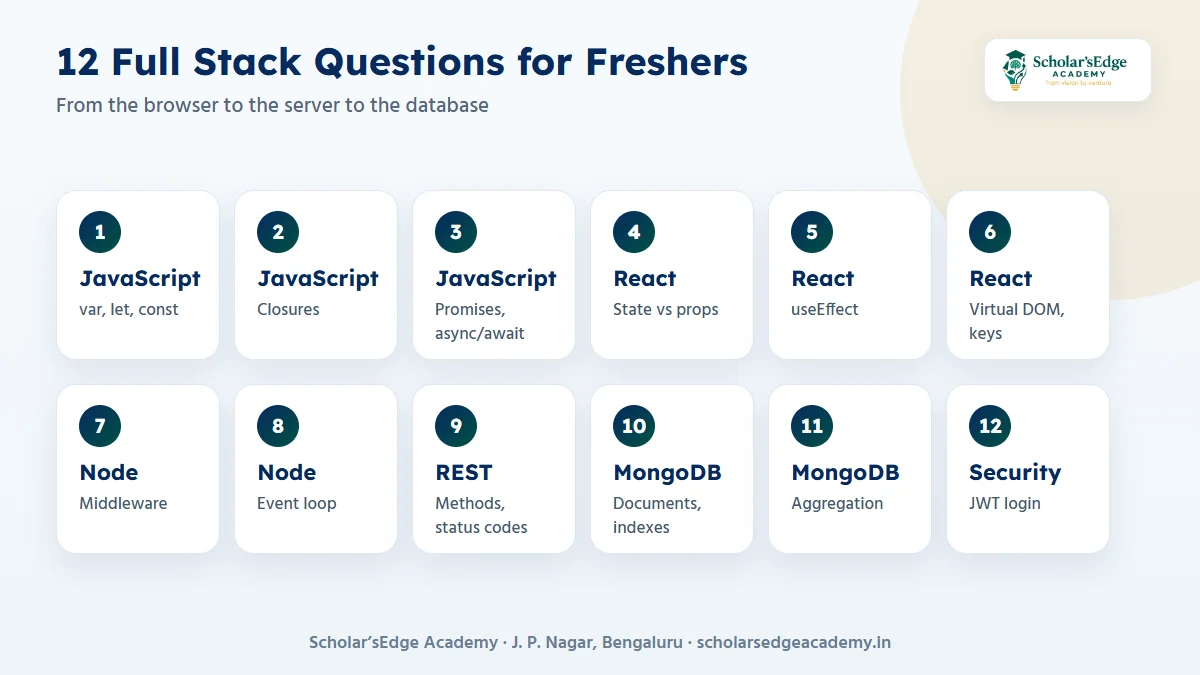
| Layer | Question | What it tests |
|---|---|---|
| JavaScript | var, let and const | Scope and reassignment |
| JavaScript | Closures | Functions that remember their surroundings |
| JavaScript | Promises and async/await | How asynchronous code is written |
| React | State vs props | Data owned by a component and data passed in |
| React | useEffect | Running code after render, and cleanup |
| React | The virtual DOM and keys | How React updates the page efficiently |
| Node and Express | What is middleware? | Functions that run between request and response |
| Node and Express | Event loop | How Node handles many requests on one thread |
| REST | Status codes and methods | Designing a clear API |
| MongoDB | Documents, collections, indexes | How data is stored and found quickly |
| MongoDB | Aggregation pipeline | Grouping and reshaping data |
| Security | JWT authentication | How a server knows who is calling |
- var, let and const
varis function-scoped and can be redeclared.letandconstare block-scoped, andconstcannot be reassigned. Preferconstand useletonly when a value changes. - ClosuresA closure is a function that keeps access to variables from the place it was created, even after that place has finished. It is how counters and private values work.
- Promises and async/awaitA promise represents a value that will arrive later.
asyncandawaitlet you write promise code in a straight line, withtryandcatchfor errors. - State vs propsState belongs to a component and changes over time. Props are read-only values passed from a parent. Changing state re-renders the component.
- useEffectIt runs code after the component renders, for example to fetch data. The dependency array controls when it runs again, and the returned function cleans up. See the React documentation.
- Virtual DOM and keysReact compares a lightweight copy of the page with the new one and updates only what changed. Stable keys on list items let it match old and new items correctly.
- MiddlewareIn Express, middleware is a function with the request, response and
next. It can log, check authentication or parse JSON before the route handler runs. - The event loopNode runs JavaScript on one thread and hands slow work such as files and network calls to the system, then runs callbacks when they finish. Blocking the loop with heavy computation slows every request.
- REST designUse nouns for resources, HTTP methods for actions, and clear status codes: 200 OK, 201 Created, 400 bad request, 401 unauthorised, 404 not found and 500 server error.
- MongoDB basicsMongoDB stores JSON-like documents in collections. An index speeds up queries on a field, at the cost of extra storage and slower writes. See the MongoDB documentation.
- Aggregation pipelineA pipeline passes documents through stages such as
$match,$groupand$sort, so you can total or reshape data inside the database. - JWT authenticationAfter login the server signs a token with a secret and returns it. The client sends it with later requests, and the server verifies the signature. Never store secrets in the token, and set an expiry.
Build this one project and you can answer most questions
- A React front end with a login form and a list page.
- An Express API with routes for users and items, and a middleware that checks a token.
- A MongoDB collection with one index and one aggregation query.
- Deployed to a public address, with the code on GitHub and a short README.
Say what the code should do, walk through it line by line, and name one thing you would improve. That structure works for almost every full stack question.
Mistakes freshers make
- Copying code you cannot explain. Be ready to change it live.
- Forgetting error handling. Show what happens when the request fails.
- Putting secrets in the front end. Anything in the browser can be read.
- Ignoring the database. Mention indexes and how you would shape the data.
How our course prepares you
The Full Stack Development with GenAI (MERN) course at our J. P. Nagar centre runs for 5 months: 3 hours a day, Monday to Friday, plus a Saturday lab, with a weekend batch also available. You learn HTML, CSS, Tailwind, JavaScript, TypeScript, React, Next.js, Node.js, Express, MongoDB, PostgreSQL and Docker, and build 4 real-world projects including a team capstone for a real client. A 2-month internship is included for every enrolled student.
Start with the full stack developer roadmap and the MERN stack beginner’s guide.
Ready to try a class before you decide?Book a free demo class to see the syllabus, ask about fees and batches, and meet the team. Every course includes a 2-month internship, and classes run online and offline.Book on WhatsAppCall +91 99020 58603
Frequently asked questions
What do full stack interviews for freshers usually test?
JavaScript fundamentals, React basics, how Node and Express handle requests, REST design, a database such as MongoDB, and one small project you can explain.
Do I need TypeScript for a fresher full stack role?
It is not always required, but many teams use it, so knowing the basics is an advantage.
MongoDB or PostgreSQL for a beginner project?
Either works. MongoDB is common in MERN projects, and PostgreSQL is a strong choice when your data has clear relations. Knowing both helps.
How many projects should I show?
Two or three finished and deployed projects are better than many half-built ones.
Can a fresher with no experience get a full stack job?
Yes, with clear fundamentals and deployed projects. Internship experience also helps, and our course includes a 2-month internship.
Not sure yet? Talk to us
Book a free demo class or ask for 1:1 guidance on WhatsApp at +91 99020 58603, or use the form on our contact page. You can also compare all our courses. Scholar’sEdge Academy is at Building No. 19, 25/1, 9th Cross Road, 2nd Phase, J. P. Nagar, Bengaluru, Karnataka 560078. Read how we write and check our articles in our editorial policy.
