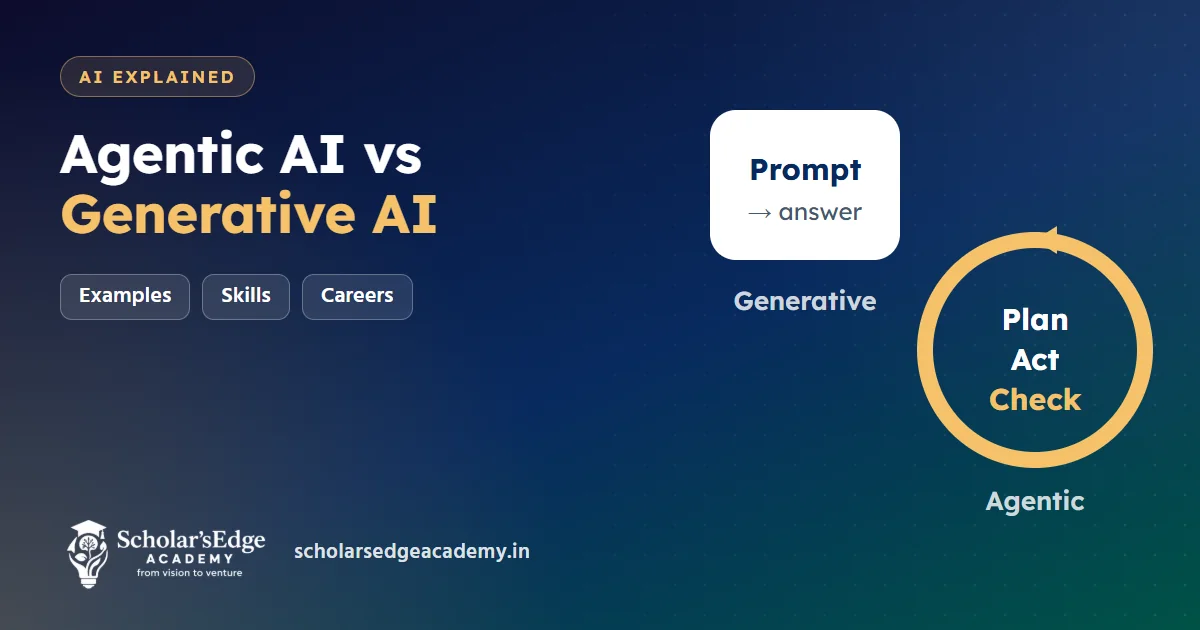
Quick answer: Generative AI creates content, such as text, images or code, when you ask for it. Agentic AI uses that same ability to pursue a goal: it plans steps, calls tools such as search, email or a database, checks the result and continues with limited supervision. In short, generative AI answers, and agentic AI acts.
Not sure where to start? Try a free demo class, online or at our J. P. Nagar centre. Book on WhatsApp
Key takeaways
- Generative AI produces one output per request. Agentic AI runs a loop of plan, act and check until a goal is met.
- Most AI agents are built on top of a large language model (LLM), so agentic AI is an extension of generative AI, not a replacement.
- Agents need tools, memory, limits and human approval for risky steps. Without them, they fail in expensive ways.
- For a career, learn generative AI first (prompts, APIs, RAG), then agents (tool calling, LangGraph, MCP).
“Agentic AI” and “generative AI” are now two of the most searched AI terms in India, and they are often used as if they meant the same thing. They do not. This guide explains the difference in plain words, with everyday examples, a side-by-side table and what each one means if you want to build a career in AI.
What is generative AI?
Generative AI is AI that creates new content from a prompt. You type a request and a model such as an LLM writes an email, summarises a report, draws an image or suggests code. It responds once, and then it waits for your next instruction.
Generative AI is very good at language and patterns, but on its own it does not take action in the world. It cannot open your calendar, check a database or send a message unless a developer connects it to those systems.
What is agentic AI?
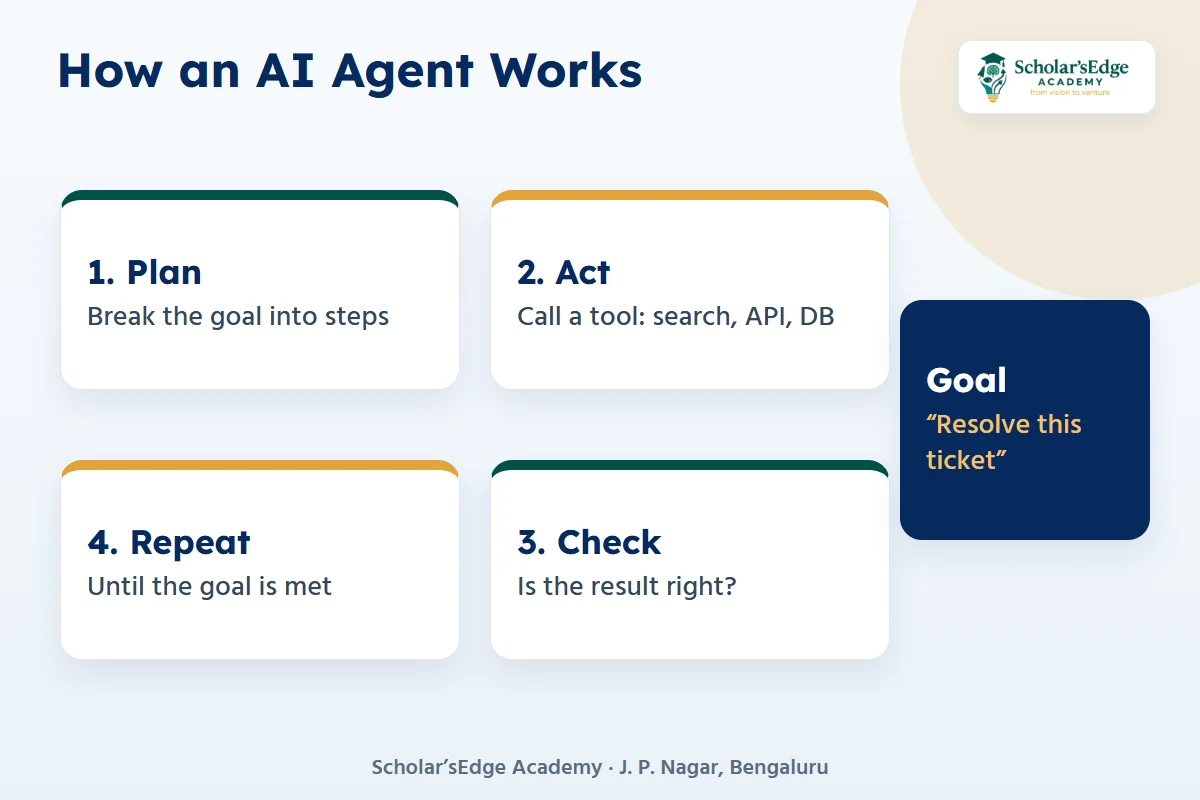
Agentic AI is AI that works toward a goal with limited supervision. IBM defines it as “an artificial intelligence system that can accomplish a specific goal with limited supervision” (IBM). An agent breaks the goal into steps, chooses a tool for each step, looks at the result and decides what to do next.
Under the hood, most agents use a generative model as their “brain”. The difference is the loop around it: tools, memory, rules and a way to check progress.
What is the difference between agentic AI and generative AI?
The main difference is action. Generative AI produces content for a person to use, while agentic AI uses content and tools to finish a task. The table compares them point by point.
| Point | Generative AI | Agentic AI |
|---|---|---|
| Main job | Create text, images or code | Complete a goal |
| How it works | One prompt, one response | Plan, act, check, repeat |
| Uses tools? | Not by itself | Yes: search, APIs, databases, email |
| Memory | Usually only the current chat | Keeps track of steps and results |
| Human role | Reads and uses the output | Sets the goal, approves risky steps |
| Example | Draft a reply to a customer | Read the ticket, check the order, issue a refund within rules, reply |
| Main risk | Wrong or made-up content | Wrong actions taken on real systems |
What are examples of agentic AI and generative AI?
The same tool can be used either way. What changes is whether the AI only writes, or also acts.
Paste a 20-page report and get a one-page summary.
Search several sources, compare them, write the summary and save it to a shared folder.
Ask for a query that finds last month’s top customers.
Write the query, run it on the database, check the result and explain it in plain words.
Are AI agents and agentic AI the same thing?
They are closely related. An AI agent is one program that can act toward a goal. Agentic AI is the wider idea, and it often means several agents working together, for example one that researches, one that writes and one that checks. Read AI agents explained for how tool calling, LangGraph and MCP fit together.
Is agentic AI better than generative AI?
No. It is better only for multi-step tasks that need tools. For a quick answer or a draft, plain generative AI is faster, cheaper and easier to control. Agents also fail more often in real projects: Gartner predicted in June 2025 that over 40% of agentic AI projects will be canceled by the end of 2027, citing cost, unclear value or weak risk controls (Gartner).
If one good answer solves the problem, use generative AI. If the job needs several steps on real systems, consider an agent, and keep a person in charge of anything that costs money or cannot be undone.
What skills do you need to build agentic AI?
You need generative AI skills first, then agent skills. The ladder below is the order most people learn them in.
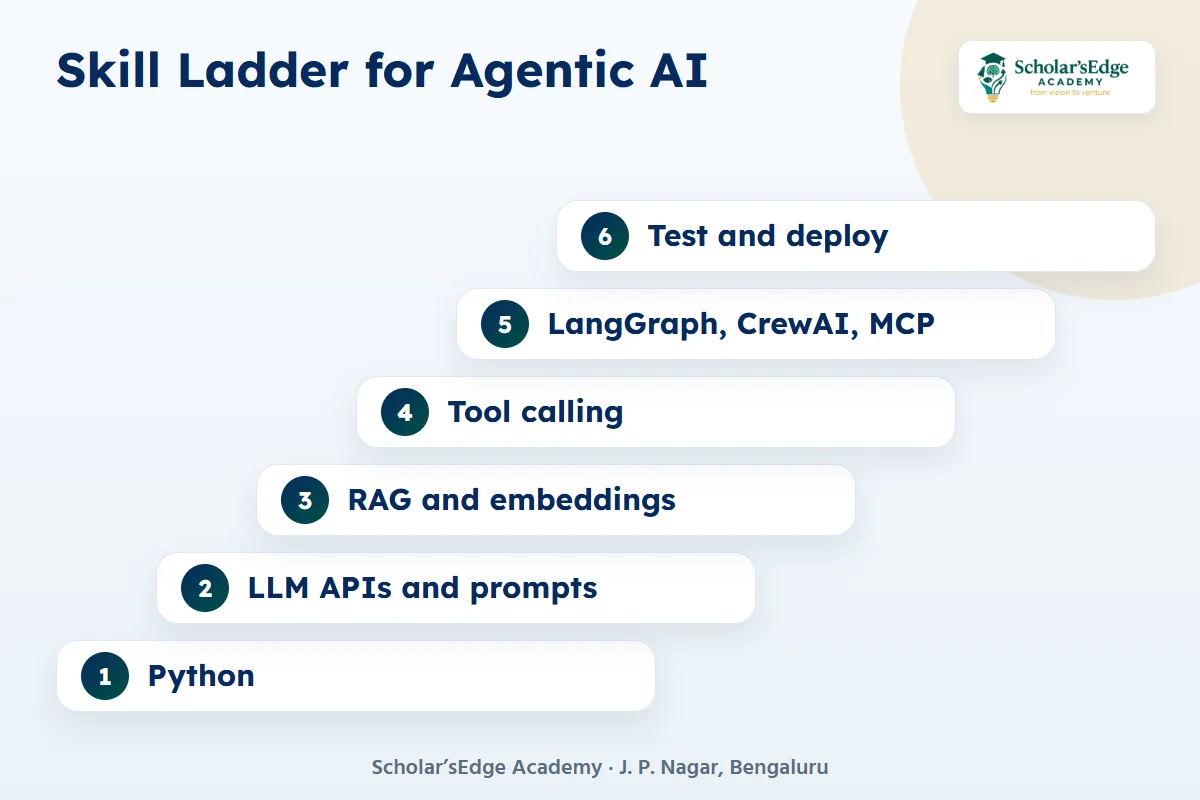
- PythonVariables, functions, APIs and working with JSON.
- LLM APIs and promptsCall a model from code and write clear, testable prompts.
- RAGEmbeddings and vector databases so the model answers from your documents. See what is RAG.
- Tool callingLet the model call functions you write, with limits and error handling.
- Agent frameworksLangGraph, CrewAI and MCP to manage steps, memory and several agents.
- Testing and deploymentMeasure answers, log every action and deploy with Docker and the cloud.
AI is already part of developer work: in the 2025 Stack Overflow survey, 84% of respondents said they use or plan to use AI tools in their development process. Our AI application developer roadmap shows the full path.
Where can you learn agentic AI in Bangalore?
Our AI Application Developer course in J. P. Nagar covers both: Python, FastAPI, LLM APIs, prompt engineering, embeddings, vector databases and RAG, then AI agents with tool calling, LangGraph, CrewAI, MCP and multi-agent systems, deployed with Docker and AWS. You build a company document chatbot, a customer-support agent and a natural-language-to-SQL assistant, then a deployed capstone. It runs 5 months with a 2-month internship, and the offer fee is ₹41,999. New to AI? Start with the AI Foundations Weekend Bootcamp.
Ready to try a class before you decide?Book a free demo class to see the syllabus, ask about fees and batches, and meet the team. Every course includes a 2-month internship, and classes run online and offline.Book on WhatsAppCall +91 99020 58603
Frequently asked questions
What is the difference between agentic AI and generative AI in simple words?
Generative AI creates content when you ask. Agentic AI uses that ability to complete a goal by planning steps and using tools, with limited supervision.
Is ChatGPT generative AI or agentic AI?
A plain chat is generative AI. When an assistant is allowed to browse, run code or use other tools to finish a task, it is working in an agentic way.
Does agentic AI replace generative AI?
No. Most agents use a generative model inside them. Agentic AI adds planning, tools and memory around it.
Is agentic AI safe to use at work?
It can be, with limits: give agents only the access they need, log every action and require human approval for payments, deletions and messages to customers.
Should a fresher learn generative AI or agentic AI first?
Generative AI first. Agents are built on prompts, LLM APIs and RAG, so those skills come before agent frameworks.
Do I need coding to build AI agents?
For real agents, yes, mainly Python. No-code tools exist for simple automations, but jobs that build agents expect programming skills.
Sources we checked
We checked these on 15 November 2026. Figures from outside sources can change; check the source before you rely on them.
- IBM: what is agentic AI.
- Gartner, 25 June 2025: over 40% of agentic AI projects will be canceled by end of 2027.
- Stack Overflow 2025 Developer Survey: AI.
- Course details: AI Application Developer course.
Not sure yet? Talk to us
Book a free demo class or ask for 1:1 guidance on WhatsApp at +91 99020 58603, or use the form on our contact page. You can also compare all our courses and our combo courses. Scholar’sEdge Academy is at Building No. 19, 25/1, 9th Cross Road, 2nd Phase, J. P. Nagar, Bengaluru, Karnataka 560078. Read how we write and check our articles in our editorial policy.
