Full Stack Development

Full Stack Developer Interview Questions & Answers: Complete Preparation Guide

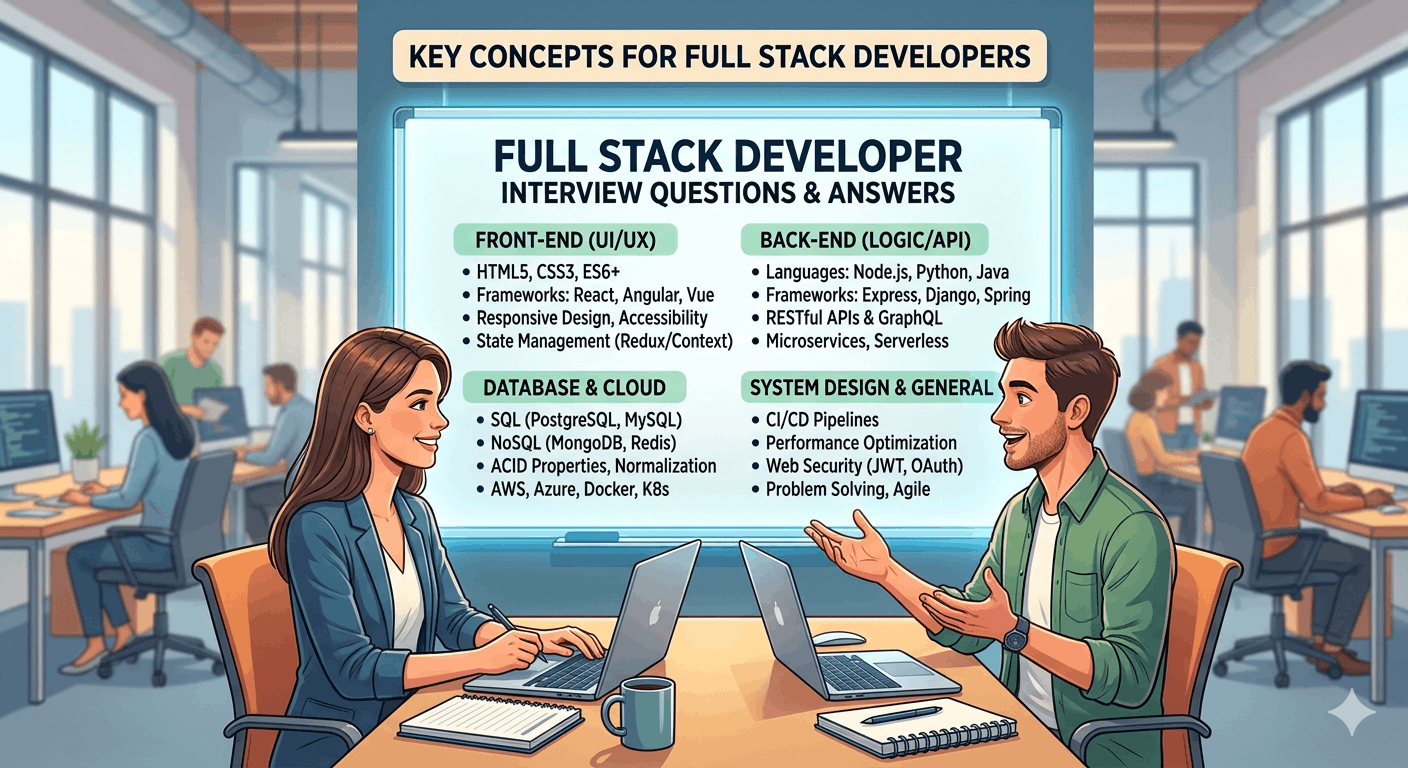
Full stack developer interview questions and answers cover JavaScript fundamentals, React component architecture, Node.js backend concepts, database design, API development, system design scenarios, and coding challenges that companies actually ask. At Scholar’s Edge Academy, our interview preparation program equips career switchers with proven answers, real-world project examples, and hands-on practice for technical rounds that land high-paying full stack positions. This comprehensive guide delivers the exact questions hiring managers ask, detailed answer frameworks, and preparation strategies that transform nervous candidates into confident developers ready to ace any interview. JavaScript and Frontend Interview Questions Core JavaScript Concepts Question 1: Explain the difference between var, let, and const Direct Answer: var has function scope and gets hoisted, let has block scope without hoisting to the top, and const also has block scope but creates immutable bindings that cannot be reassigned. Detailed Explanation: javascript // var – function scoped function varExample() {     if (true) {         var x = 10;     }     console.log(x); // 10 – accessible outside block }   // let – block scoped function letExample() {     if (true) {         let y = 10;     }     console.log(y); // ReferenceError }   // const – block scoped, immutable binding const user = { name: ‘John’ }; user.name = ‘Jane’; // Allowed – object mutation user = {}; // Error – cannot reassign Scholar’s Edge Academy teaches these fundamentals through practical coding exercises where you debug scoping issues in real applications. Question 2: What is closure and provide a practical use case? Direct Answer: A closure is a function that remembers variables from its outer scope even after that scope has finished executing. Closures enable data privacy, factory functions, and callback patterns. Practical Example: javascript function createCounter() {     let count = 0; // Private variable          return {         increment: function() {             count++;             return count;         },         decrement: function() {             count–;             return count;         },         getCount: function() {             return count;         }     }; }   const counter = createCounter(); console.log(counter.increment()); // 1 console.log(counter.increment()); // 2 console.log(counter.getCount()); // 2 This pattern appears frequently in Scholar’s Edge Academy projects for managing application state and creating module patterns. Question 3: Explain event delegation and its benefits Direct Answer: Event delegation attaches a single event listener to a parent element instead of multiple listeners on child elements, improving performance and handling dynamically added elements automatically. Implementation: javascript // Without delegation – multiple listeners document.querySelectorAll(‘.button’).forEach(button => {     button.addEventListener(‘click’, handleClick); });   // With delegation – single listener document.querySelector(‘.container’).addEventListener(‘click’, (e) => {     if (e.target.matches(‘.button’)) {         handleClick(e);     } }); Benefits: Reduces memory consumption Works with dynamically added elements Simplifies event handler management Improves application performance React Interview Questions Question 4: What are React hooks and why were they introduced? Direct Answer: React hooks are functions that let you use state and lifecycle features in functional components without writing classes. They solve problems with class component complexity, code reuse difficulties, and confusing this keyword behavior. Common Hooks Table: Hook Purpose Use Case useState Manage component state Form inputs, toggles, counters useEffect Side effects and lifecycle API calls, subscriptions, DOM updates useContext Access context values Theme, authentication, global state useReducer Complex state logic Form validation, shopping carts useMemo Memoize expensive calculations Large data filtering, sorting useCallback Memoize functions Prevent child re-renders Scholar’s Edge Academy curriculum emphasizes hooks from day one because modern React development relies exclusively on functional components. Question 5: Explain the Virtual DOM and reconciliation process Direct Answer: The Virtual DOM is a lightweight JavaScript representation of the actual DOM. React compares the new Virtual DOM with the previous version, calculates minimal changes needed, and updates only those specific parts in the real DOM for optimal performance. Reconciliation Process: Component state or props change React creates new Virtual DOM tree Diffing algorithm compares old and new trees React identifies minimum changes required Batch updates applied to real DOM Performance Implications: Reduces expensive DOM operations Enables efficient batch updates Allows declarative programming model Improves application responsiveness Question 6: How do you optimize React application performance? Direct Answer: Optimize React apps through code splitting, memoization, lazy loading, proper key usage, debouncing expensive operations, and using production builds. Optimization Techniques: javascript // Code splitting with lazy loading const Dashboard = React.lazy(() => import(‘./Dashboard’));   // Memoization to prevent re-renders const MemoizedComponent = React.memo(({ data }) => {     return <div>{data.map(item => <Item key={item.id} {…item} />)}</div>; });   // useMemo for expensive calculations const sortedData = useMemo(() => {     return data.sort((a, b) => a.value – b.value); }, [data]);   // useCallback for stable function references const handleClick = useCallback(() => {     console.log(selectedId); }, [selectedId]); Scholar’s Edge Academy projects require passing Lighthouse performance audits, ensuring you build optimized applications.   Backend and Node.js Interview Questions Question 7: Explain the Event Loop in Node.js Direct Answer: The Event Loop is Node.js’s mechanism for handling asynchronous operations. It continuously checks the call stack and callback queue, executing callbacks when the stack is empty, enabling non-blocking I/O operations. Event Loop Phases: Timers: Executes setTimeout and setInterval callbacks Pending Callbacks: Executes I/O callbacks deferred from previous cycle Idle/Prepare: Internal operations only Poll: Retrieves new I/O events, executes callbacks Check: Executes setImmediate callbacks Close Callbacks: Handles socket closures Practical Example: javascript console.log(‘Start’);   setTimeout(() => {     console.log(‘Timeout’); }, 0);   Promise.resolve().then(() => {     console.log(‘Promise’); });   console.log(‘End’);   // Output: Start, End, Promise, Timeout // Promises (microtasks) execute before timers (macrotasks) Question 8: What is middleware in Express.js? Direct Answer: Middleware functions have access to request and response objects and the next middleware function in the application’s request-response cycle. They execute code, modify request/response objects, end the cycle, or call the next middleware. Middleware Types: javascript // Application-level middleware app.use((req, res, next) => {     console.log(‘Time:’, Date.now());     next(); });   // Router-level middleware router.use(‘/user/:id’, (req, res, next) => {     console.log(‘Request URL:’, req.originalUrl);     next(); });   // Error-handling middleware app.use((err, req, res, next) => {     console.error(err.stack);     res.status(500).send(‘Something broke!’); });   // Built-in middleware app.use(express.json()); app.use(express.static(‘public’)); Scholar’s Edge Academy teaches building custom middleware for authentication, logging, validation, and error handling. Question 9: How do you handle authentication in Node.js applications? Direct
Full Stack Development

Full stack developer salary in India

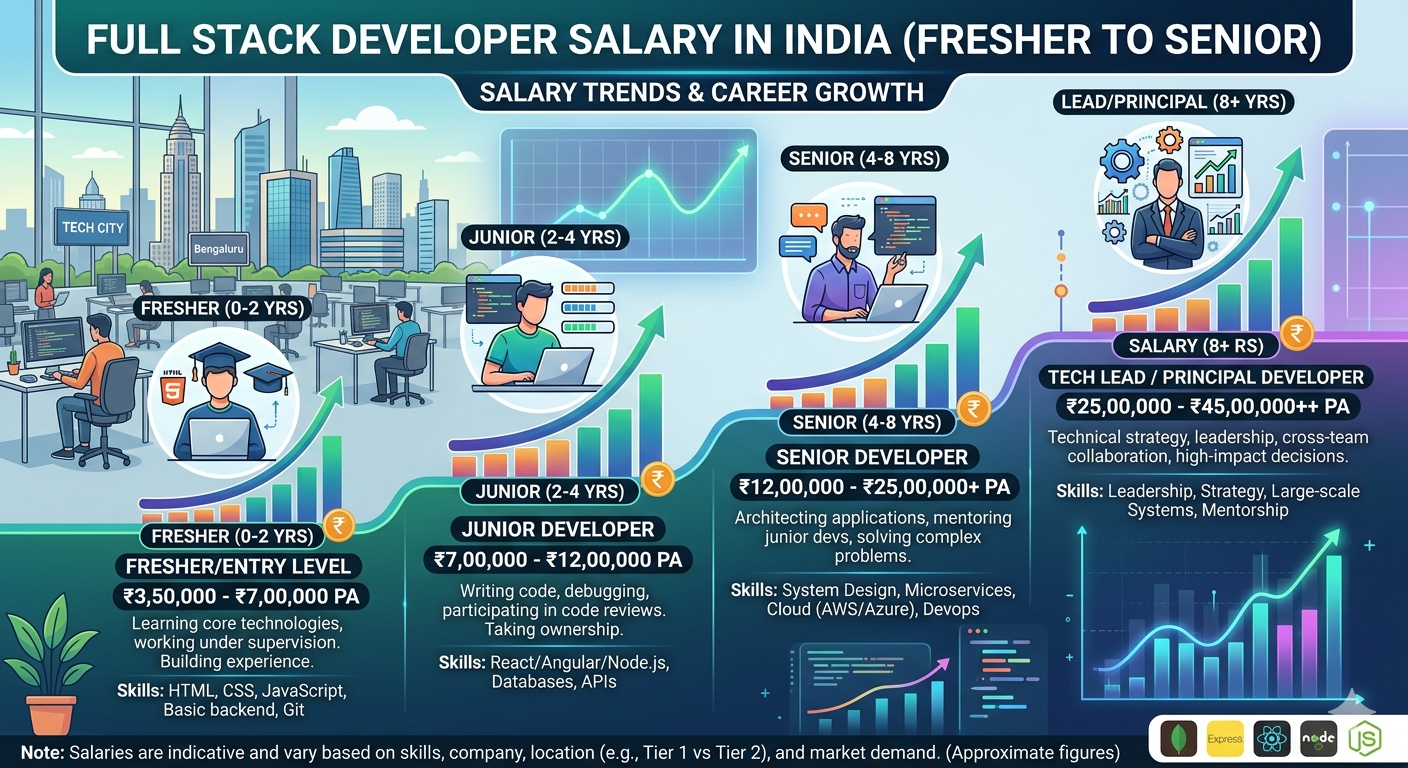
Full stack developer salary in India ranges from ₹3.5 lakhs per annum for freshers to ₹25+ lakhs for senior professionals, with average mid-level salaries around ₹8-12 lakhs annually. At Scholar’s Edge Academy, we prepare career switchers for high-paying full stack roles by teaching in-demand technologies that command premium salaries across Indian tech hubs. This comprehensive guide breaks down exact salary figures by experience level, location, company type, and technology stack, plus proven strategies to maximize your earning potential in India’s booming software development market.   Current Full Stack Developer Salary Breakdown by Experience Fresher Full Stack Developer Salary (0-2 Years) Full stack developer salary in India for entry-level positions averages ₹3.5 to ₹6 lakhs per annum, depending on skills and location. Company Type Salary Range (Annual) Typical Tech Stack Startups ₹3.5 – ₹5 lakhs MERN, MEAN Mid-sized Companies ₹4.5 – ₹6.5 lakhs React, Node.js, PostgreSQL Product Companies ₹6 – ₹9 lakhs Modern frameworks, cloud platforms Service Companies ₹3.5 – ₹5 lakhs Java, Angular, MySQL Fresher salary factors that matter most: Portfolio quality with deployed projects Problem-solving skills demonstrated in interviews Knowledge of modern frameworks (React, Next.js) Understanding of system design basics Git and collaboration tool proficiency Scholar’s Edge Academy students enter the job market with production-ready portfolios that justify higher salary negotiations. Our graduates consistently secure offers 30-40% above average fresher packages because they demonstrate practical experience, not just theoretical knowledge. Location impact on fresher salaries: Bangalore: ₹4.5 – ₹7 lakhs Pune: ₹4 – ₹6 lakhs Hyderabad: ₹4 – ₹6.5 lakhs NCR (Delhi/Gurgaon/Noida): ₹4 – ₹6 lakhs Mumbai: ₹4.5 – ₹7 lakhs Tier 2 cities: ₹3.5 – ₹5 lakhs Mid-Level Full Stack Developer Salary (3-5 Years) Mid-level professionals see significant salary jumps as they gain specialization and project ownership experience. Experience Average Salary Top 10% Earners Key Differentiators 3 years ₹8 – ₹10 lakhs ₹12 – ₹15 lakhs Microservices, CI/CD 4 years ₹10 – ₹13 lakhs ₹15 – ₹18 lakhs System design, mentoring 5 years ₹12 – ₹16 lakhs ₹18 – ₹22 lakhs Architecture, team lead Skills that boost mid-level salaries: Cloud platform expertise (AWS, Azure, GCP) Microservices architecture implementation DevOps practices and containerization (Docker, Kubernetes) Database optimization and scaling strategies Team collaboration and code review experience Scholar’s Edge Academy curriculum includes advanced modules on cloud deployment, microservices patterns, and system design specifically because these skills separate average developers from high earners. Company type salary variations: Product-based companies (Google, Microsoft, Amazon): 3-5 years: ₹15 – ₹25 lakhs Stock options and bonuses add 20-30% to base salary Performance-based increments Unicorn startups (Swiggy, Razorpay, Cred): 3-5 years: ₹12 – ₹20 lakhs ESOPs potentially worth lakhs Rapid growth opportunities Service companies (TCS, Infosys, Wipro): 3-5 years: ₹7 – ₹12 lakhs Stable increments but lower ceiling Variable pay components Senior Full Stack Developer Salary (6-10 Years) Senior developers command premium compensation for architectural decisions and technical leadership. Experience Level Base Salary Total Compensation Responsibilities 6-7 years ₹15 – ₹20 lakhs ₹18 – ₹25 lakhs Architecture, mentoring 8-9 years ₹18 – ₹25 lakhs ₹22 – ₹32 lakhs Technical strategy, hiring 10+ years ₹22 – ₹35 lakhs ₹28 – ₹45 lakhs Engineering leadership Senior role expectations: System architecture and technology decisions Team mentoring and technical hiring Performance optimization at scale Cross-functional collaboration with product and design Technology roadmap planning Scholar’s Edge Academy provides career growth guidance beyond initial placement, helping developers plan skill development paths that lead to senior positions within 5-7 years.   Salary Breakdown by Technology Stack MERN Stack Developer Salary MERN stack (MongoDB, Express, React, Node.js) remains highly demanded across Indian startups and product companies. Salary ranges by experience: Fresher: ₹4 – ₹6.5 lakhs 2-4 years: ₹8 – ₹14 lakhs 5+ years: ₹15 – ₹24 lakhs Why MERN commands good salaries: JavaScript across entire stack reduces context switching High startup adoption for rapid development Strong community and abundant resources Cloud-native architecture compatibility Scholar’s Edge Academy specializes in MERN stack training because it offers the best ROI for career switchers. You learn one language (JavaScript) deeply while building full stack capabilities. MEAN Stack Developer Salary MEAN stack (MongoDB, Express, Angular, Node.js) popular in enterprise environments: Fresher: ₹3.5 – ₹6 lakhs 2-4 years: ₹7 – ₹12 lakhs 5+ years: ₹13 – ₹20 lakhs Angular expertise particularly valued in: Banking and financial services Large enterprise applications Government projects Legacy system modernization Java Full Stack Developer Salary Java backend with modern frontend frameworks: Fresher: ₹4 – ₹7 lakhs 2-4 years: ₹9 – ₹15 lakhs 5+ years: ₹16 – ₹26 lakhs Java full stack remains lucrative because: Enterprise company preference for Java Spring Boot ecosystem maturity Microservices architecture adoption Long-term project stability Python Full Stack Developer Salary Python with Django/Flask gaining traction: Fresher: ₹4 – ₹7 lakhs 2-4 years: ₹8 – ₹14 lakhs 5+ years: ₹15 – ₹25 lakhs Python full stack developers find opportunities in: AI/ML integrated applications Data-heavy web platforms Scientific computing applications Automation and scripting-intensive projects   City-Wise Full Stack Developer Salary Comparison Top Tech Hub Salaries City Fresher Mid-Level (3-5 yrs) Senior (6-10 yrs) Cost of Living Index Bangalore ₹5 – ₹8 lakhs ₹12 – ₹18 lakhs ₹20 – ₹32 lakhs 100 Pune ₹4.5 – ₹7 lakhs ₹10 – ₹16 lakhs ₹18 – ₹28 lakhs 85 Hyderabad ₹4.5 – ₹7 lakhs ₹11 – ₹17 lakhs ₹18 – ₹30 lakhs 80 NCR ₹4.5 – ₹7.5 lakhs ₹11 – ₹17 lakhs ₹19 – ₹30 lakhs 95 Mumbai ₹5 – ₹8 lakhs ₹12 – ₹18 lakhs ₹20 – ₹32 lakhs 110 Chennai ₹4 – ₹6.5 lakhs ₹9 – ₹15 lakhs ₹16 – ₹26 lakhs 75 Bangalore offers highest absolute salaries but cost of living considerations matter. Scholar’s Edge Academy students across India secure remote positions from Bangalore companies, earning metro salaries while living in tier 2 cities. Emerging Tech Cities Tier 2 cities showing growth: Ahmedabad: ₹3.5 – ₹6 lakhs (fresher) Jaipur: ₹3.5 – ₹5.5 lakhs (fresher) Chandigarh: ₹4 – ₹6 lakhs (fresher) Kochi: ₹3.5 – ₹6 lakhs (fresher) Indore: ₹3.5 – ₹5.5 lakhs (fresher) Remote work trends enable developers in these cities to access higher-paying

Full Stack Development

MERN Stack Explained: MongoDB, Express, React & Node.js Guide

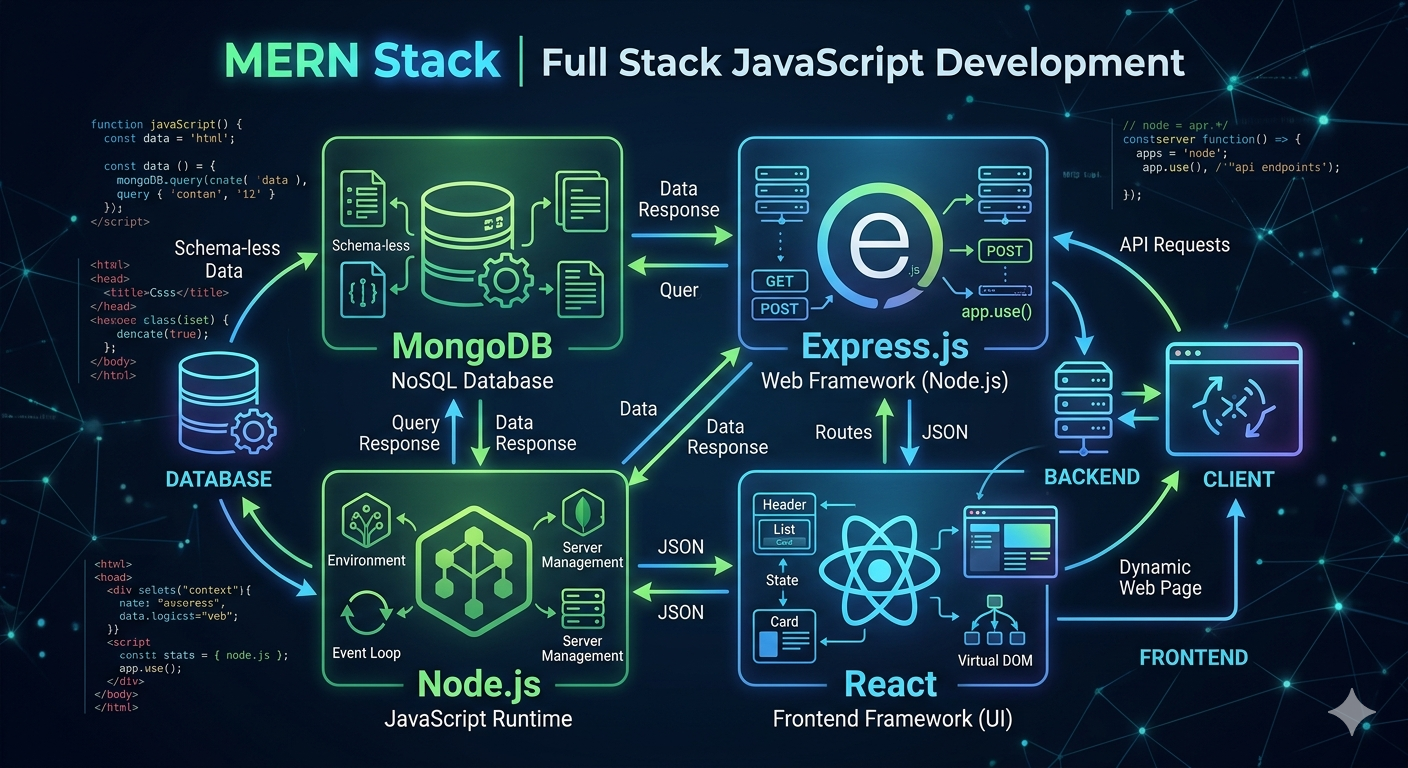
MERN stack explained: MongoDB, Express, React, Node.js represents the most popular JavaScript-based full stack development framework for building modern web applications. At Scholar’s Edge Academy, our MERN stack training program teaches working professionals how MongoDB handles database operations, Express manages server-side routing, React powers dynamic user interfaces, and Node.js executes JavaScript on the backend. This comprehensive guide breaks down each technology, demonstrates how they work together, reveals practical implementation strategies, and shows you how mastering MERN stack development accelerates your transition into high-paying full stack developer roles.   Understanding the MERN Stack Architecture MERN stack explained: MongoDB, Express, React, Node.js forms a complete JavaScript ecosystem for web development. Here’s why this matters for your career: Companies choose MERN because it uses JavaScript across the entire application stack. This means: Faster development with one language throughout Easier team collaboration and code sharing Reduced context switching between technologies Simplified deployment and maintenance Scholar’s Edge Academy structures MERN training specifically for career switchers who need production-ready skills, not just theoretical knowledge.   MongoDB: Your NoSQL Database Solution What MongoDB Brings to MERN Stack MongoDB serves as the database layer in MERN applications, storing data in flexible JSON-like documents instead of rigid table structures. Feature MongoDB Traditional SQL Data Structure Flexible documents Fixed schemas Scaling Horizontal (easy) Vertical (complex) Query Language JavaScript-based SQL syntax Schema Changes Instant Migration required Key MongoDB Capabilities: Document-based storage matching JavaScript objects Dynamic schema adapting to changing requirements Aggregation pipeline for complex data operations Built-in replication for high availability Sharding for horizontal scaling Practical MongoDB Implementation Scholar’s Edge Academy teaches MongoDB through real applications: Data Modeling Strategies: Embedding vs referencing documents One-to-many relationship patterns Many-to-many with junction collections Denormalization for read performance Query Optimization Techniques: Index creation for faster queries Explain plans for performance analysis Projection to limit returned fields Compound indexes for multi-field searches Real-World Example: javascript // User profile with embedded addresses {   _id: ObjectId(“…”),   name: “John Developer”,   email: “john@example.com”,   addresses: [     { type: “home”, street: “123 Main St”, city: “Tech City” },     { type: “work”, street: “456 Office Blvd”, city: “Startup Hub” }   ],   createdAt: ISODate(“2026-01-15”) } You’ll build applications managing user data, product catalogs, blog posts, and complex relationships using MongoDB’s flexible document model.   Express.js: Backend Framework Simplified Express Powers Your Server Layer Express.js handles HTTP requests and server-side logic in MERN applications. This lightweight framework provides: Core Express Features: Routing for different URL endpoints Middleware for request processing Template engine integration Error handling mechanisms Static file serving Building Production APIs with Express Scholar’s Edge Academy focuses on professional API development: RESTful API Design Patterns: HTTP Method Purpose Example Endpoint GET Retrieve data /api/products POST Create new resource /api/products PUT Update entire resource /api/products/:id PATCH Partial update /api/products/:id DELETE Remove resource /api/products/:id Essential Middleware Stack: Body parsing for JSON requests CORS configuration for cross-origin requests Authentication with JWT tokens Request logging for debugging Error handling for graceful failures Authentication Implementation: javascript // Protected route example router.get(‘/api/profile’, authenticateToken, async (req, res) => {   const user = await User.findById(req.user.id);   res.json(user); }); Validation and Security: Input sanitization preventing injection attacks Rate limiting to prevent abuse Helmet.js for security headers Environment variables for sensitive data You’ll create secure REST APIs, implement authentication flows, handle file uploads, and build webhook integrations using Express.   React: Dynamic Frontend Development React Creates Interactive User Interfaces React dominates frontend development in MERN applications because it offers component-based architecture and efficient rendering. React Fundamentals in MERN Context: Component Architecture: Functional components with hooks Props for data passing State management with useState Side effects with useEffect Custom hooks for reusable logic State Management Approaches: Solution Use Case Complexity Learning Curve useState Component-level state Low Easy Context API Shared state (medium apps) Medium Moderate Redux Large-scale applications High Steep Zustand Modern alternative to Redux Medium Easy Connecting React to Express Backend Scholar’s Edge Academy emphasizes practical API integration: Data Fetching Patterns: Axios for HTTP requests Async/await for clean code Loading states for better UX Error handling and retry logic Optimistic updates for responsiveness Real Implementation: javascript // Fetching products from Express API const [products, setProducts] = useState([]); const [loading, setLoading] = useState(true);   useEffect(() => {   axios.get(‘/api/products’)     .then(response => setProducts(response.data))     .catch(error => console.error(error))     .finally(() => setLoading(false)); }, []); Form Handling and Validation: Controlled components Client-side validation Server-side validation feedback File upload with preview Multi-step form flows You’ll build dashboards, authentication interfaces, shopping carts, and real-time chat applications using React connected to Express backends.   Node.js: JavaScript Runtime Environment Node.js Enables Server-Side JavaScript Node.js runs JavaScript outside browsers, powering both Express and build tools in MERN development. Why Node.js Works for MERN: Event-driven architecture for scalability Non-blocking I/O for concurrent requests NPM ecosystem with 2+ million packages Single language across frontend and backend Active community and corporate support Node.js Core Concepts Scholar’s Edge Academy covers essential Node.js skills: Asynchronous Programming: Callbacks and callback hell Promises for cleaner async code Async/await syntax Event loop understanding Stream processing for large data Module System: CommonJS vs ES modules Creating reusable modules NPM package management Dependency versioning Security auditing Performance Optimization: Clustering for multi-core systems Caching strategies with Redis Database connection pooling Memory leak detection Load balancing techniques How MERN Technologies Work Together Complete Application Flow MERN stack explained: MongoDB, Express, React, Node.js creates seamless full stack applications through this workflow: Request Flow Example: User Action: Clicks “Add to Cart” button in React React Processing: Component sends POST request to Express API Express Routing: Route handler receives request Validation: Express middleware validates product data Database Operation: MongoDB stores cart item Response: Express sends confirmation back to React UI Update: React updates cart display without page reload Authentication Flow: User submits login form (React) Express validates credentials against MongoDB Server generates JWT token React stores token in localStorage Subsequent requests include token in headers Express middleware verifies token Protected routes return user-specific data Scholar’s Edge Academy projects implement complete authentication systems, payment processing, file uploads, and real-time features so you understand how MERN technologies integrate. Development Tools and Workflow Essential

Full Stack Development

Backend Technologies Used in Full Stack Development 2026

The full stack development process requires backend technologies which include Node.js and Python frameworks Django and Flask and Java framework Spring Boot and PostgreSQL and MongoDB databases and RESTful APIs and authentication systems and cloud deployment platforms. The full stack program at Scholar’s Edge Academy centers on teaching professionals essential server-side skills through hands-on projects that replicate actual production environments. This guide provides essential backend stack components together with their implementation methods and database design patterns and technology mastery paths that lead to high-paying development jobs in 2026.   Why Successful Full Stack Development Depends on Backend Technologies All applications which you use every day depend on the backend technologies that power full stack development. Frontend skills enable you to display your work while backend skills demonstrate your capacity to develop systems that can scale and maintain security and process actual business operations.   Companies hiring full stack developers need engineers who can: Design and implement robust APIs Structure databases for performance and scalability Implement secure authentication and authorization Deploy applications to production environments Scholar’s Edge Academy builds curriculum around these industry requirements, ensuring you gain backend skills that employers actively seek in 2026.   Core Backend Programming Languages Node.js: JavaScript for Server-Side Development Node.js dominates backend development because it enables full stack JavaScript development: Advantage Impact Real-World Use Single language stack Faster development cycles Netflix, LinkedIn, Uber Non-blocking I/O High concurrency handling PayPal, NASA NPM ecosystem 1.3M+ packages available Walmart, eBay Microservices architecture Scalable application design Medium, Trello Express.js Framework Benefits: Minimal, unopinionated structure Robust routing capabilities Middleware ecosystem for cross-cutting concerns Easy integration with databases and authentication Scholar’s Edge Academy teaches Node.js through building production APIs, implementing real-time features with Socket.io, and deploying scalable microservices that handle thousands of concurrent users. Python: Versatile Backend Powerhouse Python backend frameworks offer rapid development and clean syntax: Django Framework – Batteries-included approach: Built-in admin interface saves development time ORM for database abstraction Security features (CSRF, SQL injection protection) Template engine for server-side rendering Flask Framework – Lightweight and flexible: Microframework design philosophy Easy learning curve for beginners Extension ecosystem for added functionality Perfect for APIs and microservices FastAPI – Modern async framework: Automatic API documentation (Swagger/OpenAPI) Type hints for better code quality Async/await for high performance Built-in data validation with Pydantic Scholar’s Edge Academy curriculum covers Django for enterprise applications and FastAPI for modern API development, giving you versatility across project types. Java: Enterprise-Grade Backend Solutions Java Spring Boot remains the enterprise standard: Dependency injection for testable code Spring Security for authentication/authorization JPA/Hibernate for database operations Massive ecosystem of production-tested libraries When Java Makes Sense: Large enterprise applications Banking and financial systems High-security requirements Long-term maintainable codebases You’ll learn Spring Boot fundamentals at Scholar’s Edge Academy, understanding when Java’s type safety and maturity outweigh its verbose syntax.   Database Technologies and Data Management Relational Databases (SQL) PostgreSQL leads modern SQL databases: Core PostgreSQL Features: ACID compliance for data integrity Advanced indexing strategies (B-tree, GiST, GIN) JSON/JSONB support for flexible schemas Full-text search capabilities MySQL Alternative: Simpler administration Faster read operations Wide hosting support Strong community resources Database Design Skills You’ll Master: Normalization and denormalization strategies Index optimization for query performance Transaction management and locking Migration strategies and version control Scholar’s Edge Academy teaches database design through e-commerce projects, social platforms, and analytics systems that require complex relationships and data integrity. NoSQL Databases MongoDB for Document-Based Storage: Use Case Why MongoDB Alternative Rapid prototyping Flexible schema DynamoDB Real-time analytics Fast writes Cassandra Content management Nested documents Couchbase IoT data storage Horizontal scaling InfluxDB MongoDB Advantages: Schema flexibility during development Native JSON document storage Powerful aggregation framework Horizontal scaling through sharding Redis for Caching and Sessions: In-memory data structure store Sub-millisecond response times Session storage for authentication Pub/sub messaging patterns You’ll implement caching strategies, session management, and data modeling patterns that optimize application performance at Scholar’s Edge Academy.   API Development and Architecture RESTful API Design Principles Backend technologies used in full stack development center on API design: REST Fundamentals: Resource-based URL structure HTTP methods (GET, POST, PUT, DELETE, PATCH) Stateless communication patterns JSON response formatting Best Practices You’ll Implement: Consistent naming conventions Proper HTTP status codes (200, 201, 400, 401, 404, 500) Versioning strategies (URL vs header-based) Pagination and filtering patterns Error Handling Standards: Descriptive error messages Consistent error response structure Logging for debugging and monitoring Graceful degradation strategies Scholar’s Edge Academy projects require building complete REST APIs with documentation, testing, and error handling that meets industry standards. GraphQL: Modern API Alternative GraphQL solves over-fetching and under-fetching: GraphQL Benefits: Client-specified data requirements Single endpoint for all queries Strong typing and introspection Real-time data with subscriptions When to Choose GraphQL: Complex data relationships Mobile apps with bandwidth constraints Rapid frontend iteration requirements Multiple client types (web, mobile, desktop) You’ll build both REST and GraphQL APIs at Scholar’s Edge Academy, understanding trade-offs and appropriate use cases for each approach.   Authentication and Security Implementation Modern Authentication Strategies Security separates professional backends from amateur projects: JWT (JSON Web Tokens): Stateless authentication mechanism Scalable across multiple servers Custom claims for user roles/permissions Refresh token patterns for security OAuth 2.0 and Social Login: Third-party authentication (Google, GitHub, Facebook) Authorization code flow Scope-based permissions Secure token management Session-Based Authentication: Server-side session storage Cookie-based user tracking CSRF protection requirements Database or Redis session stores Scholar’s Edge Academy teaches implementing secure authentication from scratch, integrating OAuth providers, and understanding security best practices that protect user data. Security Best Practices Production Backend Security Requirements: Data Protection: Password hashing with bcrypt or Argon2 SQL injection prevention through parameterized queries Input validation and sanitization XSS (Cross-Site Scripting) protection API Security: Rate limiting to prevent abuse CORS configuration for browser security API key management Request encryption (HTTPS/TLS) Environment Security: Environment variable management Secrets rotation policies Dependency vulnerability scanning Security headers implementation You’ll implement comprehensive security measures in every Scholar’s Edge Academy project because insecure code demonstrates unprofessional development practices.   Server and Deployment Technologies Cloud Platforms and Infrastructure Modern deployment requires cloud proficiency:

Full Stack Development

Frontend Technologies Every Full Stack Developer Must Master in 2026

The necessary frontend skills for full stack developers in 2026 require them to learn React.js, Vue.js, Angular, TypeScript, responsive CSS frameworks, and modern build tools. The full stack development program at Scholar’s Edge Academy provides working professionals with essential client-side technologies together with backend skills so they can create production-ready applications that offer superior user experiences. This guide provides essential information about frontend stack elements which businesses require, while also detailing the methods to implement these elements and how technology expertise helps people progress to high-paying development positions. Purpose of Frontend Technologies for Full Stack Developers Modern web applications depend on frontend technologies which every full stack developer must learn. The truth is that backend development skills alone will not help you secure competitive full stack developer positions throughout 2026. Companies need developers who can:   Build responsive, interactive user interfaces Implement seamless client-server communication Optimize application performance and load times Create accessible, mobile-first experiences   The curriculum at Scholar’s Edge Academy teaches career switchers who want to learn both frontend and backend skills for success in today’s job market.   Essential Frontend Skills for Your Development Path JavaScript Frameworks and Libraries TechnologyUse CaseMarket DemandLearning PriorityReact.jsComponent-based UIs, SPAs68% of companiesHighVue.jsProgressive web apps, lightweight projects42% of companiesMediumAngularEnterprise applications, large-scale projects35% of companiesMediumNext.jsServer-side rendering, SEO-optimized apps51% of companiesHigh React.js controls the frontend market because it provides.   Core Frontend Technologies You Must Master JavaScript Frameworks and Libraries Technology Use Case Market Demand Learning Priority React.js Component-based UIs, SPAs 68% of companies High Vue.js Progressive web apps, lightweight projects 42% of companies Medium Angular Enterprise applications, large-scale projects 35% of companies Medium Next.js Server-side rendering, SEO-optimized apps 51% of companies High React.js dominates the frontend landscape because it offers: Component reusability that speeds development Virtual DOM for optimal performance Massive ecosystem with tested solutions Strong community support and job opportunities Scholar’s Edge Academy structures React training around real-world projects, not theoretical exercises. You’ll build complete applications using hooks, context API, and state management patterns that employers actually use. Vue.js provides gentler learning curves for developers new to frontend frameworks. The progressive framework approach lets you adopt features incrementally, making it perfect for transitioning backend developers. Angular suits enterprise environments where TypeScript integration and opinionated architecture reduce decision fatigue on large teams. TypeScript: The Modern JavaScript Standard TypeScript transforms JavaScript development by adding static typing that catches bugs before runtime. Here’s what makes it essential: Type safety reduces production errors by 40% Enhanced IDE support with intelligent autocomplete Better code documentation through type definitions Easier refactoring in large codebases Scholar’s Edge Academy integrates TypeScript from day one because most modern companies expect this skill. You’ll learn: Interface design and type inference Generic types for reusable components Advanced patterns like decorators and mixins Migration strategies from JavaScript projects CSS Technologies and Frameworks Modern CSS skills separate professional developers from amateurs. Master these technologies: Tailwind CSS – Utility-first framework that speeds development: Rapid prototyping without writing custom CSS Consistent design systems across projects Smaller production bundles through purging Mobile-first responsive design by default Sass/SCSS – CSS preprocessing for maintainable styles: Variables and mixins for DRY code Nesting that mirrors HTML structure Modular architecture with partials Functions for dynamic styling CSS-in-JS solutions (Styled Components, Emotion): Component-scoped styling prevents conflicts Dynamic theming based on props Server-side rendering compatibility Type-safe styles with TypeScript Scholar’s Edge Academy teaches practical CSS architecture that scales. You’ll build design systems, implement responsive layouts, and optimize rendering performance. State Management Solutions Frontend applications need robust state management as complexity grows: Redux – Predictable state container: Centralized application state Time-travel debugging capabilities Middleware for async operations DevTools for development insights MobX – Reactive state management: Simpler setup than Redux Automatic dependency tracking Less boilerplate code Observable state updates Context API + Hooks – Built-in React solution: No external dependencies Perfect for medium-sized apps Cleaner than prop drilling Hooks integration (useContext, useReducer) You’ll learn when to use each approach based on project requirements, team size, and performance needs. Build Tools and Development Environment Module Bundlers and Build Systems Modern frontend development requires efficient build pipelines: Webpack remains industry standard for: Code splitting and lazy loading Asset optimization (images, fonts, styles) Development server with hot reloading Production builds with minification Vite emerges as faster alternative: Lightning-fast development server Instant hot module replacement Optimized production builds Framework-agnostic design Parcel offers zero-configuration bundling: Automatic dependency resolution Built-in transformations Multi-core processing Simple project setup Scholar’s Edge Academy provides hands-on experience configuring these tools, understanding bundle analysis, and optimizing build performance for production deployments. Version Control and Collaboration Git proficiency separates job-ready developers from beginners: Branching strategies (Git Flow, trunk-based) Pull request workflows and code reviews Merge conflict resolution Semantic versioning practices You’ll use GitHub throughout the Scholar’s Edge Academy program, building a portfolio that demonstrates collaboration skills employers value.   API Integration and Data Fetching Modern Data Fetching Approaches Frontend applications depend on efficient API communication: REST APIs – Traditional approach: Standard HTTP methods (GET, POST, PUT, DELETE) Resource-based endpoints Stateless communication Wide compatibility GraphQL – Modern alternative: Request exactly the data you need Single endpoint for all queries Strong typing and introspection Real-time subscriptions Axios vs Fetch API comparison: Feature Axios Fetch API Browser Support IE11+ Modern browsers only Request/Response Interceptors Built-in Manual implementation Automatic JSON Transformation Yes Manual .json() call Request Cancellation Easy AbortController needed Scholar’s Edge Academy curriculum covers both REST and GraphQL integration, teaching authentication, error handling, caching strategies, and optimistic updates. Asynchronous Programming Patterns Master async operations for responsive applications: Promises and async/await syntax Error handling in async flows Parallel vs sequential requests Race conditions and debouncing You’ll build applications that handle loading states, error boundaries, and retry logic professionally. Testing and Quality Assurance Frontend Testing Strategies Professional developers write tests. Here’s the testing stack: Unit Testing with Jest: Component logic verification Utility function testing Snapshot testing for UI Mock functions and modules Integration Testing with React Testing Library: User interaction simulation Accessibility testing Component integration verification Real DOM testing End-to-End Testing with Cypress:

Full Stack Development

Prerequisites for Learning Full Stack Development

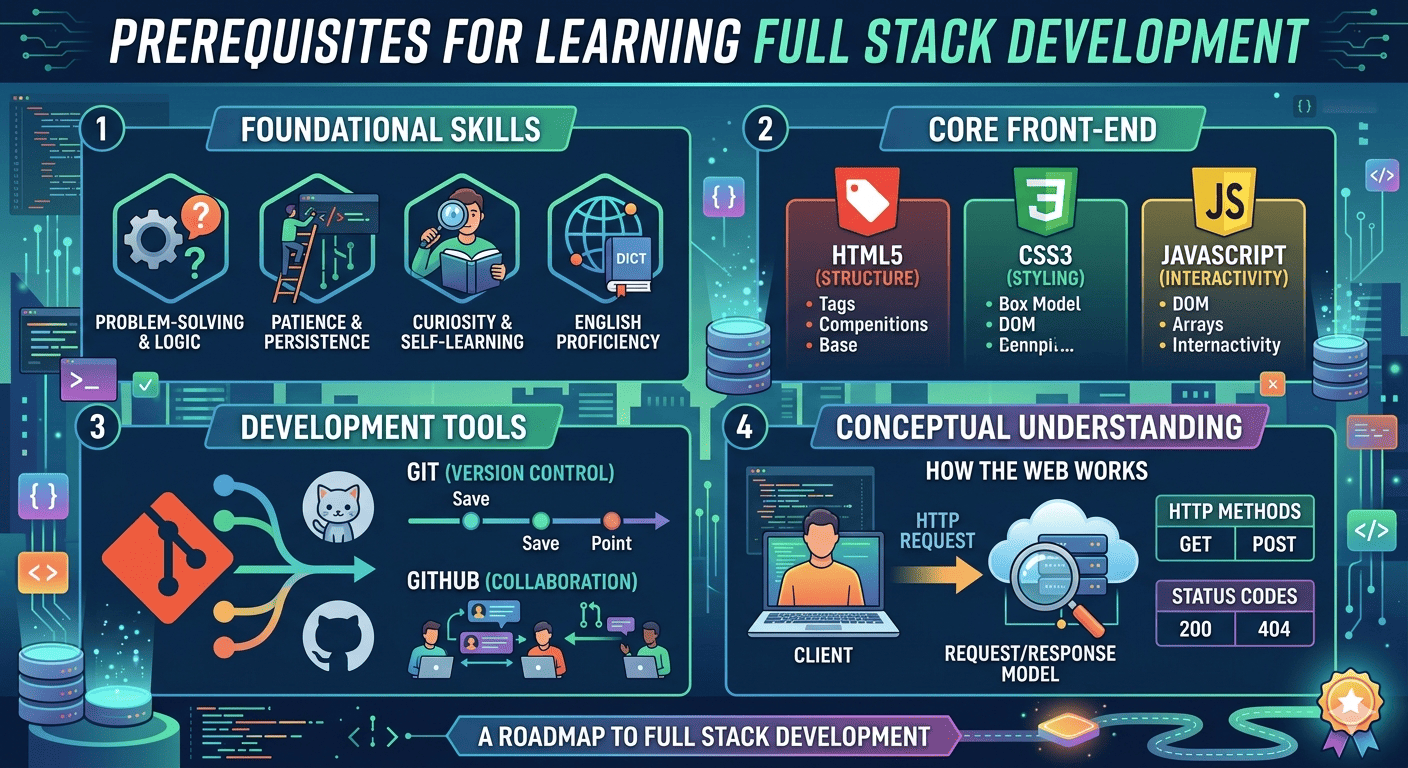
The full stack development journey begins for you when you acquire the essential skills that all developers need to master. The guide provides a complete list of requirements which start from essential computer skills and basic programming knowledge and continue until candidates achieve database understanding and version control system proficiency. The complete pathway to full stack development training has been proven through Scholar’sEdge Academy which has helped hundreds of students achieve essential skills needed for training in development.  Who Can Learn Full Stack Development? Full stack development welcomes learners from all backgrounds. The beauty of this field lies in its accessibility—you don’t need a computer science degree to excel. Non-IT Professionals Can Succeed When They Have: Strong logical thinking abilities Problem-solving mindset Willingness to learn technical concepts Dedication to consistent practice IT Professionals Already Possess: Technical foundation knowledge Understanding of software concepts Familiarity with development environments Basic troubleshooting skills Scholar’sEdge Academy has trained both categories successfully, proving that motivation matters more than your starting point.   Essential Technical Prerequisites Computer Fundamentals You Must Know Before writing your first line of code, you need solid computer operation skills. Skill Area What You Need Why It Matters Operating Systems Windows, Linux, or Mac navigation Development happens across platforms File Management Creating, organizing, moving files Projects require structured file systems Internet Basics Browsers, search, downloads Accessing resources and documentation Typing Speed Minimum 30 WPM Coding efficiency depends on typing Programming Fundamentals Required You cannot skip basic programming concepts when entering full stack development. Core Programming Concepts: Variables and data types Conditional statements (if-else logic) Loops (for, while iterations) Functions and parameters Arrays and objects Basic algorithms Scholar’sEdge Academy recommends starting with JavaScript or Python. These languages provide gentle learning curves while building strong foundations. Why These Concepts Matter: Both frontend and backend development rely heavily on these fundamentals. When you understand variables, you’ll grasp state management in React. When you master loops, database queries become intuitive. Mathematics and Logical Thinking Math Skills That Help Full stack development isn’t calculus-heavy, but certain mathematical concepts prove valuable. Helpful Mathematical Areas: Basic arithmetic operations Percentage calculations Logic and Boolean algebra Pattern recognition Basic statistics (for data handling) For Non-IT Learners: Don’t panic about advanced mathematics. High school level math suffices for most full stack development tasks. Scholar’sEdge Academy focuses on practical application rather than theoretical mathematics. Logical Reasoning Abilities Your ability to think logically outweighs mathematical prowess. Develop These Thinking Skills: Breaking complex problems into smaller parts Understanding cause and effect relationships Pattern identification Sequential thinking Debugging mindset Practice puzzles, play strategy games, or solve coding challenges on platforms like HackerRank to sharpen logical thinking. Web Technology Basics HTML and CSS Foundation Before tackling frameworks, master the building blocks of web development. HTML Essentials: Document structure (tags, elements, attributes) Semantic HTML5 elements Forms and input types Links and navigation Media embedding CSS Fundamentals: Selectors and specificity Box model understanding Flexbox and Grid layouts Responsive design principles Basic animations Scholar’sEdge Academy structures these prerequisites into a two-week intensive module. Students gain hands-on experience building real web pages before advancing to JavaScript frameworks. JavaScript Basics JavaScript powers both frontend and backend in modern full stack development. JavaScript Prerequisites: DOM manipulation Event handling ES6+ syntax features Asynchronous programming concepts JSON data handling API consumption basics Learning Path Recommendation: Spend 4-6 weeks on JavaScript fundamentals before touching React, Angular, or Vue. This investment pays dividends throughout your full stack journey. Database Concepts Understanding Data Storage Full stack developers must communicate with databases confidently. Database Type When to Use Prerequisites SQL (MySQL, PostgreSQL) Structured data, relationships Table concepts, query basics NoSQL (MongoDB) Flexible schemas, scalability JSON understanding In-Memory (Redis) Caching, session storage Key-value pair concepts Fundamental Database Concepts: CRUD operations (Create, Read, Update, Delete) Database normalization basics Primary and foreign keys Indexing principles Query optimization awareness SQL Query Fundamentals Learn basic SQL before your full stack course begins. Essential SQL Commands: SELECT statements with WHERE clauses JOIN operations (INNER, LEFT, RIGHT) GROUP BY and aggregate functions INSERT, UPDATE, DELETE operations Basic subqueries Scholar’sEdge Academy provides SQL preparatory materials to all enrolled students, ensuring everyone starts with equivalent database knowledge. Version Control Basics Git and GitHub Essentials Version control isn’t optional in modern development workflows. Git Concepts You Need: Repository initialization Commit workflow Branch creation and merging Pull and push operations Conflict resolution basics GitHub Platform Skills: Creating repositories Cloning projects Pull request workflow Basic collaboration features Time Investment: Dedicate one week to Git fundamentals. This skill serves your entire development career, not just full stack projects. Development Tools Familiarity Code Editors and IDEs Comfort with development environments accelerates your learning. Recommended Tools: Visual Studio Code (most popular) Sublime Text (lightweight alternative) WebStorm (professional option) Essential Editor Skills: File navigation shortcuts Multi-cursor editing Extensions installation Integrated terminal usage Debugging panel basics Command Line Proficiency Terminal comfort separates struggling learners from confident developers. Command Line Basics Required: Directory navigation (cd, ls, pwd) File operations (touch, mkdir, rm, mv) Package manager usage (npm, yarn) Running development servers Environment variable configuration Scholar’sEdge Academy includes terminal training in the foundation phase, ensuring students overcome command line anxiety early. Soft Skills That Matter Self-Learning Ability Full stack development evolves rapidly. Your learning journey never truly ends. Develop These Habits: Reading documentation effectively Searching for solutions independently Following tutorials and courses Joining developer communities Building side projects Problem-Solving Mindset Technical skills mean nothing without strong problem-solving abilities. Cultivate These Approaches: Breaking errors into searchable queries Systematic debugging processes Testing hypotheses methodically Asking quality questions in forums Learning from failed attempts For Non-IT Professionals: Start with beginner-friendly coding challenges. Websites like Codecademy, freeCodeCamp, and Codewars build problem-solving muscles through practice. Time Commitment Expectations Realistic Learning Timeline Understanding time requirements prevents frustration and dropout. Prerequisites Phase: Computer fundamentals: 1-2 weeks Programming basics: 6-8 weeks HTML/CSS: 2-3 weeks JavaScript fundamentals: 4-6 weeks Database basics: 2 weeks Git/GitHub: 1 week Total Preparation Time: Non-IT professionals should allocate 4-5 months for comprehensive preparation. IT professionals with some programming exposure can compress this

Full Stack Development

Full Stack Developer Roles & Responsibilities

A full stack developer handles both frontend and backend development tasks, managing everything from user interfaces to databases and server configurations. These professionals build complete web applications, collaborate with cross-functional teams, ensure application performance, maintain code quality, and implement security measures across the entire technology stack. At Scholar’sEdge Academy, we prepare students for this dynamic role by focusing on practical skills that employers actively seek in today’s competitive job market.   Core Responsibilities of Full Stack Developers Application Development & Architecture Frontend Development Tasks: Creating responsive user interfaces using HTML, CSS, and JavaScript Building single-page applications with React, Angular, or Vue.js Implementing mobile-first design principles Ensuring cross-browser compatibility Optimizing page load speed and performance Backend Development Duties: Designing and developing RESTful APIs Building server-side logic with Node.js, Python, or Java Managing database schemas and queries Implementing authentication and authorization systems Creating microservices architecture Database Management Database Type Primary Responsibilities Common Technologies Relational Schema design, query optimization, data integrity MySQL, PostgreSQL, SQL Server NoSQL Document modeling, scaling strategies, data distribution MongoDB, Redis, Cassandra Cloud Databases Configuration, backup management, performance tuning AWS RDS, Azure SQL, Google Cloud SQL DevOps & Deployment Full stack developers at Scholar’sEdge Academy learn these critical deployment skills: Setting up continuous integration and continuous deployment pipelines Managing version control using Git and GitHub Configuring cloud hosting on AWS, Azure, or Google Cloud Platform Implementing containerization with Docker Monitoring application performance and error tracking Managing server infrastructure and scaling applications   Technical Skills Required Programming Languages Must-Have Languages: JavaScript (ES6+) for frontend and backend development Python for backend services and data processing SQL for database operations TypeScript for type-safe application development Additional Valuable Languages: Java for enterprise applications PHP for content management systems Ruby for rapid application development Go for high-performance services Frameworks & Libraries Scholar’sEdge Academy curriculum covers these industry-standard frameworks: Frontend Frameworks: React.js for component-based interfaces Next.js for server-side rendering Tailwind CSS for utility-first styling Redux for state management Backend Frameworks: Express.js for Node.js applications Django for Python web development Spring Boot for Java enterprise applications Flask for lightweight Python services   Daily Tasks & Workflow Morning Responsibilities Reviewing pull requests from team members Participating in daily standup meetings Checking error logs and monitoring dashboards Prioritizing tasks from project management tools Development Activities Writing clean, maintainable code Debugging existing application issues Implementing new features based on requirements Conducting code reviews for quality assurance Writing unit tests and integration tests Updating technical documentation Collaboration & Communication Working with UX designers on interface implementations Coordinating with product managers on feature specifications Supporting QA teams during testing phases Mentoring junior developers Communicating project status to stakeholders Career Levels & Progression Experience Level Responsibilities Average Salary Range (India) Junior Developer (0-2 years) Bug fixes, feature implementation under supervision ₹3.5L – ₹6L per year Mid-Level Developer (2-5 years) Independent feature development, code reviews ₹6L – ₹12L per year Senior Developer (5-8 years) Architecture decisions, team mentoring ₹12L – ₹20L per year Lead Developer (8+ years) Technical leadership, project planning ₹20L – ₹35L per year Industry-Specific Responsibilities E-commerce Development Building shopping cart functionality Integrating payment gateways Managing inventory systems Implementing search and filter features Creating product recommendation engines SaaS Application Development Developing multi-tenant architectures Building subscription management systems Creating user onboarding workflows Implementing role-based access control Developing analytics dashboards Fintech Applications Ensuring regulatory compliance Implementing encryption and security protocols Building transaction processing systems Creating audit trails Developing reporting mechanisms Soft Skills & Professional Competencies Problem-Solving Abilities Full stack developers must analyze complex technical challenges, break down problems into manageable components, research solutions effectively, and implement fixes efficiently. Communication Skills Explaining technical concepts to non-technical stakeholders Writing clear documentation Providing constructive code review feedback Presenting project updates to management Time Management Balancing multiple projects simultaneously Meeting sprint deadlines consistently Prioritizing critical bugs over feature requests Estimating development time accurately   Tools & Technologies Ecosystem Development Tools Visual Studio Code for code editing Postman for API testing Chrome DevTools for debugging Figma for design collaboration Jira for project tracking Version Control & Collaboration Git for source code management GitHub for code hosting and collaboration GitLab for CI/CD integration Bitbucket for enterprise repositories Testing & Quality Assurance Jest for JavaScript testing Selenium for automated browser testing JUnit for Java applications Pytest for Python testing   How Scholar’sEdge Academy Prepares You Our comprehensive training program covers: Practical Learning Approach: Real-world project development from day one Industry mentor guidance throughout the course Live coding sessions with experienced developers Capstone projects for portfolio building Career Support Services: Resume building workshops Mock interview preparation Job placement assistance Alumni network access Updated Curriculum: Latest framework versions and best practices Cloud computing and containerization Modern development workflows Security and performance optimization   Future Trends & Emerging Responsibilities AI & Machine Learning Integration Implementing AI-powered features Working with machine learning APIs Building chatbots and virtual assistants Creating personalized user experiences Progressive Web Applications Developing offline-first applications Implementing service workers Creating app-like experiences on the web Optimizing for mobile performance Serverless Architecture Building functions-as-a-service applications Managing cloud function deployments Implementing event-driven architectures Optimizing serverless performance and costs   Conclusion Full stack developer roles & responsibilities encompass frontend development, backend programming, database management, DevOps practices, and continuous collaboration with cross-functional teams. These professionals create complete web applications while staying current with evolving technologies and industry best practices. At Scholar’sEdge Academy, we equip students with comprehensive technical skills, practical project experience, and career support to excel in this demanding yet rewarding field. Whether you are starting your technology career or transitioning from another domain, mastering full stack development opens doors to diverse opportunities across industries and geographies. Frequently Asked Questions What is the difference between a full stack developer and a software engineer? A full stack developer specializes in web application development across frontend and backend layers, while a software engineer has broader responsibilities that may include desktop applications, mobile development, system architecture, and infrastructure planning. Full stack developers focus specifically on web technologies and application delivery. Do full stack developers need to know DevOps?

Full Stack Development

Is Full Stack Development a Good Career in India? A Complete Guide

The profession of full stack development serves as a highly desirable career option for Indian workers during the year 2026. The profession provides substantial financial benefits because entry and mid-level employees earn between ₹3.5-12 lakhs annually while senior developers receive salaries between ₹15-25 lakhs. The field has become one of the most stable technology professions because 78% of Indian businesses currently search for full stack developers. Full stack development offers various income options and work-from-home opportunities and constant career advancement in both startup companies and multinational corporations and freelance marketplaces for both career changers and new technology workers.  The Indian job market demonstrates its need for full stack developers because they possess essential skills. The Indian tech ecosystem has undergone major changes. Companies no longer want specialists who handle only frontend or backend work. Developers need to develop skills which enable them to manage the complete software development process.  Scholar’sEdge Academy’s career counselors report that their full stack graduates receive 3-4 job offers on average. single-stack developers receive only 1-2 job offers. Businesses require this solution because their needs exceed business trends.   Current Market Statistics You Should Know Metric Value Source Average Entry Salary ₹3.5-6 lakhs/year PayScale India 2026 Mid-Level Salary ₹8-12 lakhs/year Glassdoor India Senior Developer Salary ₹15-25 lakhs/year Naukri.com Job Openings (Monthly) 45,000+ positions LinkedIn Jobs India Remote Work Options 67% of positions FlexJobs India Freelance Hourly Rate ₹800-2,500/hour Upwork, Toptal The numbers reveal a robust career path. But salary alone doesn’t tell the complete story. Real Income Potential: Beyond Your Base Salary Full stack developers in India earn through multiple channels: Primary Employment Income Your main job provides the foundation. Bengaluru, Pune, Hyderabad, and Gurugram offer the highest base salaries, while remote positions from international companies can pay 40-60% more. Freelance Projects Platforms like Upwork, Freelancer, and Toptal connect you with global clients. A single mid-sized project (₹50,000-1,50,000) can match your monthly salary. Many developers at Scholar’sEdge Academy’s alumni network report earning an additional ₹3-8 lakhs annually through weekend freelancing. Product Development Building and selling SaaS products, mobile apps, or web tools creates passive income. Several developers launch micro-SaaS products earning ₹30,000-2,00,000 monthly. Teaching and Mentoring Experienced developers charge ₹1,000-3,000 per hour for private tutoring or create online courses generating recurring revenue. Skills That Actually Matter in 2026 Stop chasing every framework. Focus on these core competencies: Frontend Technologies React.js or Next.js for modern web applications TypeScript for type-safe JavaScript development Responsive design using Tailwind CSS or Material UI State management with Redux or Zustand Backend Development Node.js with Express or NestJS framework Python with Django or FastAPI Database design (PostgreSQL, MongoDB, Redis) RESTful APIs and GraphQL implementation DevOps and Deployment Docker containerization basics CI/CD pipeline setup (GitHub Actions, Jenkins) Cloud platforms (AWS, Azure, Google Cloud) Version control with Git and GitHub Essential Soft Skills Problem decomposition and algorithmic thinking Clear communication with non-technical stakeholders Project estimation and deadline management Code review and mentoring capabilities Scholar’sEdge Academy’s curriculum emphasizes building real projects over theoretical knowledge. Their students create 8-12 production-grade applications before graduation, giving them portfolio strength that impresses recruiters. Career Growth Timeline: What to Expect Year 1-2: Junior Developer (₹3.5-6 lakhs) You’ll work on assigned features, fix bugs, and learn codebase navigation. Focus on writing clean code and understanding business logic. Companies hiring at this level include TCS, Infosys, Wipro, and numerous startups. Year 3-5: Mid-Level Developer (₹8-12 lakhs) You’ll own complete features, mentor juniors, and make architectural decisions. This phase builds your specialization while maintaining full stack versatility. Opportunities expand to product companies like Flipkart, Swiggy, Razorpay, and Paytm. Year 6-8: Senior Developer (₹15-20 lakhs) You’ll lead technical initiatives, design system architecture, and guide team strategy. Many developers transition into tech lead or engineering manager roles here. Year 9+: Architect/CTO (₹25+ lakhs) You’ll shape company-wide technical direction, evaluate technologies, and build engineering culture. Some developers launch their own startups or consulting practices at this stage. Industry Sectors Actively Hiring Full Stack Developers The demand spans across industries: Fintech Companies Paytm, PhonePe, Razorpay, CRED, and hundreds of payment startups need developers who understand secure, scalable financial systems. E-Commerce Platforms Flipkart, Amazon India, Meesho, and Myntra continuously expand their engineering teams for feature development and optimization. Healthcare Technology Practo, PharmEasy, 1mg, and telemedicine platforms require developers for patient management systems and healthcare apps. EdTech Sector BYJU’S, Unacademy, Vedantu, and platforms like Scholar’sEdge Academy’s online learning system need developers for interactive learning experiences. SaaS Product Companies Zoho, Freshworks, Chargebee, and numerous B2B software companies build complex web applications requiring full stack expertise. Challenges You’ll Face (And How to Handle Them) Rapid Technology Changes New frameworks emerge constantly. Solution: Master fundamentals (JavaScript, Python, database design) that remain constant while frameworks change. Imposter Syndrome You’ll feel overwhelmed seeing others’ expertise. Reality: Everyone faces this. Focus on consistent learning rather than comparing yourself to senior developers with 10+ years of experience. Work-Life Balance Deadlines and production issues can extend work hours. Strategy: Set boundaries early, communicate capacity honestly, and choose companies with healthy engineering cultures. Skill Depth vs Breadth Dilemma Should you specialize or stay generalist? Answer: Build T-shaped skills—deep expertise in 1-2 areas (your vertical) with working knowledge across the stack (your horizontal). How to Start Your Full Stack Development Career Self-Learning Path (6-12 months) Free resources like FreeCodeCamp, The Odin Project, and MDN Web Docs provide structured learning. Requires strong self-discipline and 3-4 hours daily commitment. Structured Training Programs (4-6 months) Bootcamps and academies like Scholar’sEdge Academy’s full stack program offer mentorship, projects, and placement support. Investment ranges from ₹50,000-2,50,000 but accelerates your job readiness. College Degree with Side Projects (4 years) Computer Science or related engineering degrees provide foundation. Supplement coursework with personal projects and internships to build practical skills. Career Switching (6-9 months) Professionals from non-tech backgrounds can transition through intensive bootcamps focusing on practical skills over computer science theory. Building a Portfolio That Gets Interviews Recruiters spend 6-8 seconds scanning your portfolio. Make those seconds count: Project Selection Include 4-6 projects demonstrating different skills:

Full Stack Development

Full Stack Developer Roadmap

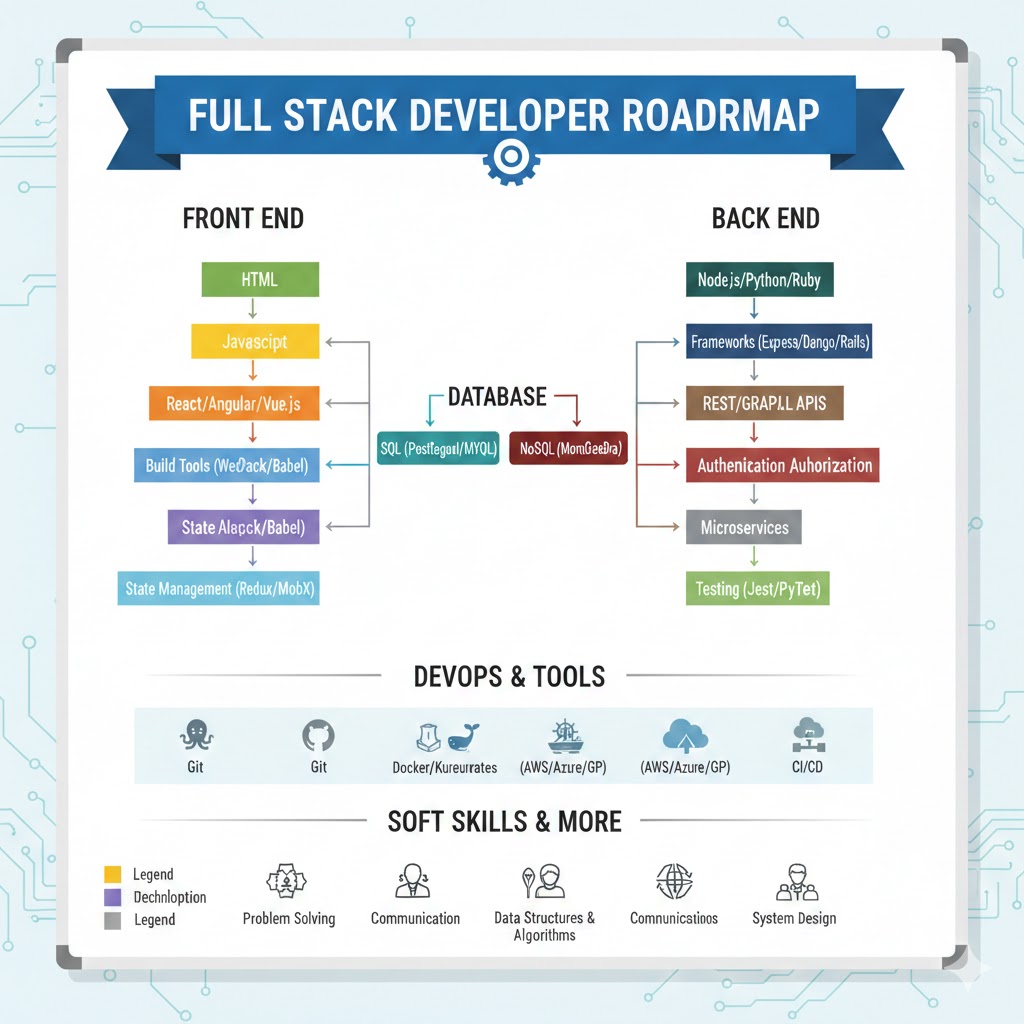
Full Stack Developer Roadmap: From Beginner to Job-Ready in 2026 Scholar’sEdge Academy offers an established pathway which teaches students all essential skills needed for their first developer position. The guide provides complete training through actual projects which use professional technologies including React and Node.js and database systems. The training program teaches you how to create industry-standard applications which will help you develop your professional portfolio and succeed in technical evaluations. What Skills Do Full Stack Developers Actually Need? The work of full stack developers involves developing both frontend and backend components. The process requires you to learn about user experience on websites together with website data processing through server systems. Frontend Technologies You Must Know Website functionality depends on three fundamental technologies which are HTML together with CSS and JavaScript. These three technologies control everything users see and interact with on websites. The use of modern frameworks results in faster development progress. The most sought-after skill of React expertise remains the top requirement followed by Vue.js and Angular skills. React serves as the optimal starting point according to Scholar’sEdge Academy because it provides the most extensive employment opportunities and strong community backing. Backend Development Essentials Node.js with Express.js gives you JavaScript on the server side. The entire application development process requires you to use a single programming language. Python with Django or Flask offers another solid path. Python’s clear syntax enables beginners to learn backend programming fundamentals through practical experience. Database expertise establishes a boundary which determines whether developers possess entry-level skills or advanced professional capabilities. You should study SQL databases such as PostgreSQL together with NoSQL databases like MongoDB. The 6-Month Learning Path to Employment The 6-Month Learning Path to Employment Month 1-2: Frontend Fundamentals Start your learning process by studying HTML5 semantic elements together with CSS Grid and Flexbox. Develop five responsive websites through your own coding efforts without using any frameworks. The foundation establishes correct understanding which protects against future misunderstandings. Daily practice of JavaScript is necessary for effective learning. The learner needs to dedicate 3-4 hours for coding different ES6 features and array methods and promises and async/await patterns. The user will develop interactive calculators and todo lists and weather applications.   Week-by-Week Breakdown Week Focus Area Deliverable 1-2 HTML/CSS Basics Personal Portfolio Site 3-4 JavaScript Fundamentals Interactive Quiz App 5-6 DOM Manipulation Dynamic Task Manager 7-8 API Integration Movie Search Application Month 3-4 The period from Month 3-4 includes the study of React and Modern Frontend development techniques. Developers gained new component development methods through React hooks. Students will learn useState and useEffect and useContext and custom hooks through the development of actual applications.  Many beginners face challenges with state management because of its complexity. The built-in context API of React functions as a beginner-friendly option which leads to simpler learning for Redux. The approach helps students at Scholar’sEdge Academy because it decreases their frustration while it develops their self-assurance.  The following projects serve as proof of your React abilities: The e-commerce product catalog displays items which customers can add to their shopping cart. The social media dashboard provides users with authentication capabilities. The real-time chat application enables users to communicate through WebSockets. Users of the blog platform can create content using markdown formatting.  Node.js and Express.js provide developers with tools for creating RESTful APIs through their fast development process. The system requires users to understand routing and middleware and error handling and request validation.  The ability to authenticate people serves as the dividing line between amateur and expert users. The system requires implementation of three authentication methods which include JWT tokens and bcrypt password hashing and OAuth social logins.  The process of database design needs designers to think through every aspect of their design. The system requires users to master four fundamental concepts which include normalization and relationships and indexing and query optimization. The system requires users to develop scalable schemas according to their application needs.  The system requires users to understand these essential backend concepts. Server-side rendering enables better performance for websites while improving their search engine optimization capabilities. Next.js enables developers to create modern web applications through its combination of React and backend development features.  The design patterns of APIs directly impact the ability to maintain a system. The system requires users to either implement REST principles system or they can use GraphQL to create adaptable data retrieval methods. Month 6: DevOps and Deployment Git version control is mandatory for any developer job. Practice branching strategies, pull requests, and collaborative workflows on GitHub. Deployment transforms local projects into live applications. Learn these platforms: Vercel for frontend applications Heroku or Railway for full stack apps AWS EC2 for more control and scalability Docker for containerization CI/CD pipelines automate testing and deployment. Set up GitHub Actions to run tests and deploy automatically when you push code. Creating Your Employment-Ready Portfolio Your portfolio demonstrates capabilities better than any resume. Include 4-6 substantial projects that show different skills. Requirements for Portfolio Project Each project needs clean code, proper documentation, and live deployment. Add README files that explain your technical decisions and the challenges which you solved. The most impressive applications to employers are full stack applications. Create projects that use React for front ends and Node.js for back ends with real database systems. The projects that help Scholar’sEdge Academy students secure jobs the most include these three examples Task management system with team collaboration E-commerce platform with payment integration Social network with user profiles and posts Analytics dashboard which retrieves data from various APIs. Technical Interview Preparation Data structures and algorithms appear in most technical interviews. Focus on arrays, objects, linked lists, trees, and hash tables. Common Algorithm Challenges Category Practice Problems Arrays Two Sum, Maximum Subarray Strings Valid Anagram, Longest Substring Trees Binary Tree Traversal, Validate BST Dynamic Programming Climbing Stairs, House Robber LeetCode, HackerRank, and CodeSignal offer practice platforms. Solve 2-3 problems daily during your final month of preparation. System design questions test senior-level thinking. Understand load balancers, caching strategies, database sharding, and

Full Stack Development

Frontend vs Backend vs Full Stack Development: Key Differences Explained

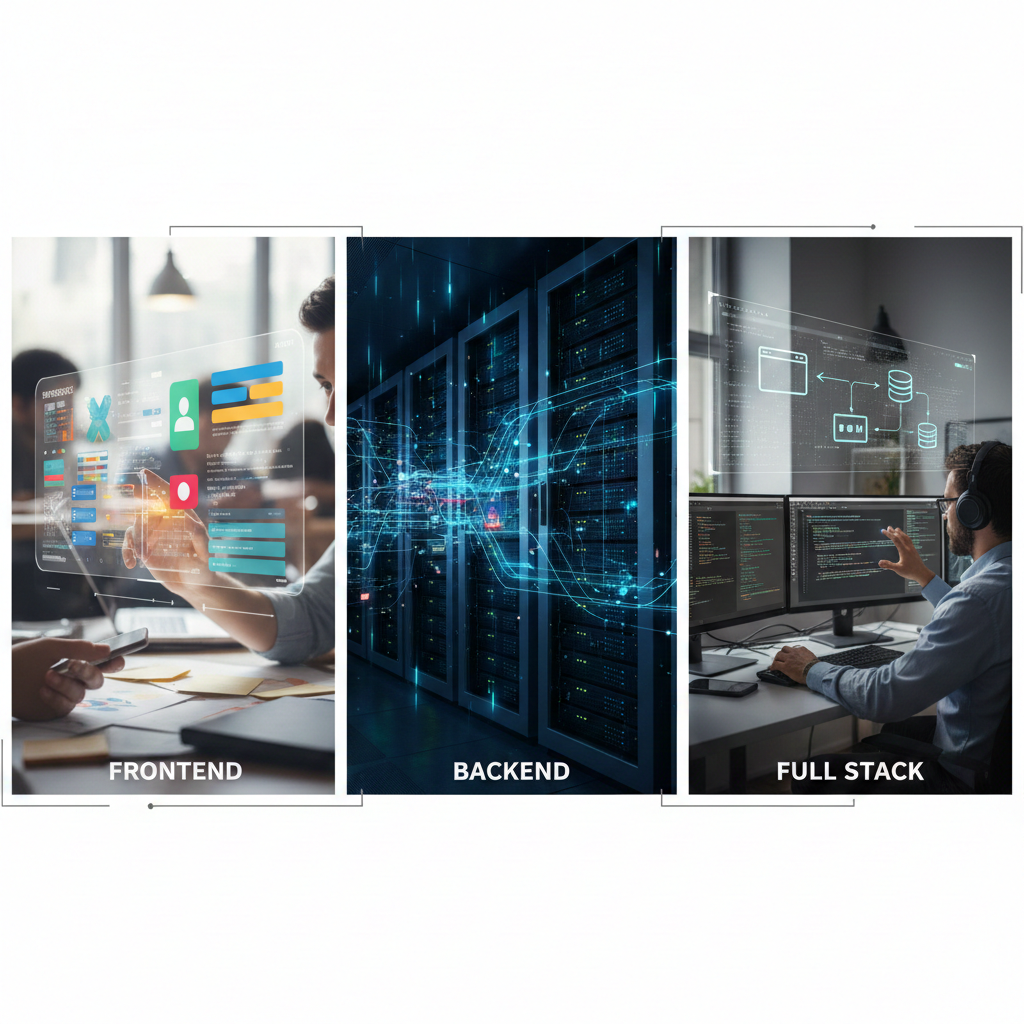
The field of web development separates into three main specializations which include frontend developers who create user interfaces through HTML and CSS and JavaScript. Backend developers create server functions which interact with databases and APIs through coding in Python and Java and Node.js. Full Stack developers master both sides, managing complete web applications from user interface to database. Frontend roles focus on visual design and user experience, backend roles emphasize data management and server performance, while full stack positions require broader technical knowledge across the entire development lifecycle. The comprehensive training programs at Scholar’sEdge Academy enable you to select and master the most suitable development path which matches your career objectives and technical abilities. What is Frontend Development? Frontend development creates everything users interact with on websites and applications. The frontend work begins when you click a button and scroll through content and fill out a form. Core Technologies: HTML serves as the foundation for web content organization CSS manages the appearance and layout of web content JavaScript enables web content to become interactive and dynamic React, Angular, Vue.js serve as the backbone of contemporary web applications At Scholar’sEdge Academy, frontend developers learn how to turn design mockups into interactive and responsive websites. The position requires both original solution development and strict technical execution. Key Responsibilities: Creating user interfaces that work properly on different devices Improving website speed and performance through various optimization techniques Developing accessibility features which enable all users to access content Working together with design teams and backend development teams Testing website performance across different web browsers What is Backend Development? The backend development system provides vital support for all website operations which users cannot see. The system manages three components which include server setup and database handling and application execution of user requests.  Primary Technologies: The system uses Python and Java and PHP and Ruby programming languages. The system uses Node.js to develop servers that operate with JavaScript. The system supports MySQL and PostgreSQL and MongoDB databases. The system uses RESTful APIs and GraphQL to transmit data. Backend developers handle sensitive operations like user authentication, payment processing, and data storage. ScholarsEdge Academy teaches students to implement security systems and build scalable architectural frameworks.  Core Functions: The system develops and controls database structures. The team produces backend software that handles application processes. The system creates application programming interfaces to link with the user interface. The team establishes security protocols and user verification processes. The team works to improve server capabilities through performance enhancements and system scalability. What is Full Stack Development? Full Stack development combines frontend and backend expertise into one versatile role. These developers understand the complete web development ecosystem from user interface to database architecture. Technology Stack Coverage: The system includes frontend frameworks and libraries. The system supports backend programming languages. The system includes database systems and their administration tools. The system includes DevOps tools and deployment methods. The system uses version control systems and collaboration platforms. Full Stack developers at Scholar’sEdge Academy’s gain comprehensive knowledge which makes them valuable assets for startups and established companies. The role requires continuous learning across multiple technology domains. Professional Advantages: The system provides complete project architecture understanding to users. The system enables quicker development of prototypes and minimum viable products. The system enables improved team communication between different specialization areas. The system enables users to access a wider range of job positions. The system increases salary possibilities for employees in multiple employment markets.   Frontend vs Backend vs Full Stack: Complete Comparison Aspect Frontend Backend Full Stack Primary Focus User interface and experience Server logic and databases Complete application stack Languages HTML, CSS, JavaScript Python, Java, PHP, Ruby Both frontend and backend Tools React, Vue, Angular, Sass Django, Node.js, Spring, Laravel All development tools Salary Range $70,000 – $120,000 $80,000 – $130,000 $85,000 – $140,000 Learning Curve Moderate Moderate to High High Job Demand High Very High Very High Work Style Visual and creative Logic and architecture Balanced hybrid approach Team Collaboration Designers, UX specialists DevOps, database admins Cross-functional teams Skills Required for Each Development Path Frontend Developer Skills Technical Competencies: HTML5 semantic markup and structure CSS3 animations and responsive design JavaScript ES6+ and TypeScript Frontend frameworks (React, Angular, Vue) Performance optimization techniques Browser developer tools proficiency Soft Skills: Visual design understanding Attention to detail User empathy and testing Design pattern knowledge Backend Developer Skills Technical Requirements: Server-side programming languages Database design and SQL queries API development and integration Authentication and authorization systems Caching strategies and optimization Cloud platform management Professional Abilities: Problem-solving mindset System architecture planning Security awareness Performance tuning expertise Full Stack Developer Skills Comprehensive Technical Knowledge: Complete frontend technology stack Backend programming and frameworks Database management systems DevOps and deployment pipelines Version control systems (Git) Testing frameworks and methodologies Essential Professional Skills: Project management capabilities Quick technology adaptation Cross-team communication End-to-end thinking Career Prospects and Salary Expectations The web development field offers strong career growth regardless of specialization. Scholar’sEdge Academy’s graduates enter a thriving job market with multiple career trajectories. Frontend Development Careers: Entry-level positions start around $70,000 annually. Senior frontend developers earn $120,000 or more. Specializations include UI/UX development, mobile web development, and performance engineering. Backend Development Opportunities: Backend roles begin near $80,000 for junior positions. Experienced backend architects command salaries exceeding $130,000. Career paths include API specialist, database architect, and DevOps engineer. Full Stack Development Potential: Full Stack developers start around $85,000 with potential to reach $140,000 or higher. The versatility opens doors to technical lead roles, startup CTOs, and independent consulting. How to Choose Your Development Path Consider Frontend Development if: You find pleasure in visual design together with user experience elements and creative problem-solving skills which work best when you receive instant visual results. Choose Backend Development when: The combination of data structures and system architecture with your ability to solve logic puzzles drives your interest in building secure systems which handle large volumes of data. Pursue Full Stack Development for: The opportunity to control all aspects of a project