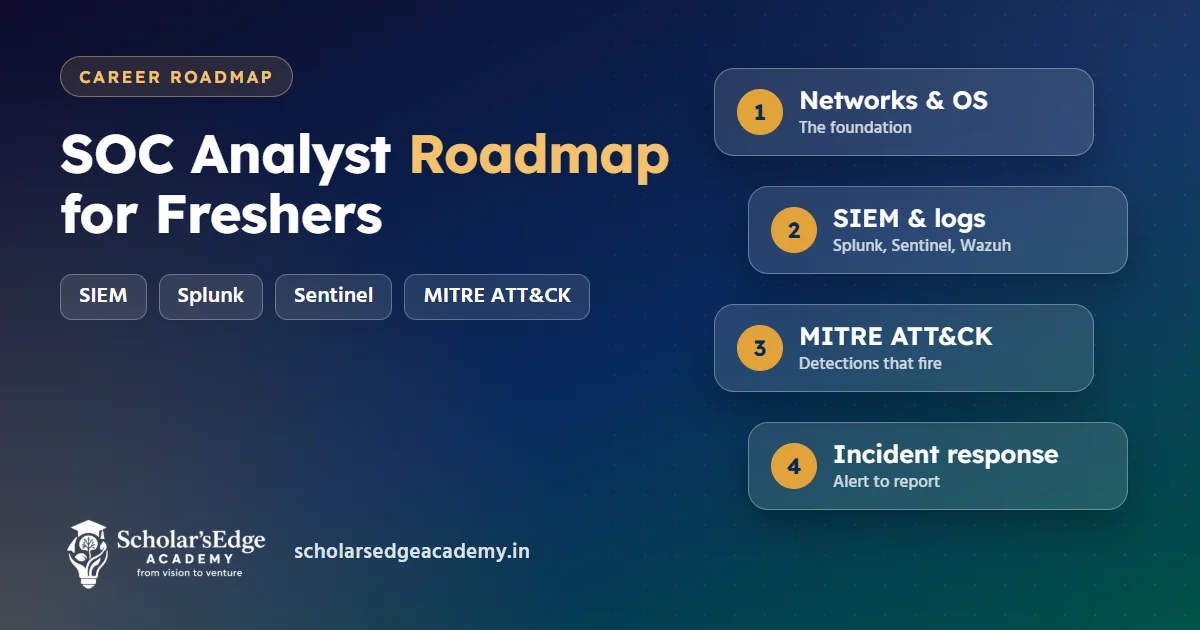
Quick answer: This SOC analyst roadmap follows the job: watch alerts, investigate them and respond to incidents. Learn networking and Linux and Windows basics, then SIEM tools such as Splunk, Microsoft Sentinel and Wazuh, MITRE ATT&CK and incident response. Our SOC Analyst & Cloud Security course in Bangalore teaches this in 4.5 months.
Not sure where to start? Try a free demo class, online or at our J. P. Nagar centre. Book on WhatsApp
A security operations centre, or SOC, is the team that monitors a company’s systems around the clock for signs of attack. The analyst is the person who looks at an alert and decides whether it is real, how serious it is and what to do next. This roadmap lists the skills a fresher needs, the tools to practise and the projects that prove you can do the job.
The SOC analyst roadmap, step by step
Start with how networks and operating systems work, then learn how attacks look in logs, then practise in a SIEM. Skipping the basics is the most common reason beginners get stuck on alerts they cannot explain.
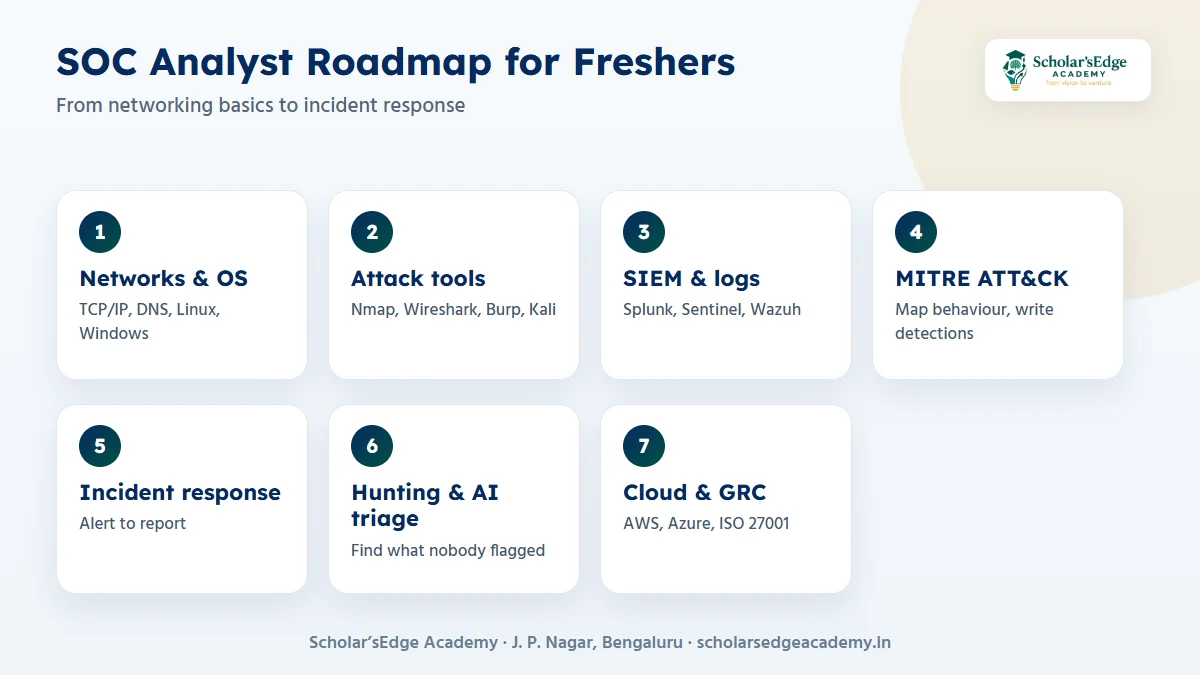
- Networking and operating systemsTCP/IP, DNS, HTTP, plus Linux and Windows administration and scripting.
- Attacks and testing toolsCommon threats, the OWASP Top 10, and tools such as Nmap, Wireshark, Burp Suite and Kali Linux.
- SIEM and log analysisSearch and read logs in Splunk, Microsoft Sentinel and Wazuh.
- Detection with MITRE ATT&CKMap attacker behaviour to ATT&CK and write detections that fire on it.
- Incident responseInvestigate an incident such as ransomware from first alert to report.
- Threat hunting and AI-assisted triageLook for threats nobody alerted on, and use AI to sort alerts faster.
- Cloud security and governanceAWS and Azure security basics, plus ISO 27001 and DPDP Act basics.
What does a SOC analyst do every day?
A SOC analyst triages alerts, investigates suspicious activity, escalates real incidents and records what happened. Many SOCs organise the work in tiers, with the first tier handling triage and later tiers handling deeper investigation and hunting, although the exact structure differs between companies.
- Review alerts from a SIEM and decide which are real.
- Check logs, user accounts and network traffic around an alert.
- Follow the incident response steps and write clear notes.
- Tune detections so the same false alarm does not repeat.
Tools a beginner should practise
Pick one tool in each group first and learn it well. The concepts transfer between products, so you can move to another tool later.
| Tool | What it is used for |
|---|---|
| Wireshark | Capturing and reading network traffic |
| Nmap | Discovering hosts and open ports |
| Burp Suite | Testing how a web application handles requests |
| Kali Linux | A Linux system packed with security tools for labs |
| Splunk | Searching and visualising log data in a SIEM |
| Microsoft Sentinel | A cloud-native SIEM from Microsoft |
| Wazuh | An open-source platform for threat detection and monitoring |
The official documentation is the best place to learn each product: Splunk, Microsoft Sentinel and Wazuh. For a plain-English explanation of what a SIEM does, read our guide to SIEM, Splunk, Sentinel and Wazuh.
MITRE ATT&CK and the OWASP Top 10
MITRE ATT&CK is a public knowledge base that describes how real attackers behave, step by step. Analysts use it as a shared language when they write detections and reports, and you can browse it for free at attack.mitre.org. The OWASP Top 10 lists the most common web application risks and is a good place to learn how web attacks work.
Projects that prove you can do the job
- Build a small home SOC lab and send its logs to a SIEM.
- Write your own detection rule and show it firing on test activity.
- Investigate a simulated ransomware incident and write the timeline.
- Review a cloud account for risky settings and list the fixes.
Recruiters read short case notes more easily than they read a list of tools. For each project write the alert, what you checked, what you found and what you did.
Interview questions to practise
- What is the difference between an alert, an event and an incident?
- An alert says a user logged in from two countries within minutes. What do you check?
- What are the stages of incident response, and what happens in each?
- How would you tell a false positive from a real attack?
- Describe one detection you wrote and why it fires.
Common mistakes beginners make
- Learning tools without networking. If you cannot read a packet or a DNS record, a SIEM search is guesswork.
- Chasing every certification first. Practical lab work teaches you more than reading for an exam.
- Not writing things down. SOC work depends on clear notes that another analyst can follow.
- Ignoring the cloud. Many alerts now come from cloud accounts, so basic AWS or Azure security is worth learning early.
How our course covers this roadmap
The Cybersecurity – SOC Analyst & Cloud Security course runs for 4.5 months at our J. P. Nagar centre: 3 hours a day, Monday to Friday, plus a Saturday lab, with a weekend batch also available.
- You learn: networking, Linux and Windows administration, Nmap, Wireshark, Burp Suite, Kali Linux, Splunk, Microsoft Sentinel, Wazuh, log analysis, MITRE ATT&CK and incident response, plus AWS and Azure cloud security, LLM security basics, and ISO 27001 and DPDP Act basics.
- Projects: a home SOC lab with custom detections, a ransomware incident investigation, a cloud security audit and a simulated SOC shift.
- Roles it prepares you for: SOC Analyst L1, Security Analyst, Cloud Security Associate and GRC Associate.
- Who can join: Engineering, BCA, BSc IT and MCA graduates, and IT support and network staff.
- Alignment: CompTIA Security+, Splunk and Microsoft SC-200. These exams are booked and taken separately with the exam providers.
- Internship and fee: a 2-month internship is included, and the offer fee is ₹31,999 (regular ₹39,999).
Still comparing paths? Read is cybersecurity a good career choice in Bangalore and cybersecurity vs cloud and DevOps.
Related reading: IT jobs without coding for freshers.
Related guides: Cybersecurity Interview Questions for Freshers: SOC Analyst Edition.
Ready to try a class before you decide?Book a free demo class to see the syllabus, ask about fees and batches, and meet the team. Every course includes a 2-month internship, and classes run online and offline.Book on WhatsAppCall +91 99020 58603
Frequently asked questions
Can a fresher become a SOC analyst?
Yes. Entry-level SOC roles are meant for people who can read logs, understand basic attacks and follow a process. Our course starts from networking and operating system basics.
Do I need to know coding for cybersecurity?
Basic scripting helps you automate checks and read logs, but you do not need to be a software developer. The course teaches scripting alongside Linux and Windows administration.
Which SIEM should I learn first?
Learn one well, then move to another, because the ideas are the same. We teach Splunk, Microsoft Sentinel and Wazuh so you see different approaches.
Who can join the SOC Analyst & Cloud Security course?
Engineering, BCA, BSc IT and MCA graduates, and IT support and network staff.
Are the certification exams included?
The training is aligned to CompTIA Security+, Splunk and Microsoft SC-200. The exams are booked and taken separately with the exam providers.
Not sure yet? Talk to us
Book a free demo class or ask for 1:1 guidance on WhatsApp at +91 99020 58603, or use the form on our contact page. You can also compare all our courses and our combo courses. Scholar’sEdge Academy is at Building No. 19, 25/1, 9th Cross Road, 2nd Phase, J. P. Nagar, Bengaluru, Karnataka 560078. Read how we write and check our articles in our editorial policy.
