What does a SOC analyst actually do, what skills do you need, and who is cybersecurity right for? A practical guide with our course details in Bangalore.

What does a SOC analyst actually do, what skills do you need, and who is cybersecurity right for? A practical guide with our course details in Bangalore.

Should a beginner start with a 4-weekend AI bootcamp or a full course? Compare the AI Foundations Weekend Bootcamp with our main courses in Bangalore.

Compare our five combo courses with single courses: months, fees and savings for AI Software Engineer, Growth Marketer, Data Professional and more.

Not sure which course to join after BCA, BSc or engineering? Match your interest to one of our 7 courses in Bangalore, with fees and eligibility.

Any graduate can join both. Compare AI-Powered Performance Marketing and Data Analytics with AI on skills, fees, projects and roles in Bangalore.
SOC Analyst & Cloud Security or Cloud & DevOps Engineering? Compare tools, fees, projects and roles to choose the right course in Bangalore.

Data Analytics with AI or Data Engineering with AI? Compare tools, fees, eligibility and job roles to choose the right data course in Bangalore.

Full Stack Development with GenAI or AI Application Developer? Compare skills, fees, projects and roles to pick the right course in Bangalore.
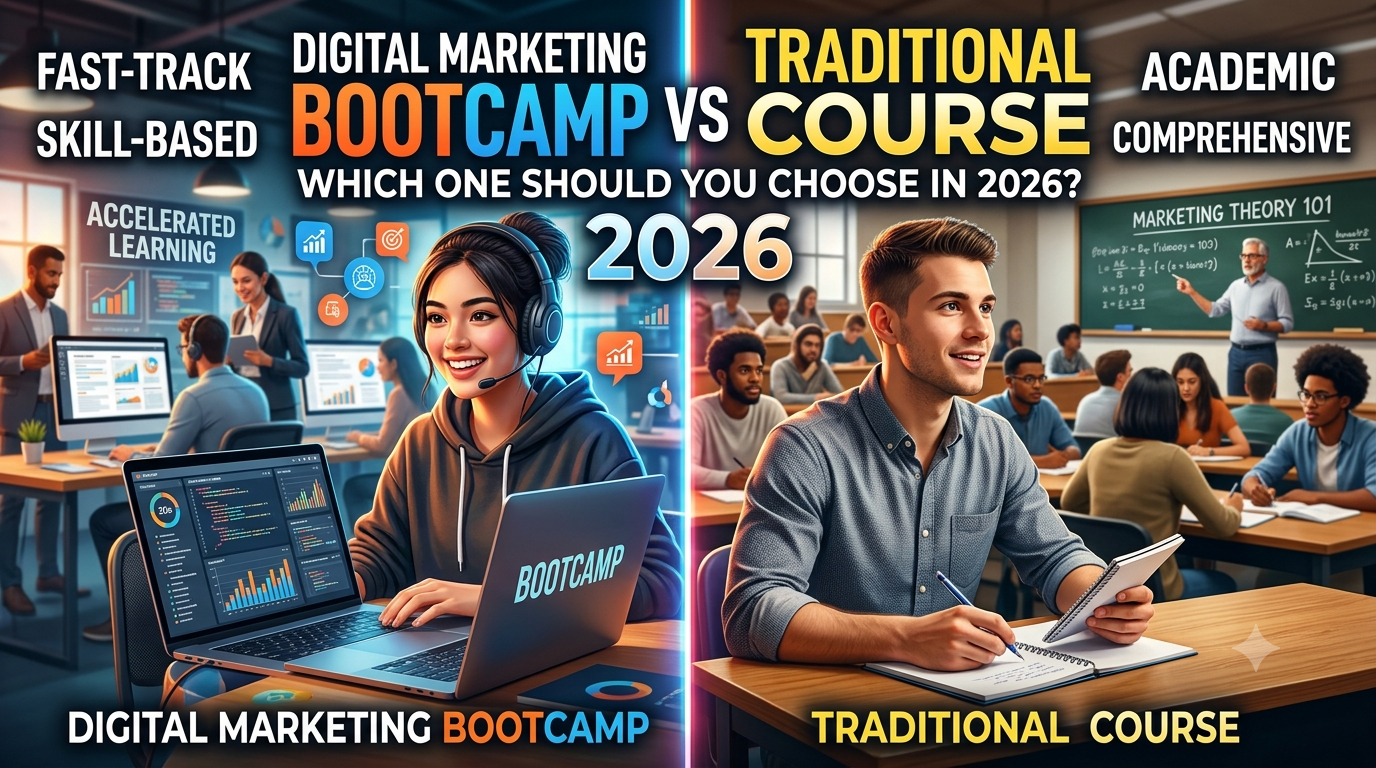
If you are weighing a digital marketing bootcamp vs a more traditional course, the short answer is kinda like this: a bootcamp gets you job ready skills in weeks, via hands on projects live tools and placement support, while a traditional course kind of spreads the theory out over months or even years with a wider academic foundation. Scholar’sEdge Academy’s digital marketing bootcamp is designed for people who want practical, current, and hiring team relevant knowledge…without spending years before they can kick off their career. Below, we line up both styles across cost, timeline, curriculum, certification and career outcomes, so you can decide what best fits your goals, budget, and your schedule. Quick Answer: So Which One should you Pick? If you need to start earning faster, or you are trying to pivot careers quickly, go with a digital marketing bootcamp. If you really want a formal degree, deeper academic grounding, or you are aiming at research, lecturing, or something similar, a traditional marketing course may match your path better. For most working professionals, students, and career switchers, a well structured bootcamp like the one from Scholar’sEdge Academy tends to deliver a quicker return on investment. Digital Marketing Bootcamp vs Traditional Course: Side-by-Side Comparison Factor Digital Marketing Bootcamp Traditional Course Duration 8 to 16 weeks 1 to 3 years Cost Lower, project-based fee Higher, semester-based fee Curriculum SEO, PPC, social media marketing, analytics, content strategy Broad marketing theory with limited digital focus Tools Covered Google Ads, Meta Ads Manager, GA4, SEMrush, HubSpot Often outdated or textbook-based Format Live, cohort-based, mentor-led Lecture-based, self-paced or classroom Certification Industry-recognized, skill-based Academic degree or diploma Job Support Placement assistance, portfolio building, interview prep Career services vary by institution Best For Career switchers, working professionals, entrepreneurs Students wanting a formal degree pathway Cost Comparison A traditional marketing degree might run into lakhs of rupees in a span of two to three years, if you count tuition, study material , and the fact that you are losing time away from earning. A digital marketing bootcamp on the other hand is usually priced more around outcomes. Scholar’sEdge Academy’s bootcamp is designed where you pay for the skills you actually put to use on the job, not for semesters of coursework that feels a bit unrelated. Duration and Flexibility Traditional courses mostly follow an academic calendar. Bootcamps do not, not really. Bootcamps typically run in focused sprints, often about 8 to 16 weeks, and that part matters. Sessions are generally planned around working professionals schedule, so it can feel more workable. Meanwhile traditional courses can stretch from one to three years, with rigid semester timelines. With a bootcamp, learners can often start applying for roles within months , not years. Curriculum and Practical Skills This is where the difference becomes pretty visible. Traditional programs tend to teach marketing history, consumer behavior theory, and broader business ideas, with digital marketing as just one module among many. A bootcamp is built around what employers actually hire for right now, like right now-right now. Scholar’sEdge Academy’s curriculum includes: Search engine optimization (SEO) and keyword research Pay-per-click (PPC) and paid social advertising Content marketing plus copywriting fundamentals Email marketing, and also marketing automation Google Analytics 4 (GA4) and data-driven decision making Social media strategy across Meta, LinkedIn and Instagram Certification and Recognition Traditional courses award a degree or diploma, which can carry weight for corporate roles or academic tracks that specifically ask for one. Bootcamp certifications are more skill-based and tied to real tools, and many recruiters in performance marketing, e-commerce, and startups value that almost as much, or sometimes more, because it suggests current, hands on capability. Job Placement & Career Support For many people, career support is the thing that kinda tips the scale when comparing a digital marketing bootcamp vs a traditional course. Bootcamps such as Scholar’sEdge Academy tend to come with resume reviews , mock interviews, and portfolio work that feels more real. Then the placement side—often through a placement cell— is typically supported by live industry connections, so it’s not just theory on paper. With traditional institutions you might get campus placements too, but the schedule is slower, and it tends to be less tailored to digital roles . Also, most bootcamp graduates show up to the job market with a working portfolio of campaigns , not only a transcript. Learning Format Traditional programs usually lean on lectures, textbooks and exams. Bootcamps lean on doing , more hands on style, less passive watching. At Scholar’sEdge Academy, learners tackle real campaigns, run real ad budgets in sandbox accounts, and receive mentor feedback directly. That process builds confidence faster than theory alone , honestly. How to Decide : A quick checklist, sort of Before you choose, ask yourself these few things, really – Do I need to start working in a few months Choose a bootcamp. – Do I need a formal degree for visa, government, or academic requirements. Choose a traditional course. – Am I switching careers with limited time or savings, Choose a bootcamp. – Do I want deep theoretical grounding in marketing and business strategy, then a traditional course may fit better, honestly. – Is hands on tool experience (Google Ads, GA4, SEMrush) important for the job I’m aiming at? Choose a bootcamp. Why learners trust Scholar’sEdge Academy Scholar’sEdge Academy programs are built and delivered by working digital marketing professionals who actually manage live client accounts, not just instructors reading from slides, and you can feel that difference. Each module is updated to match current platform changes, algorithm updates and even hiring trends so the skills you learn stay aligned with what recruiters ask for right now. The mentors also bring real, verifiable industry experience across SEO, paid media, and analytics, then the curriculum gets rechecked regularly against real job descriptions, not vague summaries. This mix of practitioner led teaching, clear outcomes, and continuously refreshed content, is what makes Scholar’sEdge Academy different from generic online courses. So, choosing a digital marketing bootcamp vs a more
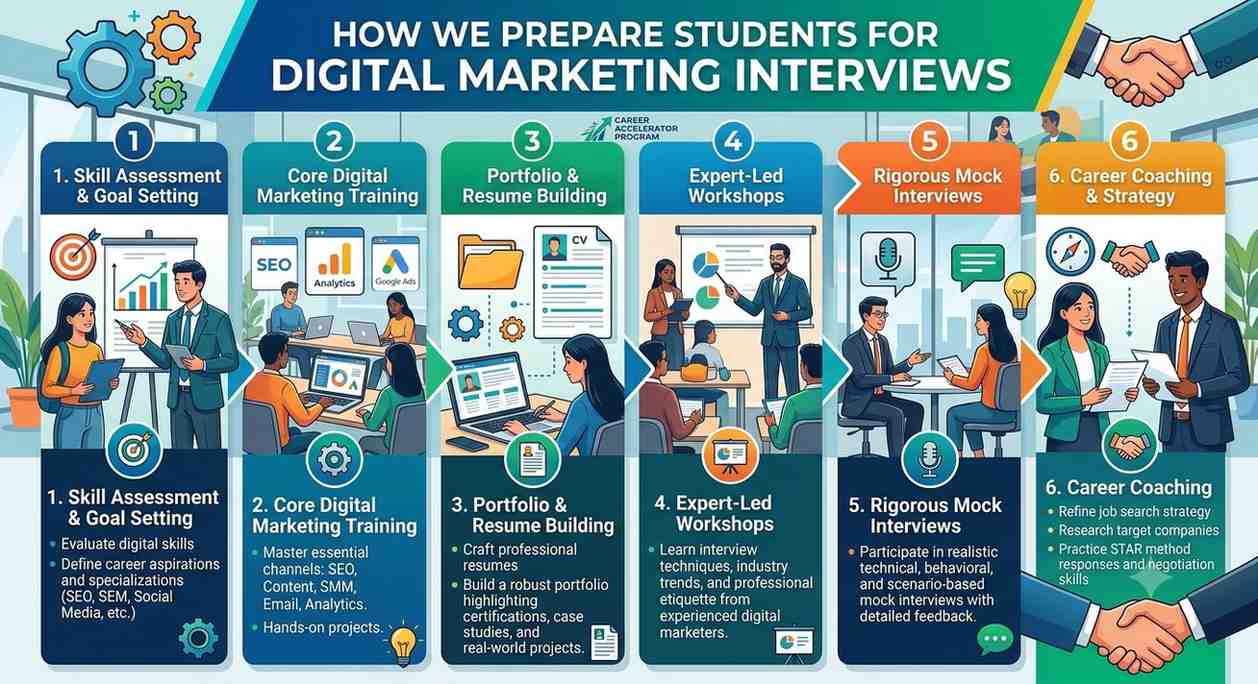
Quick answer: We prepare students for digital marketing interviews through a five-stage process: an interview audit, technical coaching, mock interviews, live task rounds and offer coaching, so they can explain their campaigns and handle practical tasks confidently. Scholar’sEdge Academy prepares students for digital marketing interviews through a structured, hands-on program covering mock interviews, live campaign assignments, portfolio building, and salary negotiation coaching. Every module is built around real hiring scenarios so graduates walk into interviews knowing exactly what to say, what to show, and how to close the conversation with an offer. What Happens Inside Our Digital Marketing Interview Preparation Program How we prepare students for digital marketing interviews at Scholar’sEdge Academy comes down to one principle, replicate the real hiring process before the real thing happens. Like from the moment you finish your core coursework, our placement team switches on a dedicated interview readiness track. It is built around the specific stages employers use when they screen candidates and select them, so it feels close to the actual world. Most job seekers rehearse answers in their heads. Our students do the practice in live sessions with experienced trainers who have sat on hiring panels before, at agencies at e-commerce brands and also SaaS companies. That little mismatch in preparation is what separates people who get callbacks, from those who do not. The 5-Stage Interview Readiness Framework Stage 01 Interview audit We map each student’s target roles to the exact competencies those employers test. Stage 02 Technical coaching Deep dives into SEO, paid media, analytics, email automation, and content strategy scenarios. Stage 03 Mock interviews Simulated panel interviews recorded and reviewed with detailed feedback. Stage 04 Live task rounds Real campaign briefs completed under timed conditions, mirroring employer test assignments. Stage 05 Offer coaching Salary benchmarking, negotiation scripts, and job offer evaluation support. Technical Interview Topics We Cover Digital marketing job interviews increasingly include technical screening rounds. Scholar’sEdge Academy trains students across every area that regularly appears in these assessments. Topic area What interviewers test How we prepare you Search engine optimization On-page audits, keyword research, technical SEO issues Live audit exercises on real websites with trainer review Google Ads and paid search Campaign structure, Quality Score, bid strategy logic Account build tasks using practice ad accounts Meta and social paid media Audience targeting, creative testing, ROAS interpretation Case study analysis and whiteboard sessions Google Analytics 4 and reporting Goal tracking, funnel analysis, dashboard creation Hands-on GA4 workspace sessions with real data sets Email marketing and automation Segmentation logic, A/B testing, deliverability concepts Campaign planning exercises and flow-building tasks Content strategy and copywriting Brief interpretation, tone matching, conversion writing Timed writing tasks with peer and trainer critique Marketing analytics and attribution Multi-touch attribution, CAC, LTV, funnel metrics Data interpretation exercises with messy datasets Mock Interview Structure at Scholar’sEdge Academy Our mock interview sessions arent role-plays. Theyre more like structured interview simulations that keep very close to the format real employers use, including that behavioral segment, case study presentations, and then live task assessments. Sorta, the whole thing feels like what you’d meet in the wild, not just practice for practice sake. What each session includes – A 45-minute recorded panel-style interview with two trained interviewers – Questions pulled from our database of 300-plus verified digital marketing interview questions gathered from hiring managers – Immediate debrief, covering answer structure, confidence signals and technical accuracy. (Yes, all three) – A written feedback report delivered within 24 hours – A follow-up session to rework weaker answers before the next round Behavioral interview coaching Most candidates underperform in behavioral questions not because they lack experience, but more because they dont quite know how to frame it. We guide students to use a structured response approach that makes the impact obvious, without sounding overly rehearsed. Every answer ties back to measurable results from the students own project work or internship background. Portfolio and work sample preparation Employers in digital marketing regularly ask to see work samples before they extend an offer. Scholar’sEdge Academy makes sure every student finishes the program with a verified, role-ready portfolio, that includes the same types of deliverables hiring managers actually request, not just “pretty” items. Portfolio asset Why employers ask for it SEO audit report (real site) Demonstrates analytical thinking and technical knowledge Google Ads campaign structure document Shows planning logic and platform fluency GA4 dashboard screenshot with narrative Proves ability to translate data into decisions Email campaign with performance summary Validates copywriting and testing methodology Content strategy document Shows strategic thinking beyond execution Case study presentation deck Tests communication and storytelling under pressure Salary Negotiation and Offer Evaluation Coaching Getting the interview right is only half of the whole outcome. Scholar’sEdge Academy helps students with the negotiation conversation that most people just sidestep or they manage poorly. Our trainers guide you through the latest digital marketing salary benchmarks by role, city, and experience level, and then coach you on how to counter an offer, request benefits, and actually judge the full compensation package not only the base pay. Role specific salary bands for digital marketing executive, specialist, and manager levels Scripts for replying to low offers ,without pulling out of the process Support for judging equity, bonus schemes, and remote work arrangements Mock negotiation calls recorded and then reviewed Placement Support and Hiring Network Our interview preparation plan ties directly into our placement support service. Students get access to Scholar’sEdge Academy’s verified employer network, which covers digital marketing agencies, in house marketing teams, and performance marketing consulting firms that are currently looking for trained graduates. Placement support feature What it covers Resume and LinkedIn optimization Keyword alignment to job descriptions, ATS formatting, headline coaching Job application strategy Target company research, outreach templates, recruiter contact guidance Referral introductions Direct introductions to hiring managers in our employer network Interview scheduling support Coordination and briefing before confirmed interviews Post-offer check-in 30-day and 90-day follow-ups after placement Ready to walk into your next interview prepared? Speak with a career advisor at Scholar’sEdge