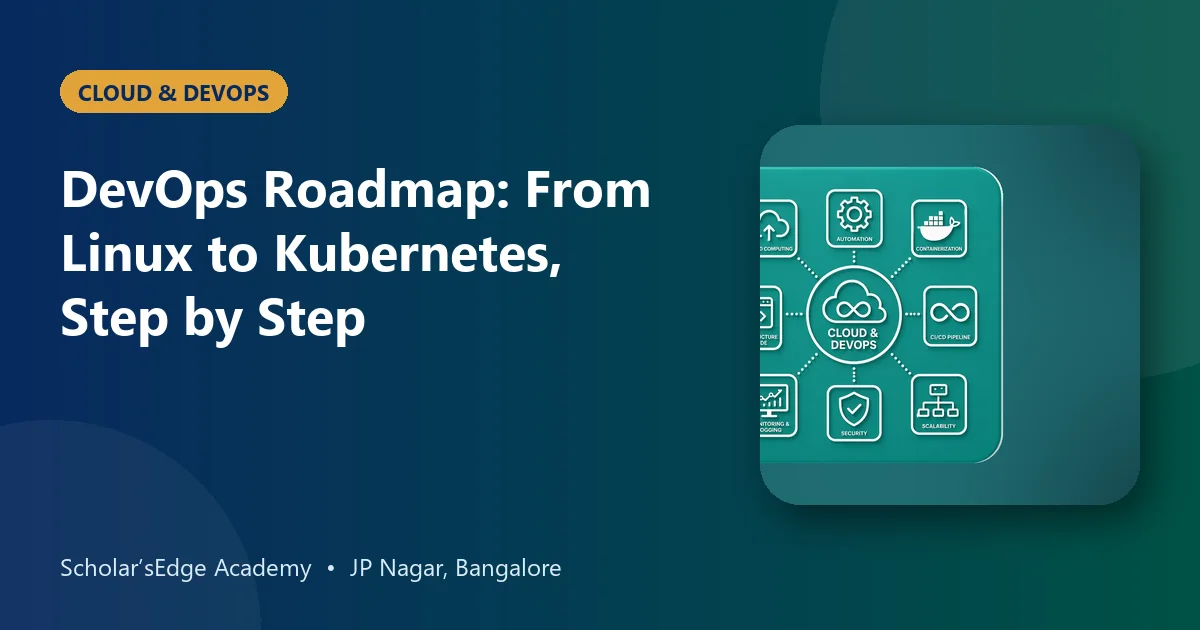
Quick answer: Start with Linux, networking and shell scripting, then a cloud platform such as AWS. Learn containers with Docker, orchestration with Kubernetes, CI/CD with Jenkins or GitHub Actions, infrastructure as code with Terraform and Ansible, and monitoring with Prometheus and Grafana. Practise every step on real deployments.
The roadmap
| Stage | Learn | Practise |
|---|---|---|
| 1. Foundations | Linux, networking, shell scripting | Automate a routine server task |
| 2. Cloud | AWS EC2, S3, VPC, IAM, RDS, CloudWatch | Host a simple app on AWS |
| 3. Containers | Docker, then Kubernetes and Helm | Run an app in containers on Kubernetes |
| 4. CI/CD | Jenkins, GitHub Actions | Automate build, test and deploy |
| 5. Infrastructure as code | Terraform, Ansible | Recreate your setup from code |
| 6. Monitoring | Prometheus, Grafana | Dashboards and alerts for your app |
Beyond tools
Good DevOps engineers also understand cost: which resources you are paying for and how to switch off what you do not need. Data-centre operations basics and an introduction to AI infrastructure are increasingly useful too.
Learn DevOps with real projects
Our Cloud & DevOps Engineering course covers this roadmap in 4 months, with a three-tier app on AWS using Terraform, a CI/CD pipeline to Kubernetes, a monitoring stack and a cloud migration capstone, plus a 2-month internship. It is aligned to AWS certifications (exams booked separately). Offer fee ₹20,999. Also see Cybersecurity vs Cloud & DevOps.
The roadmap as stages
| Stage | Learn | You are ready to move on when you can |
|---|---|---|
| 1. Linux and networking | Shell commands, files and permissions, processes, SSH, DNS, ports | Set up a Linux server and troubleshoot why a site is not reachable |
| 2. Scripting and Git | Bash scripts, a little Python, Git branches and pull requests | Automate a repetitive task and manage it in a Git repository |
| 3. Cloud basics (AWS) | EC2, S3, VPC, IAM, RDS, CloudWatch | Deploy a simple web app on AWS with correct permissions |
| 4. Containers | Docker images, containers, volumes, Docker Compose | Package an app and its database so it runs the same everywhere |
| 5. CI/CD | GitHub Actions or Jenkins pipelines | Make every push run tests and deploy automatically |
| 6. Kubernetes | Pods, deployments, services, ingress, Helm | Run and update an app on a cluster without downtime |
| 7. Infrastructure as code | Terraform, Ansible | Create and destroy a whole environment from code |
| 8. Monitoring | Prometheus, Grafana, alerts | See when something breaks before users tell you |
Common mistakes beginners make
- Starting with Kubernetes. Without Linux, networking and Docker, Kubernetes errors are very hard to understand.
- Only watching videos. DevOps is learned by breaking and fixing real servers.
- Ignoring cost. Always set billing alerts on a cloud account and shut down what you do not use.
- Keeping secrets in code. Learn early to store passwords and keys in a secrets manager, not in Git.
Three portfolio projects that show the full path
- A three-tier app (web, API, database) on AWS, created with Terraform.
- A CI/CD pipeline that builds a Docker image and deploys it to Kubernetes on every merge.
- A monitoring stack with Prometheus and Grafana, with at least one alert that you trigger and fix.
These are the projects in our 4-month Cloud & DevOps Engineering course, followed by a 2-month internship.
Related reading: is DevOps good for freshers.
Related guides: AWS for Beginners: Which Services to Learn First for Cloud and DevOps, Docker vs Kubernetes: What Is the Difference? and DevOps Interview Questions for Freshers: 12 Questions With Answers.
Ready to try a class before you decide?Book a free demo class to see the syllabus, ask about fees and batches, and meet the team. Every course includes a 2-month internship, and classes run online and offline.Book on WhatsAppCall +91 99020 58603
Frequently asked questions
Do I need coding for DevOps?
You need shell scripting and comfort reading configuration and code; the course starts with Linux and scripting basics.
Docker or Kubernetes first?
Docker first. Kubernetes runs and manages containers, so understanding containers comes first.
Who can join the Cloud & DevOps course?
Engineering, BCA, BSc and MCA graduates, and system administrators and IT support staff.
Can I attend the classes online?
Yes. Scholar’sEdge Academy runs online and offline (classroom) classes, so you can join online or attend at our J. P. Nagar centre in Bengaluru. Every main course includes a 2-month internship.
Not sure yet? Talk to us
Book a free demo class or ask for 1:1 guidance on WhatsApp at +91 99020 58603, or use the form on our contact page. You can also compare all our courses and our combo courses. Scholar’sEdge Academy is at Building No. 19, 25/1, 9th Cross Road, 2nd Phase, J. P. Nagar, Bengaluru, Karnataka 560078.
