Quick answer: AWS for beginners starts with six core services: IAM (who can do what), EC2 (virtual servers), S3 (storage), VPC (networking), RDS (managed databases) and CloudWatch (monitoring). Learn them in that order by building one small application, then add Docker, CI/CD and Terraform. Our Cloud & DevOps Engineering course in Bangalore covers all of these in 4 months.
Amazon Web Services has a very large catalogue, and beginners often feel lost on the first page of the console. The way out is to ignore most of it. This guide lists the few services that matter first, what to build with them, and what to learn after that if you want a cloud or DevOps job.
The six AWS services to learn first
IAM, EC2, S3, VPC, RDS and CloudWatch cover access, compute, storage, networking, databases and monitoring. Almost every real application uses some form of all six, so learning them together gives you a working mental model of the cloud.
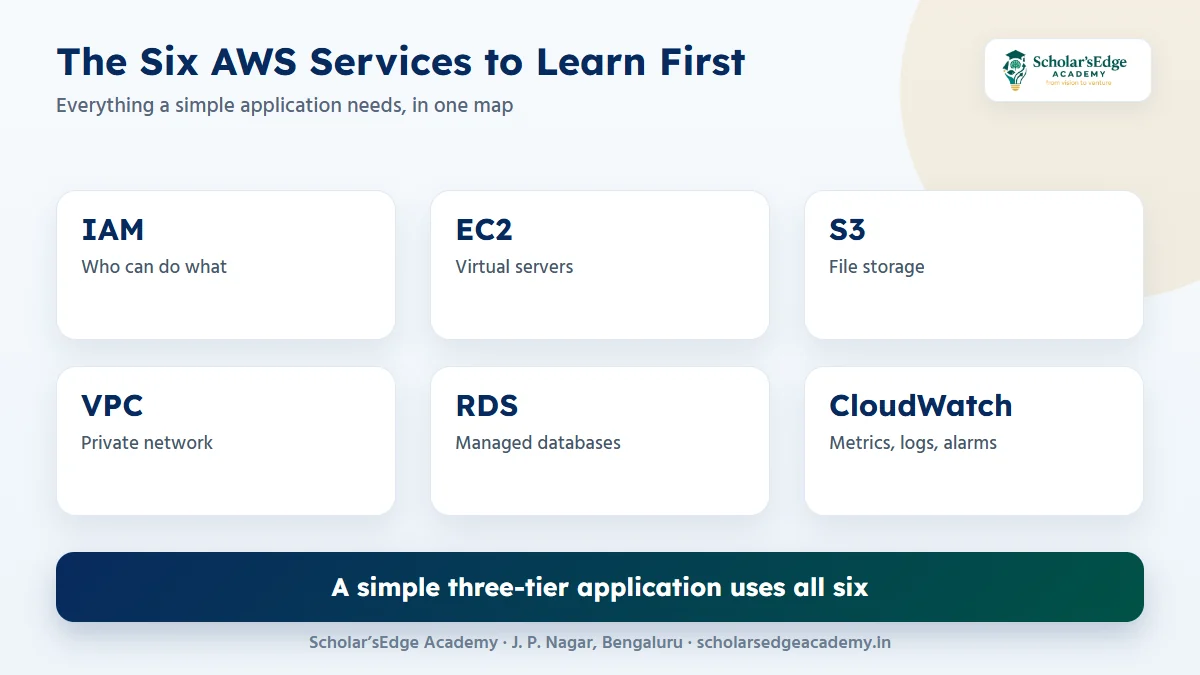
| Service | What it does | A good first task |
|---|---|---|
| IAM | Controls who can access what | Create a user with only the permissions it needs |
| EC2 | Provides virtual servers | Launch a server and connect to it securely |
| S3 | Stores files as objects | Host static files and set safe access rules |
| VPC | Gives you a private network in the cloud | Build a network with public and private subnets |
| RDS | Runs managed databases | Create a database and connect an app to it |
| CloudWatch | Collects metrics, logs and alarms | Set an alarm that fires on high load |
The official AWS documentation has a guide for each service: IAM, EC2, S3, VPC, RDS and CloudWatch.
Build one small project, in this order
Learning one service at a time from the table feels slow. Build a small three-tier application instead, and learn each service because the project needs it. You will remember it far longer.
- Secure the accountUse IAM to create a user and avoid working as the root user.
- Create the networkBuild a VPC with public and private subnets.
- Launch the web serverRun the application on an EC2 instance.
- Add the databaseCreate an RDS database in a private subnet.
- Store the filesPut images or backups in S3.
- Watch itAdd a CloudWatch alarm so you know when something breaks.
Concepts that matter as much as services
- Regions and availability zones. AWS runs in separate geographic regions, each with several isolated zones, so you can design for failure.
- The shared responsibility model. AWS secures the cloud itself; you secure what you put in it, such as permissions and data.
- Cost awareness. Set a budget and billing alerts in AWS Budgets before you experiment, and check the current terms of the AWS Free Tier because they change.
What to learn after the basics
Once you can build and secure a simple application, learn to ship and manage it the way teams do. That means containers with Docker, orchestration with Kubernetes, pipelines with Jenkins or GitHub Actions, infrastructure as code with Terraform and Ansible, and monitoring with Prometheus and Grafana. Our DevOps roadmap from Linux to Kubernetes lays out the full path.
AWS also offers certifications. The AWS Certified Cloud Practitioner is its entry-level certification, and it is a reasonable first goal. Read the current details on the AWS Certification pages.
Common beginner mistakes on AWS
- Working as the root user. Create an IAM user with limited permissions and keep the root account for emergencies.
- Leaving resources running. Stop or delete test servers and databases when you finish, and set a billing alert.
- Opening everything to the internet. Allow only the ports you need and keep databases in a private subnet.
- Clicking instead of recording. Every manual change is hard to repeat, which is why teams use infrastructure as code with Terraform.
Questions interviewers ask about AWS basics
- What is the difference between a security group and a network ACL?
- When would you choose S3 over a database?
- What is the shared responsibility model?
- How would you give an application access to S3 without storing keys in the code?
- What does a CloudWatch alarm do, and what would you monitor first?
How our course covers AWS and DevOps
The Cloud & DevOps Engineering course runs for 4 months at our J. P. Nagar centre: 3 hours a day, Monday to Friday, plus a Saturday lab, with a weekend batch also available.
- You learn: Linux, networking and shell scripting, AWS core services (EC2, S3, VPC, IAM, RDS, CloudWatch), Docker, Kubernetes and Helm, CI/CD with Jenkins and GitHub Actions, Terraform and Ansible, and monitoring with Prometheus and Grafana, plus data-centre operations basics, cloud cost basics and an introduction to AI infrastructure.
- Projects: a three-tier app on AWS with Terraform, a CI/CD pipeline to Kubernetes, a monitoring stack and a cloud migration capstone.
- Who can join: Engineering, BCA, BSc and MCA graduates, and system administrators and IT support staff.
- Roles it prepares you for: Cloud Operations Associate, Junior DevOps Engineer and Data Centre Operations Associate.
- Alignment: AWS certifications. The AWS exams are booked and taken separately with AWS.
- Internship and fee: a 2-month internship is included, and the offer fee is ₹20,999 (regular ₹29,999).
Choosing between tracks? Compare cybersecurity vs cloud and DevOps or read the data engineering roadmap for freshers, which also uses AWS.
Ready to try a class before you decide?Book a free demo class to see the syllabus, ask about fees and batches, and meet the team. Every course includes a 2-month internship, and classes run online and offline.Book on WhatsApp
Frequently asked questions
Which AWS services should a beginner learn first?
IAM, EC2, S3, VPC, RDS and CloudWatch. Together they cover access, servers, storage, networking, databases and monitoring.
Is AWS free to learn?
AWS offers a Free Tier, but its terms change, so read the current rules before you start and set a budget alert so you are not surprised by a bill.
Do I need coding to learn AWS and DevOps?
You need shell scripting and comfort reading configuration files and code. Our course starts with Linux and scripting basics.
Should I learn AWS or DevOps first?
Learn Linux and basic AWS first, then the DevOps tools that run on it, such as Docker, Kubernetes, CI/CD and Terraform.
Does the course prepare me for AWS certification?
The training is aligned to AWS certifications. The AWS exams themselves are booked and taken separately with AWS.
Not sure yet? Talk to us
Book a free demo class or ask for 1:1 guidance on WhatsApp at +91 99020 58603, or use the form on our contact page. You can also compare all our courses and our combo courses. Scholar’sEdge Academy is at Building No. 19, 25/1, 9th Cross Road, 2nd Phase, J. P. Nagar, Bengaluru, Karnataka 560078. Read how we write and check our articles in our editorial policy.
