
Quick answer: Google Ads vs Meta Ads comes down to intent: Google Ads reaches people who are already searching, while Meta Ads reaches people by interest before they search. Beginners should learn Google Search ads first, then Meta ads, and track both in GA4. Our performance marketing course in Bangalore covers both.
Not sure where to start? Try a free demo class, online or at our J. P. Nagar centre. Book on WhatsApp
Every beginner in digital marketing asks the same question: Google Ads or Meta Ads? The honest answer is that they do different jobs. This guide explains the difference in simple terms, when each one works better for a local business or a course provider, and the order we suggest for learning them.
Google Ads vs Meta Ads: the core difference
Google Ads reaches people at the moment they search for something, such as “data analytics course in JP Nagar”. Meta Ads reaches people while they scroll, based on who they are and what they like. One answers a need; the other introduces an option.
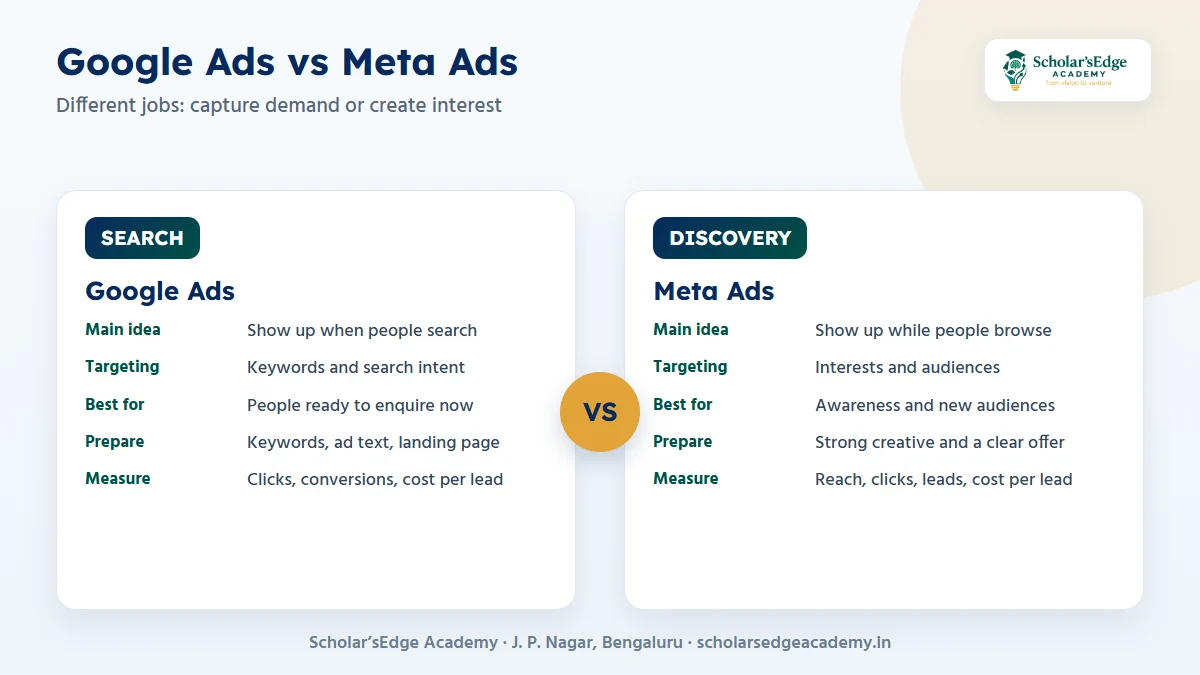
| Google Ads | Meta Ads | |
|---|---|---|
| Main idea | Show up when people search | Show up while people browse |
| Where ads appear | Google Search, display sites, YouTube and more | Facebook, Instagram and other Meta placements |
| Targeting based on | Keywords and search intent | Interests, behaviour and audiences you build |
| Works best for | People ready to enquire or buy now | Building awareness and reaching new audiences |
| What you must prepare | Keyword list, ad text and a matching landing page | Strong images or videos and a clear offer |
| How you measure it | Clicks, conversions and cost per lead | Reach, clicks, leads and cost per lead |
Details change as the platforms update, so check the official help centres: Google Ads Help and Meta Business Help Centre.
When should you use Google Ads?
Use Google Ads when people already search for what you sell. A training institute, a clinic or a repair service fits well, because someone typing the service and the area is close to a decision.
- Search ads for high-intent keywords such as course names plus the city.
- Landing pages that match the keyword and show fees, syllabus and a clear enquiry button.
- Negative keywords, so you do not pay for clicks from people looking for something else.
When should you use Meta Ads?
Use Meta Ads when people may not know you exist yet, or when your offer is visual. A short video, a student result you can verify or a free demo class announcement can reach many relevant people and bring them to a form or a WhatsApp chat.
- Interest and location targeting around your service area.
- Retargeting people who visited your site or watched your video.
- Lead forms or click-to-WhatsApp ads that make enquiring one tap.
Which should a beginner learn first?
Learn Google Search ads first, because the logic is easy to see: a keyword, an ad, a click and a lead. Then learn Meta Ads, where creative and audience matter more. Learn GA4 and Google Tag Manager early, since neither platform is worth running without conversion tracking.
- Marketing basicsCustomers, offers, funnels and what “performance” means.
- Websites and landing pagesA page that matches the ad and has one clear action.
- GA4 and Tag ManagerTrack enquiries, calls and form submissions.
- Google AdsSearch campaigns, keywords, budgets and quality.
- Meta AdsAudiences, creatives, placements and lead forms.
- LinkedIn Ads and reportingB2B targeting, then Looker Studio dashboards.
- AI and automationAI for creatives and copy, plus email, WhatsApp and CRM automation.
Which numbers should you track?
Track a few numbers well rather than many badly. These are the ones every campaign report should show, and they mean the same on both platforms.
| Metric | What it tells you |
|---|---|
| CTR (click-through rate) | The share of people who saw the ad and clicked it |
| CPC (cost per click) | What you pay, on average, for each click |
| Conversion rate | The share of visitors who enquire, call or sign up |
| CPL (cost per lead) | What you pay, on average, for each enquiry |
| ROAS (return on ad spend) | The revenue earned for each rupee spent on ads |
Set up conversion tracking in Google Analytics 4 first, so every enquiry, call and form submission is counted before you spend on ads.
Common beginner mistakes
- Running ads without conversion tracking, so you cannot tell what worked.
- Sending every click to the home page instead of a focused landing page.
- Changing too many things at once, which hides what caused a result.
- Judging a campaign after one day instead of waiting for enough data.
What a click or a lead costs depends on competition, targeting, ad quality and the landing page, and it changes constantly. Beware of anyone who quotes a fixed cost per lead before running a test.
How our course covers both platforms
The AI-Powered Performance Marketing course runs for 3 months at our J. P. Nagar centre: 3 hours a day, Monday to Friday, plus a Saturday campaign lab, with a weekend batch also available.
- You learn: SEO and optimisation for AI search, Google Ads, Meta Ads, LinkedIn Ads, programmatic advertising, GA4, Tag Manager, Looker Studio, and email, WhatsApp and CRM automation, with AI tools for content and creatives.
- Projects: an SEO audit, a Google and Meta campaign plan, a GA4 dashboard and a live campaign for a local business with a real budget.
- Who can join: any graduate, business owners, freelancers and marketing staff.
- Roles it prepares you for: Performance Marketing Executive, Digital Campaign Analyst, AI Marketing Associate and Ads Operations Executive.
- Internship and fee: a 2-month internship is included, and the offer fee is ₹17,999 (regular ₹24,999).
Want the bigger picture first? Read performance marketing vs digital marketing and performance marketing vs data analytics.
Related reading: how to become a performance marketer in India.
Related guides: GA4 for Beginners: How to Set Up Google Analytics 4 and Track Enquiries.
Ready to try a class before you decide?Book a free demo class to see the syllabus, ask about fees and batches, and meet the team. Every course includes a 2-month internship, and classes run online and offline.Book on WhatsAppCall +91 99020 58603
Frequently asked questions
Is Google Ads or Meta Ads better for lead generation?
It depends on your audience. Google Ads works well when people already search for your service, and Meta Ads works well for reaching new people. Many businesses test both and compare cost per lead.
Which is cheaper, Google Ads or Meta Ads?
There is no fixed answer. Costs depend on competition, targeting and ad quality, and they change over time, so the only reliable way to know is to run a small test and measure.
Do I need a website to run ads?
For Google Ads you need a landing page that matches the keyword. For Meta Ads you can send people to a lead form or a WhatsApp chat, but a good landing page usually improves results.
Can I run Google Ads and Meta Ads together?
Yes. Many businesses use Google Ads to capture people who search and Meta Ads to reach new people and retarget visitors. Track both in GA4.
Can a non-marketing graduate join the performance marketing course?
Yes. The course is open to any graduate, business owners, freelancers and marketing staff.
Not sure yet? Talk to us
Book a free demo class or ask for 1:1 guidance on WhatsApp at +91 99020 58603, or use the form on our contact page. You can also compare all our courses and our combo courses. Scholar’sEdge Academy is at Building No. 19, 25/1, 9th Cross Road, 2nd Phase, J. P. Nagar, Bengaluru, Karnataka 560078. Read how we write and check our articles in our editorial policy.
