Quick answer: Common DevOps interview questions for freshers cover what DevOps and CI/CD mean, Git merge vs rebase, Docker image vs container, a Dockerfile, Kubernetes pods, deployments and services, infrastructure as code with Terraform, blue-green vs canary releases, basic Linux commands, and monitoring with Prometheus and Grafana. Explain each with a small example you have actually run.
Not sure where to start? Try a free demo class, online or at our J. P. Nagar centre. Book on WhatsApp
DevOps engineers connect writing code to running it: they automate builds, tests, releases and monitoring so that software ships often and safely. Fresher interviews check whether you understand the ideas and have touched the tools. This guide gives twelve questions with short answers and tells you what to practise.
Twelve DevOps interview questions with short answers
Run every command yourself before the interview. Saying “I tried this on my laptop and this is what happened” is stronger than a perfect definition.
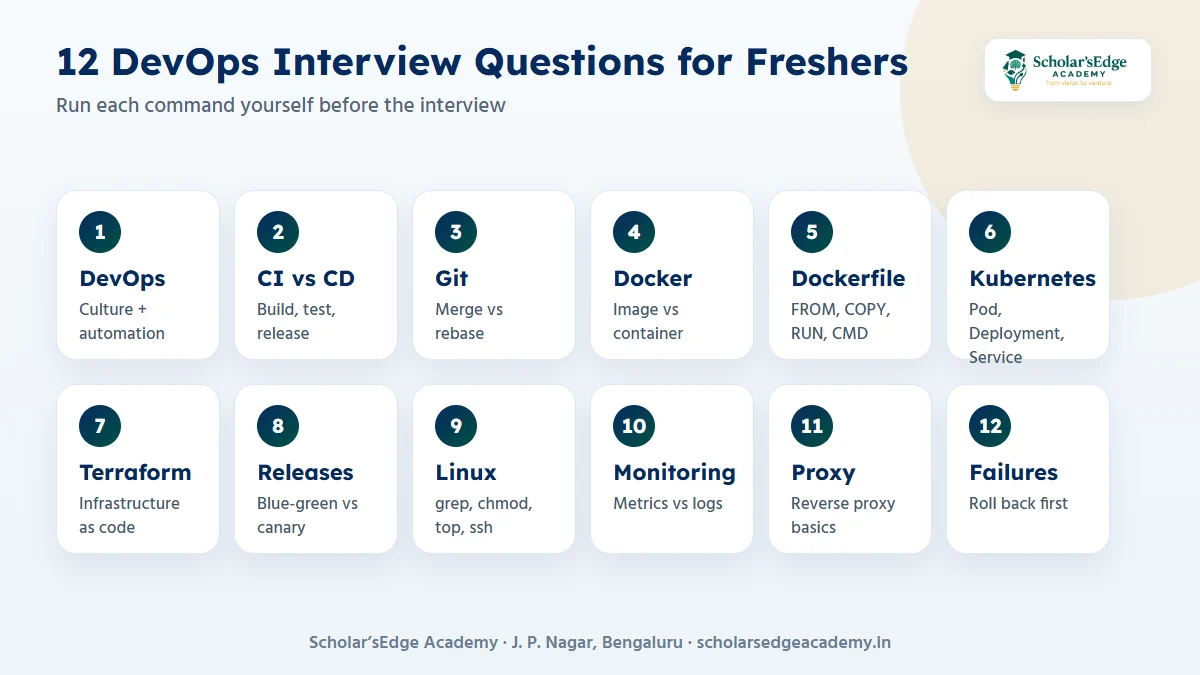
| Question | Topic |
|---|---|
| What is DevOps? | Culture and automation across development and operations |
| CI vs CD | Build and test on every commit, then release automatically |
| Git merge vs rebase | Two ways to combine branches |
| Docker image vs container | A template and a running instance of it |
| What is in a Dockerfile? | Base image, files, commands and the start command |
| Pod, Deployment, Service | Core Kubernetes objects |
| What is infrastructure as code? | Servers described in files, for example with Terraform |
| Blue-green vs canary | Two safer release strategies |
| Useful Linux commands | grep, chmod, top, df, journalctl, ssh |
| Monitoring vs logging | Numbers over time and records of events |
| What is a reverse proxy? | A server that forwards requests to others |
| A deployment failed. What do you do? | Roll back, find the cause, fix the pipeline |
- What is DevOps?DevOps joins development and operations through shared ownership and automation, so teams can release small changes often with fewer failures.
- CI vs CDContinuous integration builds and tests code every time someone pushes. Continuous delivery keeps the code always releasable, and continuous deployment releases it automatically.
- Git merge vs rebaseMerge joins two branches and keeps both histories. Rebase replays your commits on top of another branch for a straight history. Do not rebase commits that others already use.
- Image vs containerA Docker image is a read-only template with your app and its dependencies. A container is a running instance of an image. Read the Docker documentation to practise.
- DockerfileA Dockerfile starts from a base image with
FROM, copies files withCOPY, installs withRUNand sets the start command withCMD. Small images start faster and have fewer risks. - Pod, Deployment, ServiceA pod runs one or more containers. A Deployment keeps a set number of identical pods running and handles updates. A Service gives pods a stable address. See the Kubernetes concepts guide and our Docker vs Kubernetes post.
- Infrastructure as codeYou describe servers, networks and databases in files, for example with Terraform, and apply them. The setup becomes repeatable, reviewable and easy to rebuild.
- Blue-green vs canaryBlue-green runs two full environments and switches traffic at once, which allows an instant rollback. A canary release sends a small share of traffic to the new version first.
- Linux commands
grepsearches text,chmodchanges permissions,topshows processes,dfshows disk space,journalctlreads service logs andsshconnects to a server. - Monitoring vs loggingMonitoring tracks numbers such as CPU and error rate over time, for example with Prometheus and Grafana. Logs record individual events and explain why something happened.
- Reverse proxyA reverse proxy such as Nginx receives requests and forwards them to backend servers. It can add TLS, caching and load balancing.
- A failed deploymentRoll back to the last good version first, then read the pipeline logs, find the change that broke it, fix it in a branch and add a test so it does not happen again.
Hands-on tasks that make your answers believable
- Write a Dockerfile for a small web app and run it with port mapping.
- Create a GitHub Actions or Jenkins pipeline that builds and tests on every push.
- Deploy that container to a local Kubernetes cluster and expose it with a Service.
- Describe one cloud resource, such as a storage bucket, in Terraform and apply it.
- Add a dashboard that shows CPU or request counts, and break something to watch it change.
For each project, say the problem, what you built, what broke and how you fixed it. Interviewers remember stories.
Mistakes freshers make
- Memorising definitions without running anything. Follow-up questions expose this quickly.
- Treating DevOps as a tool list. It is a way of working, and tools only support it.
- Ignoring security. Mention secrets handling and least privilege.
- Skipping Linux. Most servers run it, and many questions start there.
How our course prepares you
The Cloud & DevOps Engineering course at our J. P. Nagar centre runs for 4 months: 3 hours a day, Monday to Friday, plus a Saturday lab, with a weekend batch also available. You work with Linux, AWS (EC2, S3, VPC, IAM, RDS, CloudWatch), Docker, Kubernetes, Helm, Jenkins, GitHub Actions, Terraform, Ansible, Prometheus and Grafana. Projects include a three-tier app on AWS with Terraform, a CI/CD pipeline to Kubernetes, a monitoring stack and a cloud migration capstone. A 2-month internship is included for every enrolled student.
Continue with the DevOps roadmap from Linux to Kubernetes and AWS for beginners.
Related reading: is DevOps good for freshers.
Ready to try a class before you decide?Book a free demo class to see the syllabus, ask about fees and batches, and meet the team. Every course includes a 2-month internship, and classes run online and offline.Book on WhatsAppCall +91 99020 58603
Frequently asked questions
What should a fresher learn first for DevOps?
Linux basics, Git, then Docker. After that, learn a CI/CD tool, Kubernetes and a cloud platform such as AWS.
Is coding required for DevOps?
Light scripting in Bash or Python is expected. You do not need to be a full software developer.
What is the difference between Docker and Kubernetes?
Docker builds and runs containers on one machine. Kubernetes manages many containers across many machines.
Which DevOps tools are most asked in interviews?
Git, Docker, Kubernetes, a CI/CD tool such as Jenkins or GitHub Actions, Terraform, Linux and a cloud service such as AWS.
Can a fresher get a DevOps job?
Yes, but most employers want hands-on proof, such as a pipeline and a deployed project, so build and explain one.
Not sure yet? Talk to us
Book a free demo class or ask for 1:1 guidance on WhatsApp at +91 99020 58603, or use the form on our contact page. You can also compare all our courses. Scholar’sEdge Academy is at Building No. 19, 25/1, 9th Cross Road, 2nd Phase, J. P. Nagar, Bengaluru, Karnataka 560078. Read how we write and check our articles in our editorial policy.
